Taking an iconic piece of literature and delving into a new creative line of thought is an intriguing and perilous task. When handling such monumental tales, it is only human nature to expand upon and invent, propelling off of it like a trusty foundation. Though writers and authors alike produce projects through other knowledge that has been taken in, it can be difficult to respect an original piece whilst intertwining one’s ideals. Take the play Romeo and Juliet by William Shakespeare: A quintessential tragedy that has been reproduced and reenacted throughout generations. With the multitude of interpretations, one could question the integrity of some of these so-called “offshoots”. Gnomeo and Juliet directed by Kelly Asbury aimed to utilize a different mode to portray similar themes of Shakespeare’s paradigmatic drama: Jovial animation. Through immense devices, Asbury is able to convey layered literary concepts similar to the original piece, ultimately fulfilling the role of not an adaptation of Romeo and Juliet, but a jovial homage to William Shakespeare.
The plot in of itself is shortened from a broad depiction of a classical romance into a comedic quick-beated flurry of chaos and fun. But, it does not shy away from depth in terms of the symbolism utilized. The concept of color is the emblem for all connection (and lack there of) within the film. Gnomeo and the rest of the Montagues are depicted as blue gnomes, whilst Juliet Capulet and her gnome clan are clearly a bright red. The opposing families are in parallel gardens, though perpendicular in thought and action. With red being a color associated with anger and passion in classical and modern literary portrayals, it is seemingly fitting that the Capulet family is an eccentric and rage-filled bunch with ignition inside of them. The montagues, or “the blues”, act in an emotionally instinctual manner and are severely in touch with one’s emotions, fitting the withstanding connotation blue represents in media as melancholic or of intricate emotion. Though color is not a prominent symbol within Romeo and Juliet by William Shakespeare, other work by this author heavily utilises these two complimentary colors as modes of communication. In As You Like It, color is used to emphasize the despair a character obtains when Rosalind utters “A lean cheek…a blue eye and sunken” (Act 2, scene 3, lines 33 – 35), about a hopeless romantic. But, in Macbeth, color is used to detail a fervor individual, as shown in Lady Macbeth’s famous line: “Who would have thought the old man to have had so much blood in him?” (Act 5, Scene 1, lines 30–34), using the deep rich red associated with blood as a way to ignite thoughts of vigor and exasperation.
Alongside the overall connotation of red and blue, when Gnomeo and Juliet finally meet each other’s gaze and start their connection, the flower they both physically hold onto is a light purple. Not only does this showcase the literal mixture of the assigned familial colors, but the glowing shine of the flower itself signifies the rich emotion of the Montagues and the fiery passion of the Capulets. Even whilst stumbling through conversation, Gnomeo mumbles “Well this isn’t my…this is our…greenhouse…I guess.” This directly correlates the physical purple flower to the metaphorical meshing of “the blues and the red”.
Even the first interaction between the two gnomes is upon a “green” house, which historically has connotations of growth, change, cultivation, warmth, etc. But in the world of Shakespeare, it represents jealousy and disgust. The fact both characters met upon a greenhouse could indicate potential growth and cultivation of life, but when looked at through a lens where the film is depicted as a homage, the greenhouse is foreshadowing a fierce rivalry and destructive battle. Due to these symbols such as colors and infrastructures being imminent within other Shakespearean works but not as much within Romeo and Juliet, Gnomeo & Juliet constructively employ symbolism as a way to pay homage to Shakespeare.
There is a level of humanity within the animation that exudes the importance of mortality, comparable to original Shakespearean texts. Though catered towards a younger audience, the film teeters the line of the subversion and conveyance of mortality, exemplifying the reality of consequences whilst still fostering faithfulness and light-hearted energy. Throughout the entirety of the film, the garden gnomes are tremendously self aware in terms of what materials and items will harm, just as humans would be. To the point where in the finale of the film, Tybalt, in a two-second span of time, has a revelation that once a gnome hits the brick wall he is hurling towards, he will “die”:
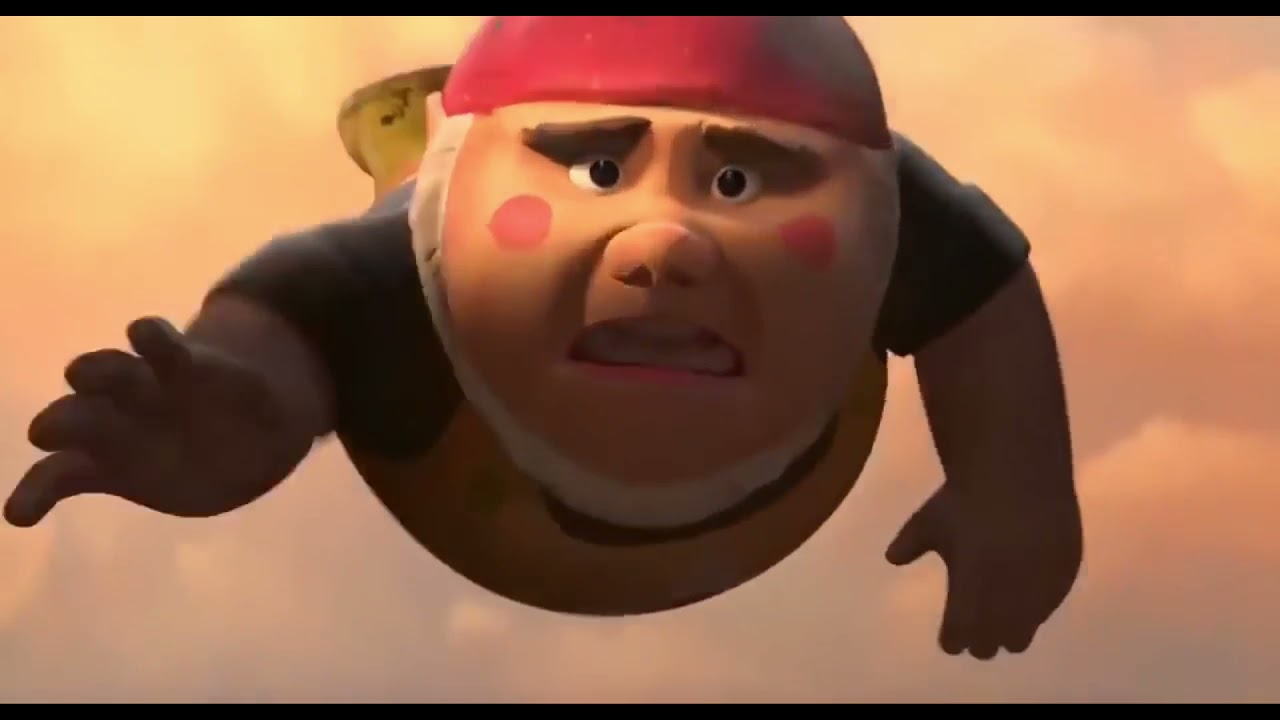
This level of sentience is similar to the sophistication of a human, to the extent where the gnomes even hold multiple funerals for their smashed companions. Though these harsh doings are undone at the end of the film to keep the pace upbeat and the target audience satisfied, there is a touch of underlying graphic meaning that truly does memorialize the utter tragedies of William Shakespeare. Thus, relaying themes of the original Romeo & Juliet tale and its tragic ending, while simultaneously informing a younger audience that themes of love and friendship can fix said hardships. There is humanity at the heart of the dialogue of the films, as well, though modified for a juvenile audience’s ear. When Juliet is faced with the task of grasping the correct steps to take with Gnomeo going forward, she asks “What’s in a name? That which we call a rose by any other name would smell as sweet”. Not only does this statement provoke philosophical thought, but is a direct quote from the original Romeo and Juliet, which ties together the modern direction and the original play cohesively.
Though Asbury binds both past and present, different aspects of Gnomeo and Juliet contribute to the underlying themes of British supremacy within the story. Which, was contextually accurate to the timeline of when the original Romeo and Juliet was written, and builds on the subconscious sophistication of the movie. The movie portrays such ideals through aspects of production and plot. In terms of productions, every character that has at least one line of dialogue within the animation obtains a British accent. This may seem odd due to the original setting of Romeo and Juliet being in Verona, Italy. But, this adds to the evidence of the film being an homage, because William Shakespeare is a citizen of the United-Kingdom. As well as it being an entirely British cast, the soundtrack of the film comprises famous British pop-stars and artists, including Elton John. This iconic artist is especially important to include due to the inspiration he allegedly has from the classical playwright. The opening lyric of John’s song The King Must Die name-drops him: “No man’s a jester playing Shakespeare ’round your throne room floor”. This deep cut exemplifies the sheer depth Kelly Asbury tried to portray in the production value of the film. On the contrary, existing plotpoints of the animation also plaster ideals accurate to the publishing of the original drama. Whilst celebrating after a heroic mission to meet Juliet for a second date, Gnomeo utilizes a worn British flag to gracefully fly down and avoid death, exemplifying the British flag as a saving grace, and proving that embodying and fully trusting the patriotism of Britain will allow even a garden gnome to fly high, and ultimately avoid death. Via a beloved character soaring through the sky on the ultimate symbol for one’s country, Asbury finds a subtle yet deeply analytical way to memorialize the time capsule in which the story was written.
Though Gnomeo and Juliet may seem trivial and slight, with its witty dialogue and comedic tone, the animation itself is actively enthralling children with a reinvented tale. Understanding the pioneering tragedies of the modern novels and plays taught in the present is vital for the deepest understanding of literature. By spoonfeeding a rather violent tale to children through a mode of laughter, the original text is still being honored and taught to some capacity, whilst memorializing Shakespeare and revelling in the way his work can be repurposed centuries after creation. By introducing primary concepts of Shakespearean work at a young age, Asbury is fostering an environment for digestible conceptualization. Without modern homages to original texts utilizing these amusing concepts to portray symbolism, foreshadowing, and allusions alike, younger generations may lose focus of the roots of literature. Though not a true adaptation of Romeo and Juliet, Gnomeo and Juliet plays a role in combining modern modes of entertainment with the old, ultimately respecting and recycling the classic tale by William Shakespeare.
–Maddie McFadden, Studies In English
Annotated Bibliography
“Gnomeo and Juliet: A True Work of Art.” Drama & Philosophy, 21 Feb. 2011, dramaandphilosophy.wordpress.com/2011/02/21/gnomeo-and-juliet-a-true-work-of-art/.
This personal commentary delves into how the movie itself grapples with true human emotion, and it goes over the medical effects it can have on an individual in a light-hearted manner.
Holden, Stephen. “A Kitsch-And-Tell Movie of Garden Variety Love.” The New York Times, 11 Feb. 2011, www.nytimes.com/2011/02/11/movies/11gnomeo.html.
This article outlines a movie review of the animation, whilst going over the pros and cons of the watch. The cons seem to dwell on how the ending of the animation is the complete opposite of the original text, whereas the pros dive into how the director turned this tale into a kid-friendly movie.
“Gnomeo and Juliet Comparative Essay | Ipl.org.” Www.ipl.org, 9 Nov. 2012, www.ipl.org/essay/Gnomeo-And-Juliet-Comparative-Essay-PCCTWMPUZT.
This essayist writes on their own feelings of the film and the original text, comparing and contrasting the plot, historical context, cultural references, etc.
Gnomeo and Juliet. Directed by Kelly Asbury, Performances by James McAvoy, Emily Blunt, Michael Cain, Ozzy Osbourne, Maggie Smith, 2011.
This 2011 film directed by Kelly Asbury is about two rival garden gnome families, each constantly feuding. Until one fateful night, when a gnome from each rival family meets and falls in love, wreaking havoc on their prospective gardens and causing chaos amongst their families.
Shakespeare, William. “Macbeth.” Www.folger.edu, Folger Shakespeare Library, 1623, www.folger.edu/explore/shakespeares-works/macbeth/read/.
The entire original text, MacBeth, written by William Shakespeare, for free accessibility online.
—. “Othello.” Www.folger.edu, Folger Shakespeare Library, 1603, www.folger.edu/explore/shakespeares-works/othello/read/.
The entire original text, Othello, written by William Shakespeare, for free accessibility online.
Shakespeare, William. “As You like It – Entire Play | Folger Shakespeare Library.” Www.folger.edu, 1623, www.folger.edu/explore/shakespeares-works/as-you-like-it/read/.
The entire original text, As You Like It, written by William Shakespeare, for free accessibility online.
“Spotify – Web Player.” Spotify, 2025, open.spotify.com/track/5aZWzadLEprtlv0ylYyruD . Accessed 10 Nov. 2025.
Elton John’s song The King Must Die off of his album Elton John: Deluxe Edition. Released on April 10th, 1970.


