Cora Rodriguez
Rethinking Modern British Literature
Project 2
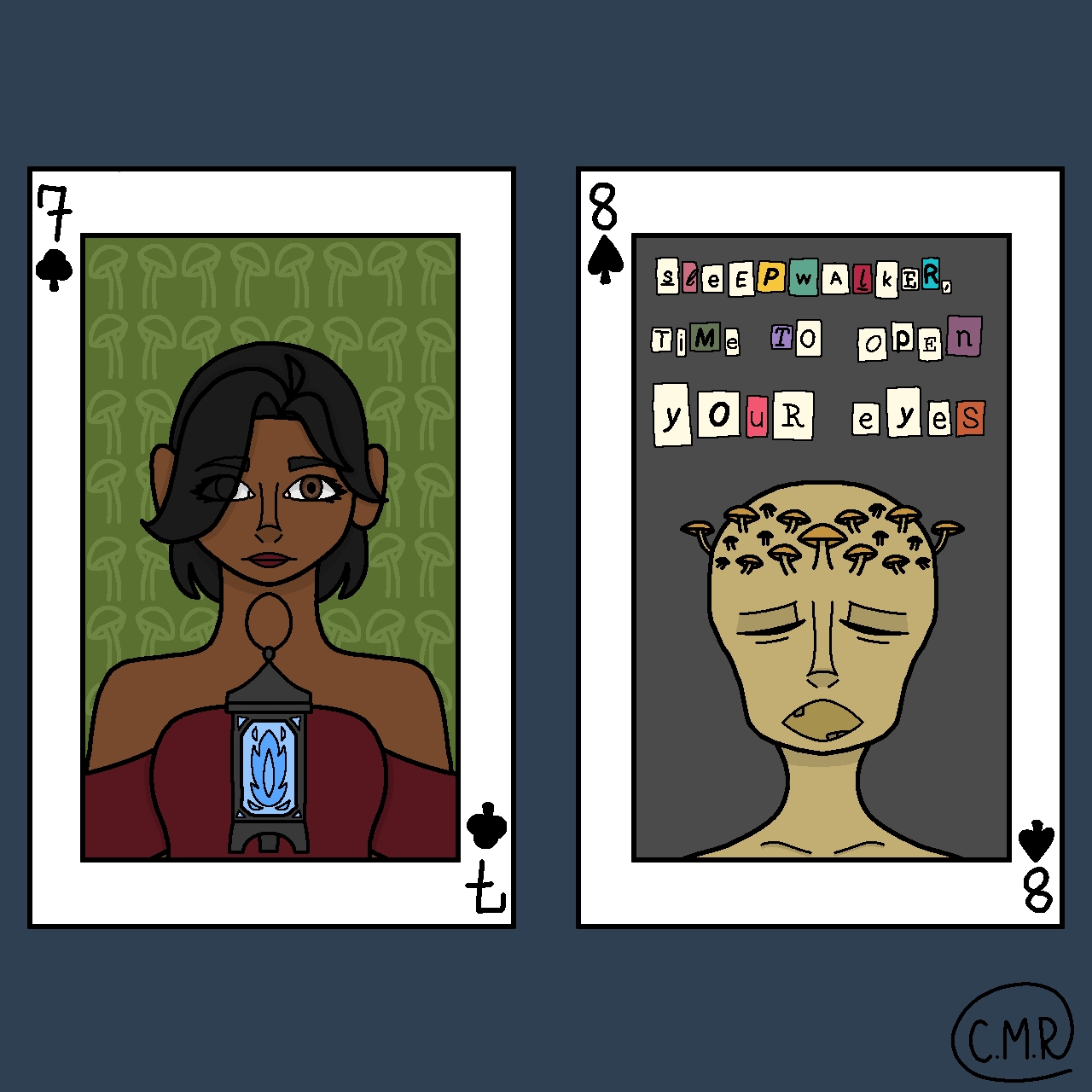
For this unessay, I had a vision. I fell in love with Mexican Gothic and instantly knew I wanted to draw something from that. In my art, Noemí is very stylish as usual in her wine-colored gown featured on the cover of the book. I didn’t know what color her eyes were, so I went with brown as it is the most common eye color in México. My copy of the book features two images of Noemí, which I used to create my sketch of her. I did take some creative liberty with her hair.
The lantern is kind of just floating in front of her, mostly because I can’t draw hands all that well. The second illustration in my book features the lantern, shining with a blue glow. I thought the blue tones in the illustration would pair well with my drawing, as there were already a lot of warm colors.
Agnes, as described in the book, isn’t doing very well. “It was the open, screaming maw of a woman, frozen in time. A mummy, a few teeth dangling from her mouth, her skin yellow. The clothing in which she had been buried had long dissolved into dust, and instead she was clothed in a different finery: mushrooms hid her nakedness. They grew from her torso and her belly, they grew around her arms and her legs, they clustered around her head creating a crown, a halo, of glowing gold.” (page 282) I didn’t quite draw her as frozen in time, as mushrooms don’t preserve things, they decompose them. “Sleepwalker, Time to open your eyes” is drawn in ransom note text above her.
Why the ransom note text and the playing card details? I had a lot of ideas in my head that amalgamated into this one. The ransom note text came from an idea of playing around with multimedia, and the playing cards sprouted from an idea to put Noemí and Agnes into tarot cards. I ended up using playing cards instead because each card has its own meaning, like tarot cards, but they are much simpler to draw. The reason why I had the idea to use tarot/playing cards was because of stereotypes and representation.
For Noemí, I chose the seven of clubs, which represents taking a stand. The card indicates believing in yourself through your strength and integrity. The suite of clubs is made up of charisma, passion, adventure, and has the element of fire, which is very fitting for Noemí. For Anges, I chose the eight of spades, which tragically represents feeling alone. The card indicates that you are bound by circumstances and restrictions beyond your control. The suite of spades is made up of liars, gossips, trouble, sharp tongues, and is the suite of the mind. While many of these attributes may not represent Agnes, they certainly do represent the Doyle family.
Why I believe my response matters: Noemí being a very strong female character is very important, especially to younger girls. Women in literature are often placed into a few set roles, such as The Virgin, The Mother, The Old Maid, and The Fallen Woman. The Virgin is the innocent girl, a passive saintess whom men adore. The Mother is who The Virgin becomes after she is married. She is submissive and has a willingness to please her husband. When The Mother is no longer married, she becomes The Old Maid. She is physically unattractive because she can no longer be valued for her beauty. If The Virgin fails to become The Mother, she becomes The Fallen Woman. She is a seductress, who steals men away. If we had to put Noemí into one of these boxes, she would end up as The Fallen Woman because of her independence. But Noemí isn’t any of these. She breaks out of the stereotypes and forms a character with depth, which was refreshing to see.
Moreno-Garcia, Silvia. Mexican Gothic. New York, Del Rey, 2020.
“Bog Bodies | Definition, Preservation, Photos, Tollund Man, & Facts | Britannica.” Encyclopædia Britannica, 2024, http://www.britannica.com/science/bog-body. Accessed 4 May 2024.
“Cards and Their Associated Meanings – UnitedCardists.com – the Forum for Cardistry, Magic, Custom Decks and All Things Playing Cards. Sponsored by Mike Ratledge and ‘Friends of UC.’” Unitedcardists.com, 25 Sept. 2012, unitedcardists.com/viewtopic.php?t=62. Accessed 4 May 2024.
“82.05.06: Female Stereotypes in Literature (with a Focus on Latin American Writers).” Yale.edu, Sept. 1982, teachersinstitute.yale.edu/curriculum/units/1982/5/82.05.06.x.html. Accessed 5 May 2024.


