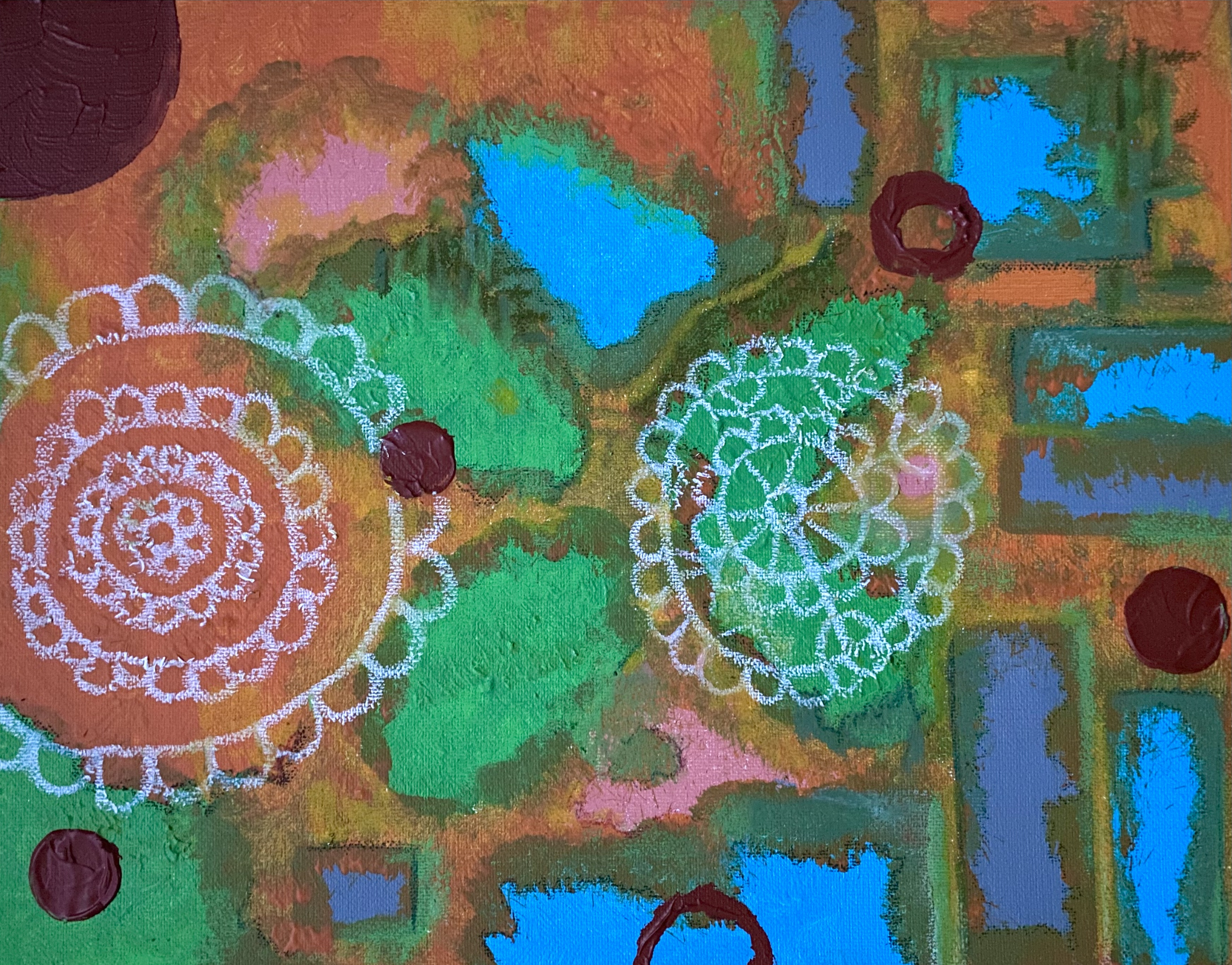
Acrylic and Oil Pastel Response
Molly Tulk, December, 2023
What initially prompted this project was the realization that most of the analysis I do of literature done both within this class and outside of it, is purely based on the text that is presented in front of me—analysis made based on what is immediately seen, rather than what is not seen. As I seek to understand further how texts make me feel, and the more multifaceted meanings and symbolism behind them, I made the decision to try a different approach in my examination. What would happen if I responded to a text purely based on what colors the different thoughts, words, associations, formatting etc presented to me? What deeper meaning would I obtain by putting onto paper what is not seen, and “reading” the text through colors rather than words?
I chose to take the poem It Is Hard to Believe that There Are Other Worlds in this World1, written by Mary Cavendish in 1653 that explores the idea that there are more worlds that coexist with us than we will ever be able to see, and experience, and the limits on the human perception. Using the idea of unseen worlds:
“Nothing so hard in nature as faith is, / For to believe impossibilities— / Not that they’re not, but that they do not clear / Unto our reason and to sense appear.”
Author Poems and Fancies Research Assistant. “It Is Hard to Believe That There Are Other Worlds in This World.” Margaret Cavendishs Poems and Fancies, 5 May 2019, library2.utm.utoronto.ca/poemsandfancies/2017/06/12/it-is-hard-to-believe-that-there-are-other-worlds-in-this-world/.
I wanted to see if I could used my artistic response to find a way to make visible the elements of “impossibilities” that the poem describes— complex cellular structures within everything as represented in the shapes in the piece, the architectural elements of the gray and the blue rectangles, the mandalas as the spirits and souls that navigate between the material and spiritual worlds, and the rust circles as representative of the concrete and contained world the “faithless” live within.
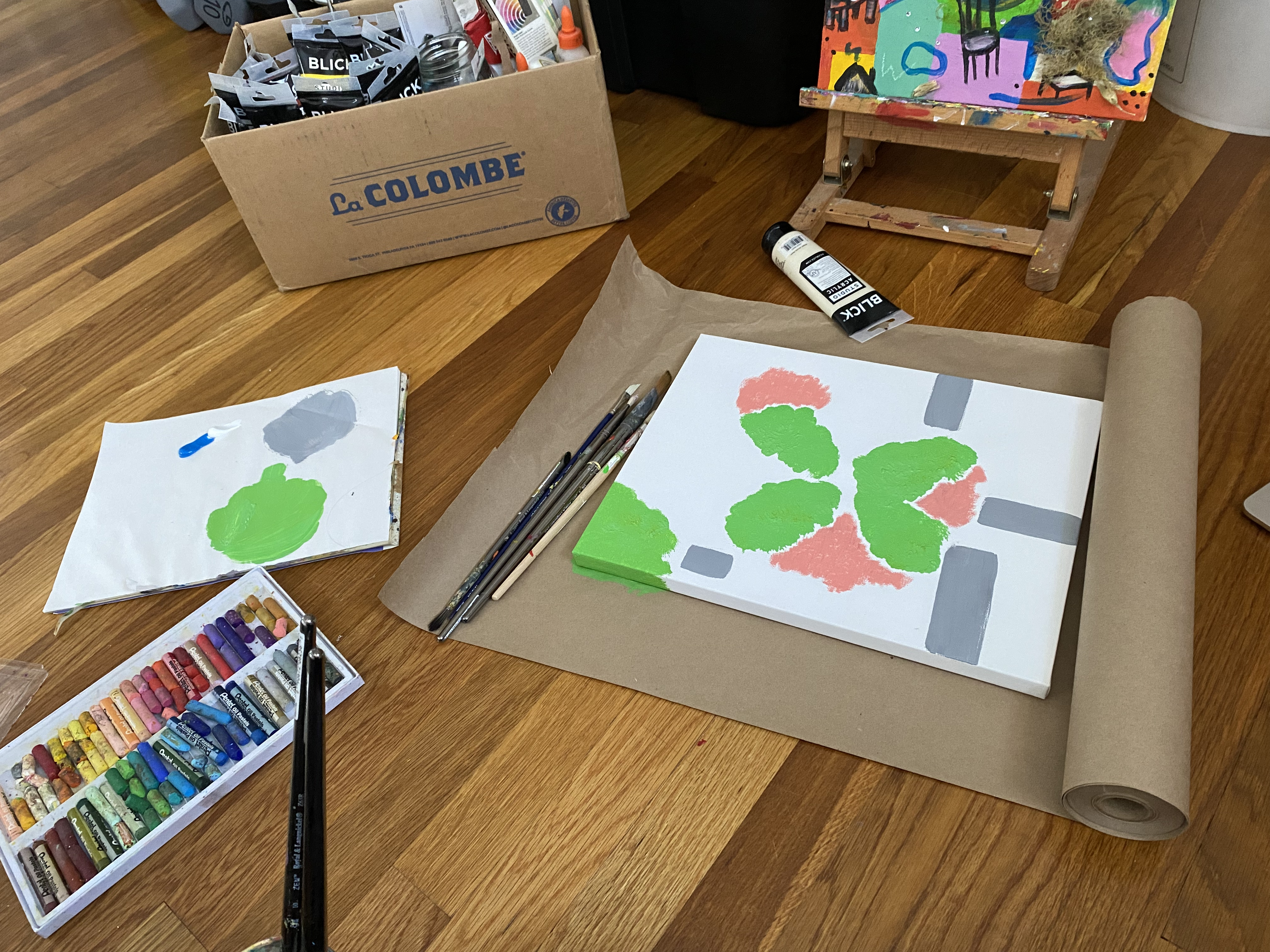
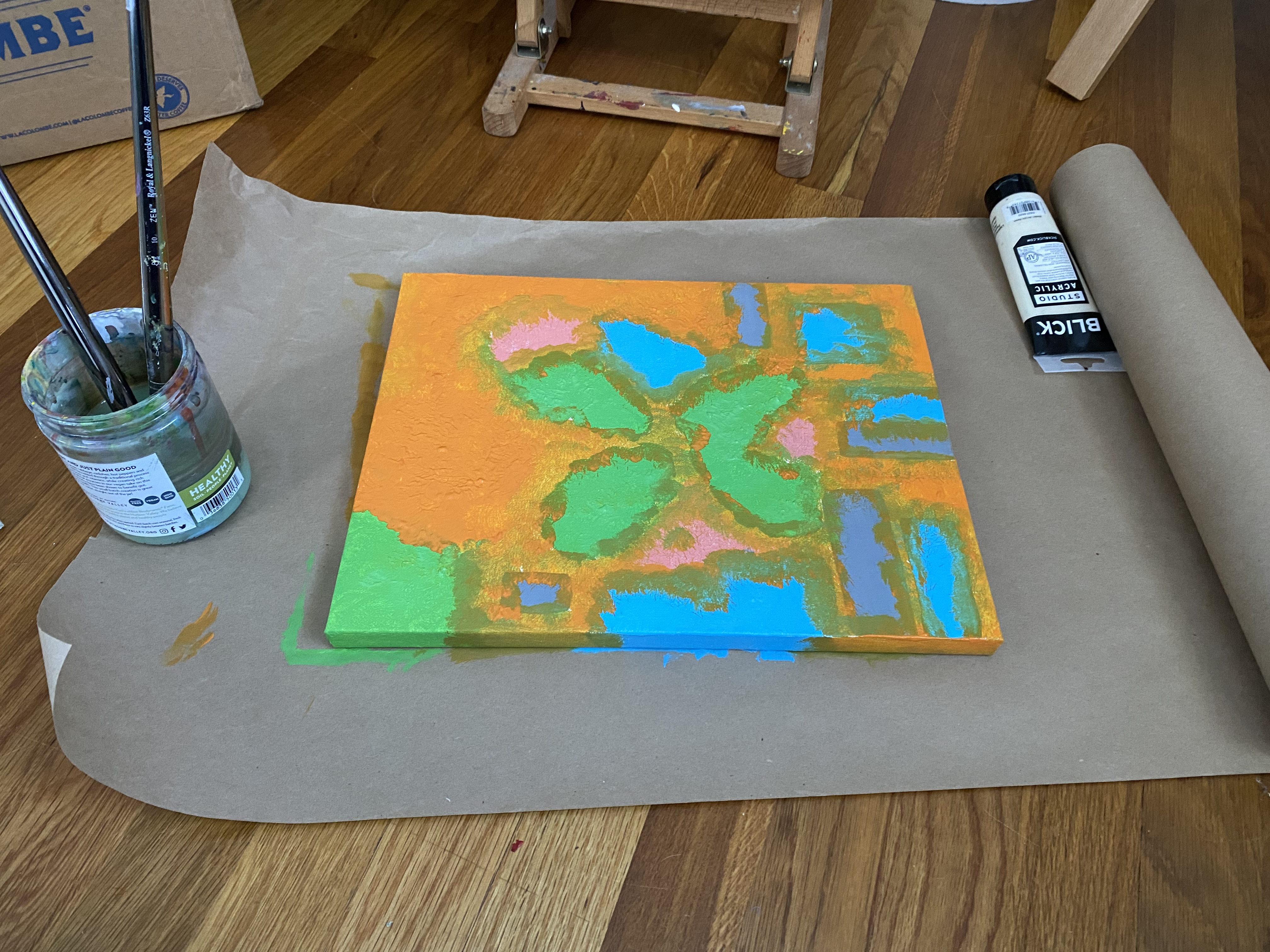
While working on this piece, I drew from scholarly articles on synesthesia such as Synesthetic Perception and Poetic Metaphor2 by Lawrence E. Marks that discusses not only the connection between color association and synesthetic experience with metaphors, but also that there are many examples where synesthetic metaphors are incorporated into poetry that could help encourage a color-based perception of a poem. I also looked at the work of the ecologically informed, multimedia, and synesthetic artist Rita Leduc3 who uses data from the environments around her, to then transform into a deepened experience of a space in color, shape, texture and material. Additionally, the work of the author and artist Carinna Parraman4 helped inform my exploration further, who writes on the connection between color, art and science.
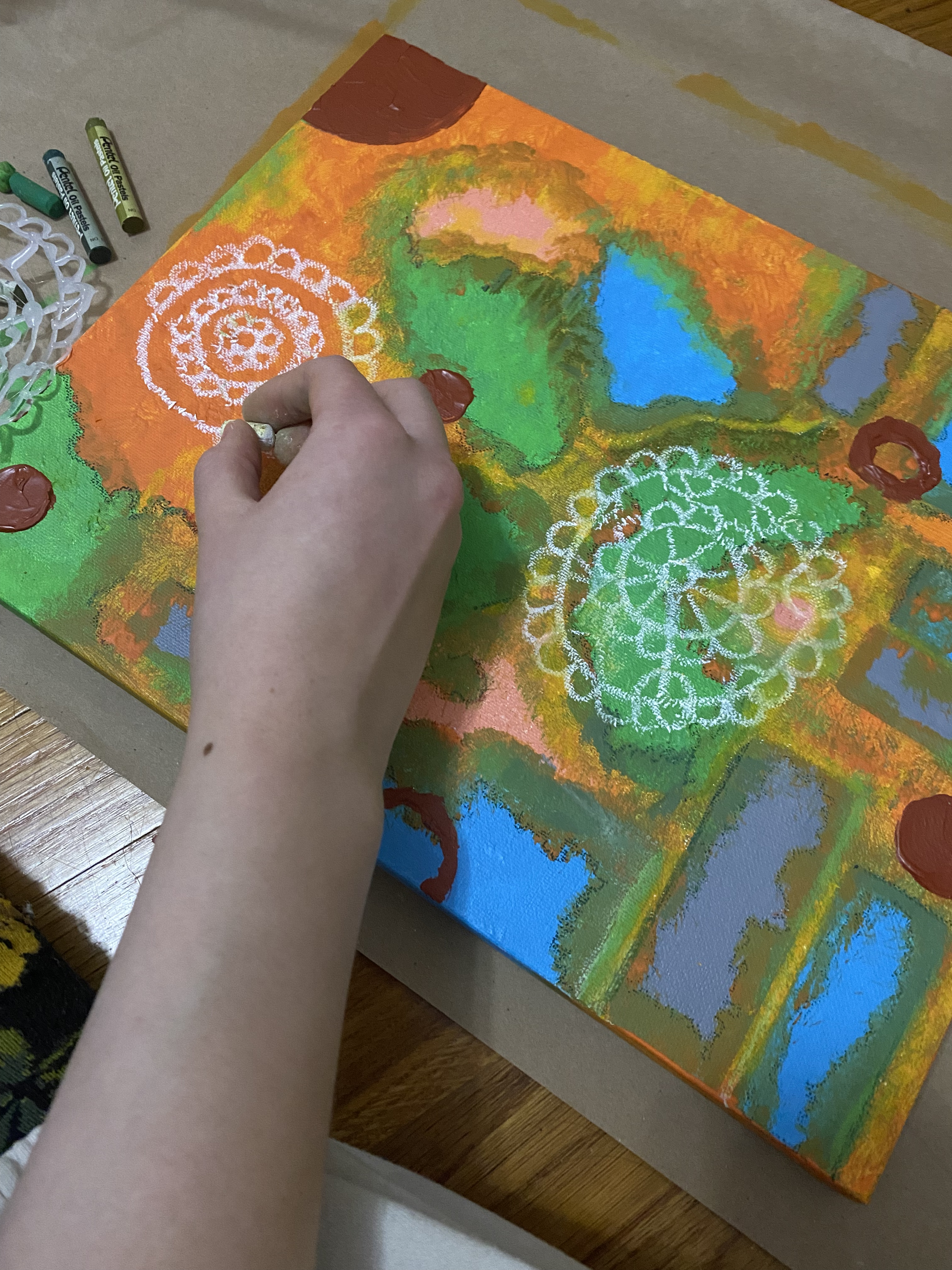
What interested me when working on this piece, is that when responding with color rather than words, it is not as easy to explain the sometimes and “random” choices when choosing colors and textures as a visual representation, and response to a text. Not only is singular experience an element to this, but my specific color choices are completely unique to me as everyone experiences both color differently, and the connection between words and their color associations differently. Could this be one of the points that Mary Cavendish was trying to make through her poem It Is Hard to Believe that There Are Other Worlds in this World? That every human and being in Nature experiences perception differently, and it not only requires a faith to understand what each individual sees, but also what none of us can? Why does our perception have to be a “rational” science? Why are we compelled as humans to need to “prove” why something exists just because not everyone sees and experiences the world this way? Through this project, I realized the true importance of interpreting, and responding to literature in a variety of mediums, as there is so much emphasis in society in only living, and seeing what is “visible” rather than looking beyond the tangible and physical to increase our vision of the both the seen world, and all the “invisible” worlds around us.
- Author Poems and Fancies Research Assistant. “It Is Hard to Believe That There Are Other Worlds in This World.” Margaret Cavendishs Poems and Fancies, 5 May 2019, library2.utm.utoronto.ca/poemsandfancies/2017/06/12/it-is-hard-to-believe-that-there-are-other-worlds-in-this-world/. ↩︎
- Marks, Lawrence E. “Synesthetic Perception and Poetic Metaphor.” Journal of Experimental Psychology: Human Perception and Performance, vol. 8, no. 1, Feb. 1982, pp. 15–23. EBSCOhost, https://doi-org.libproxy.plymouth.edu/10.1037/0096-1523.8.1.15. ↩︎
- “Rita Leduc Artist Statement.” RITA LEDUC, http://www.ritaleduc.com/statement. Accessed 12 Dec. 2023. ↩︎
- Colour in Flux: The Art and Science of Colour, aic-color.org/resources/Documents/jaic_v3_gal1nar.pdf. Accessed 12 Dec. 2023. ↩︎


