Kalibasa
Shakuntala
Translated by
Arthur W. Ryder
Again, translated by
Kieran J. Bondarchuk
*Note that most acts will be, what some might refer to as, “NOT TRANSLATED”. Some might even say that they are “NOT PRESENT”. Well . . . I’m sure Arthur had omitted and shifted some story around. What’s the big deal? A translation is a translation. Besides, it’s a more civilized time. Arthur would understand. Kalibasa maybe not so much.
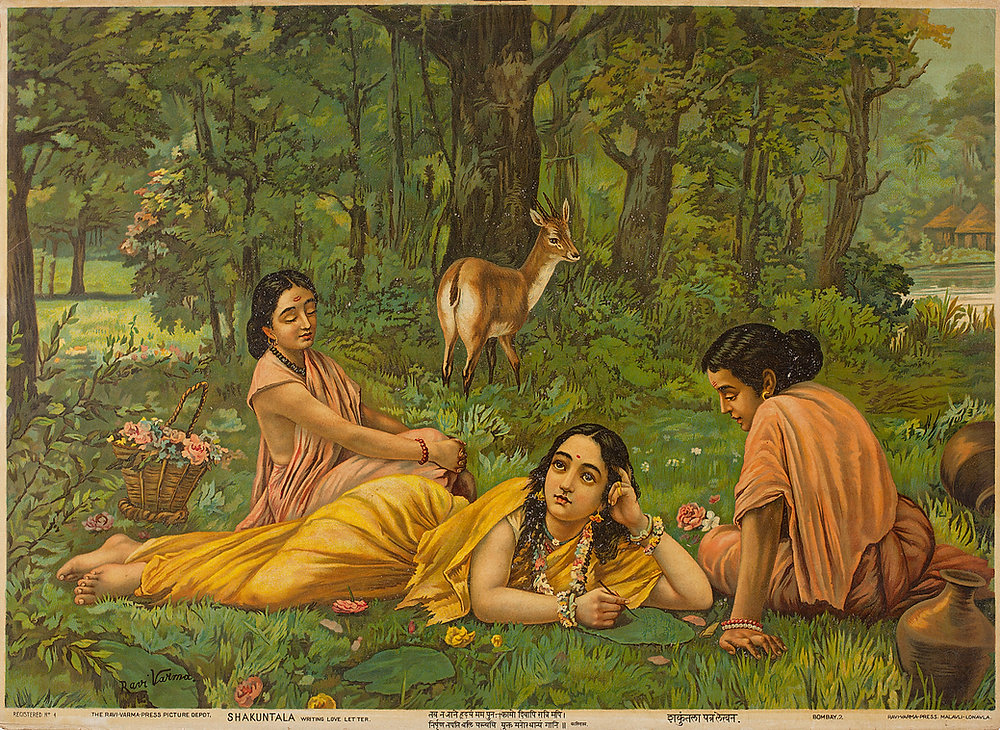
Act IV
Shakuntala’s leaving
Scene I
(Enter two friends, picking flowers)
Anus. Priyam, for some reason Shakuntala went and married a man. The real kicker though is that she did it all herself; never said no. I hate it, I hope she dies.
Priya. What the hell is wrong with you?
Anus. What’s done is done, and the man was put back out into the world by those recluse bums. He’s heading over back towards the city where he’s got enough women. You think he will remember Shakuntala when he’s got enough going around?
Priya. Don’t be such a flaming bitch. He looks very fine, so what’s the worst he can do? But think on this nugget. I don’t know what dad is gonna do when he gets back from his rummaging around whichever hole he’s taken to and decides to take notice to all this.
Anus. I think he won’t mind.
Priya. What?
Anus. Why the hell no? He’s willin to whore a daughter out if there was a man to take her. Sure as shit, He’s happy.
Priya. Guess so, somewhat. (She spits into her flower bucket.) Welp, we’ve got enough weeds to put towards that ordeal.
Anus. Well, we’ve gotta post these up to whatever god will take care of Shakuntala’s marriage. (Like a muppet.) Let’s get some more captain.
Priya. Who cares. (They do it)
Voice. (Loudly) Get Me.
Anus. Who the hell is that.
Priya. Shakuntala’s hanging around her cottage. (Thinking.) Her mind is a ways away. We’ve got enough of these damn plants. (They leave).
The Voice. You hate me?
I could say some crap
But I’m old and that don’t compute.
Maybe I’m a bit senile
But your fiancé wont remember a damn thing
Or think of you
(The girls listen, and get mad)
Priya. (In a Panic) Oh god. It’s over with. That idiot just laid down and railed the mans ego.
Anus. That’s not no regular man. That’s Durv the something. Look at those feet go.
Priya. Something about fire.
Anus. What?
Priya. Go get down at his toes. Maybe get him over here. I’m gonna get some suds to soak them toes.
Anus. OK. (Leaves).
Priya (Clearly drunk, she stumbles). Fuck. The flowers. (She close-fist grips the flowers in a big ball. Anus comes back)
Anus. Damn, he’s an angry bastard. He’s never gotten any, you can tell. I got through to him some.
Priya. Whore,- anyway. What did you do to him?
Anus. He had his back to me, so I went right to the toes and said a little thing or two. “Please dude”, I said, “Think of what she’d done, and don’t be mad bro. Your daughter is dumb as shit and probably blind too. Stupid and Blind. She’s chasing butterflies with a club. You’re pretty damn good at your thing, she’s just donkey brained.
Priya. Okay, so?
Anus. So he says: “Don’t even trip bro, its done. Its not that deep. Theres a gem right now, he’s gonna be alright when he sees it. Shes got it, he gave it to her. Don’t trip”. And he just fucking (She makes a poof noise) into thin air.
Priya. Ah we’re good. He gave Shakuntala a ring with his street name on it, we’re good. She’ll use that, it’ll be Gucci.
Anus. Alright, lets do this thing (They start walking in place).
Priya (Looking around). Hey, look. There the bitch. She’s got her cheek resting on her hand. She thinks she’s better than us, like a painting. Probably thinking about her man. I was just joking, but maybe she really is fucking stupid, you know, with all that bullshit from before.
Anus. Priya, don’t say a damn thing. It’ll play out funnier that way. She’s a delicate thing.
Priya. Ok, spark up for me please. (Pointing to the flower ball) Just spread that shit around. (They pull and excellent mambo.)
Dec. 10th, 2023
Currents in Global Literature
Prof. Nicholas Helms
Reflection
My translation of the translation
Kalibasa’s Shakuntala
Kieran J. Bondarchuk
It is intrinsic within this global literature class that in order to read global literature, which was written in a native tongue, it is not the literature itself that we read but rather the translations. The issue with a translation for any piece of literature is that the substance and impact is solely dependent on the translator. My calling of the rewrite of Shakuntala as a translation of Arthur. W. Ryders translation is a satirical comment on how translations in the end are not just direct translations (word for word), but that translators innately impose their own selves upon the works in order to translate not words, but full phrases, thus making a new essence in the text. And what I pose is that changes can be drastic, and dependent on the translators own contemporary setting as well as their own views as to how the work should appear. By no means is my rewrite a proper translation but is rather an example of an extreme case as to where the essence is lost due to translation. As well, it is satirical of how global literature is taken and changed to fit the needs of another culture, especially in the case of the colonial mindset.
To begin my argument, I’d like to cite some of Vinay Dharwadker’s article Translating the Millenium: Indian Literature in the Global Market, mostly considering what he writes of representing Indian literature through translation. He comments that a translator’s task is to, “invent ways of translating the past millennium that are commensurate with our cultural needs in the twenty-first century” (Pg. 2, Dharwadker, 2008). This idea is what I had taken in tandem with what Paul Hond had written in his article The Peculiar Perils of Literary Translation, which was published in the winter of 21’-22’ for the Columbia Magazine, where in which he states, “Given the nuances and resonances of any two languages and the unachievable ideal of perfect lexical equivalence, writers from Voltaire to Virginia Woolf have decried the futility of translation, and the philosopher and linguist Wilhelm von Humboldt declared it ‘impossible.” (Hond 2021-22). Even later in Dharwadker’s article he himself states that the act of direct translation is an abstract goal, and as well is wholly dependent on the translators take on each word, each sentence, each text, each original author. You see the act of translation itself is as subjective as the act of writing. Naturally, a translator is beholden to a publisher, as well as their own interpretations; interpretations only made that much more immediate due to barriers in translation language, especially ones so many years far between each other.
Given that I’ve given example of how translation itself is an act of subjectivity, and is dependent on the interpretation of interpreter, I’d like to further my point with the fact that the literature itself is determined by the environment of the interpreter as well as their own understanding of culture, whether it be their own or another’s. To this I reference Indra Nath Choudhuri’s article, Environment and Literature: “Aesthetics Determines Cultural Ecology”. She specifically mentions Shakuntala, when Kanva goes to gain permission from the natural surroundings of Ashram in order for Shakuntala to return to her husband’s home. She considers this short excerpt when she writes, “The present-day social environment and its impact on our living are making us lose our association with nature resulting in a new slant in our creativity.” (Pg. 173, Choudhuri, 1999). As well too, she mentions that the western world too is, “riddled with a basic fallacy; man has forgotten that he must work with nature, not against her.” Then, if we consider what I had said about the translator own imposition, then why then would the ideals of the western world not as well be imparted into the translation, to some degree? And perhaps it is, in a sense, where the idea of being entuned with nature is seen as a practice which is foreign and mystical.
And so, I am left with only questions. One; what determine the legitimacy of a translation? As well, is there any possibility for a translation which is completely beholden to being authentic towards an original? Two; if no, then is that translation itself then an original work? Does not the subject have full agency over what is said? And if not, then why have multiple translation by multiple translators? And three; Is then my own satire of the situation an equally valid form of transferring a text across the language barrier? Perhaps then it is a fruitless effort. Perhaps people are inevitably bound to follow their own notion, own cultural desires, and interpretation, thus making a true translation a task which is bound to result in an imperfect product. None the less, our understanding of translation is bound to be flawed as well, thus continuing the trend. As it is, surely translation is an imperfect art. But none the less, it is an art in of itself.
Citations
Dharwadker, Vinay. “Translating the Millennium: Indian Literature in the Global Market.” Indian Literature, vol. 52, no. 4 (246), 2008, pp. 133–46. JSTOR, http://www.jstor.org/stable/23347959. Accessed 10 Dec. 2023.
Paul Hond |, et al. “The Peculiar Perils of Literary Translation.” Columbia Magazine, magazine.columbia.edu/article/peculiar-perils-literary-translation.
Choudhuri, Indra Nath. “Environment and Literature: ‘Aesthetics Determines Cultural Ecology.’” Indian Literature, vol. 43, no. 5 (193), 1999, pp. 172–79. JSTOR, http://www.jstor.org/stable/23342694. Accessed 10 Dec. 2023.
Kālidāsa, and Arthur W. Ryder. Shakuntala and Other Writings. Dutton, 1959.

 Sprockets and Springes