
Rabindranath Tagore was born in Kolkata, India lived 80 full years; 60 of which he dedicated to poetry and making notable contributions as “a dramatist, novelist, short story writer, and writer of nonfictional prose, especially essays, criticism, philosophical treatises, journals, memoirs, and letters. . . expressed himself as musician, painter, actor-producer-director, educator, patriot, and social reformer.” There wasn’t anything he was not; he was also a loyal husband and father of five.
Prime Minister, Jawaharlal Nehru, wrote in Discovery of India, “More than any other Indian, he has helped to bring into harmony the ideals of the East and the West, and broadened the bases of Indian nationalism.” In 1913 he was awarded the Nobel Prize in Literature noting that the earliest influences that shaped his “poetic sensibility were the artistic environment of his home, the beauty of nature, and the saintly character of his father”.

After being introduced to Rabindranath Tagore in class, I realized that a lot of the information was dense and doesn’t do Tagore justice. Tagore’s natural possession of lyricism and rare attention to simplicities, goes beyond his birth and date date-hence the title; for Tagore is not “dead” but forever lives on in the materialistic presence of his literature.

Tagore began writing poetry at a very early age, and during his lifetime he published more than 40 plays, 200 stories, and nearly 60 volumes of verse, experimenting with various poetic forms and techniques such as lyric, sonnet, ode, dramatic monologue, dialogue poems, long narrative and descriptive works, and prose poems. His Gitabitan (“Song Collection”), contains 2,265 songs that were all composed, tuned, and sung by himself, starting a new genre in Bengali music, known as Rabindrasangit. He used all the musical materials that came to hand: the classical ragas, the boat songs of Bengal, Vaishnava kirtan [group chanting] and Baul devotional songs, village songs of festival and of mourning, even adopted Western tunes picked up during his travels.

I wanted to pay tribute to Tagore by highlighting what I saw as wise words of advice during a time that needs reminding and inspiration to regain the ability to appreciate nature. I researched several quotes that struck me and transposed them over photographs I’d taken myself. Tagore had hoped to bring peace and unity in the understanding of cultures and experiences. As a western culture, we don’t outright look for indigenous writers and often look for names we’ve heard before and because of that we lack cultural understanding and in a way, choose to be ignorant or educational systems choose to be ignorant in neglected literature from other cultures that is just as easily comprehensible.


My ultimate intent was to create “motivational” wallpapers for people to actually use. There is more to be said than what we have already heard and the words of Rabindranath Tagore are not limited to Bengali or Indian culture. His purpose went beyond living his own life, but spending that time to improve the lives of others. He wrote through the joys of nature and loss of loved ones to transcend the physical mind into a spiritual relationship with oneself and nature that is globally relatable.
![A tall fire burns brightly with the rest of the photo in darkness. A quote is written above the flames that says:"He remained calm and his inward peace was not disturbed by any calamity however painful. Some superhuman sakti [force] gave him the power to resist and rise above misfortunes of the most painful nature." Said by Rabindranath Tagore.](https://global.lit.nrhelms.plymouthcreate.net/wp-content/uploads/2021/11/Screen-Shot-2021-11-04-at-6.51.15-PM-784x1024.png)

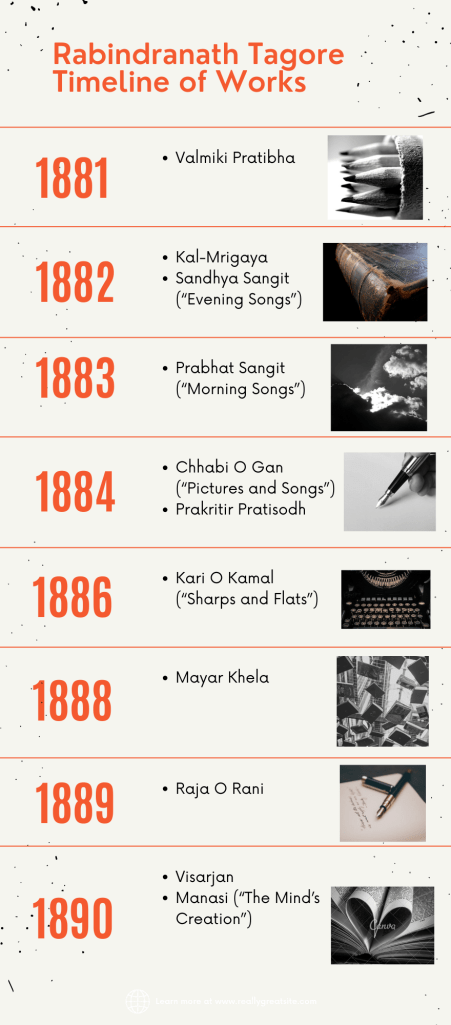
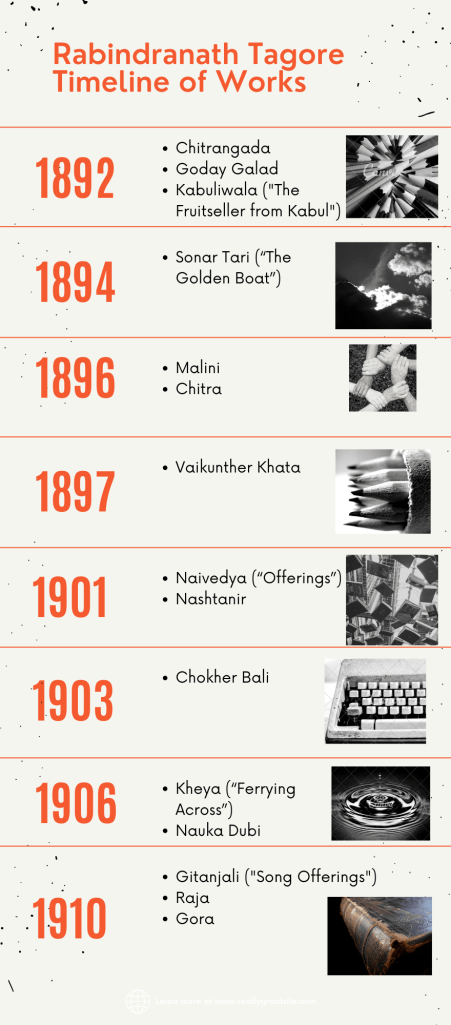
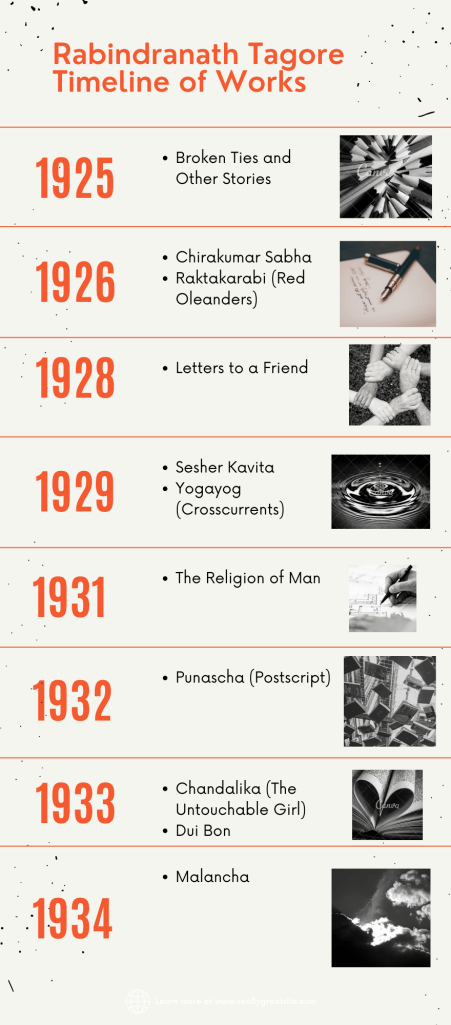
Another obstacle I encountered the inability to follow the abundance of work he had published throughout his lifetime. Dates and titles were listed in paragraphs among paragraphs disregarding chronology. Interested in the topic it was difficult and annoying to not be able to follow the index of his works. I decided to take the information given from several resources to create the following timeline:


Rabindranath Tagore collided the currents of Western and Eastern culture on a literary planes. Literature matters not only for the knowledge of others, but also highlights the idea of afterlife not just for the soul, but the life that lives on earth within his countless poems, short stories, artwork, and songs.
Here is a PDF version of the timeline: Tagore works

 Sprockets and Springes