While British decolonization of Africa ended in 1968, colonization remains a gripping issue in the modern world. As of 2017, a total of 61 existing colonies remain under the control of Australia, Denmark, the Netherlands, France, New Zealand, Norway, the United Kingdom, and the United States, with France, the United Kingdom, and the United States winning, respectively, first, second, and third for having the most colonies (“How Many Countries?”). In this way, colonization persists in its most literal manifestation; there are still nations subjected to the control of imperial powers. Britain—the country the receives the most pointed fingers in the colonial blame game—is not retired or reformed from colonial dealings; it’s just stopped fighting for new colonies. Modern colonization is by nature subtle. It flies under the radar. It exists in the minds of anyone who has ever wondered, “Why can’t that culture see that its practices harm people? Shouldn’t everyone have democracy? Wouldn’t those people be better if they were like us?” Writers Wole Soyinka and Olaudah Equiano explore the tools of colonization and reveal the workings of the colonial mindset, many elements of which still hold the world in its sticky clutches. Colonization is based on the idea that colonial powers are superior, civilized, and trying to “save” lesser developed nations from their own primitivism and savagery. Equiano and Soyinka subvert traditional concept of civilized and savage to expose the colonial tools that continue to influence perceptions into the modern day.
Equiano emphasizes the civilized characteristics of his African tribal family. He dedicates the whole first chapter of his narrative to the detailed explanation of his people’s customs, paying particular attention to the elements of his culture that reflect the western interpretation of civilization. This is seen when Equiano describes his tribe’s mealtime hygiene customs, explaining, “Before we taste food, we always wash our hands: indeed our cleanliness on all occasions is extreme” (Equiano 35). Equiano emphatically describes the cleanliness of his people, a direct opposition to the historical misconception that black skin is dark because it’s dirty.

He uses words like “indeed” and “extreme” to construct a clear, confident, and undeniable assertion as to the cleanliness of his people. His forceful appeal to cleanliness is ultimately an appeal to Europeans, who, with their technological advancements and refined culture, were most likely incapable of comprehending how Africans stayed clean living “in the bush,” without the amenities of the western world. In this way, Equiano subverts the commonly held definition of civilization by explaining the parallels between the two distinct cultural experiences through cleanliness. Even though African culture may have appeared primitive compared to the colonizer’s western ways, it shared many of the values on which the concept of civilization was founded. Equiano therefore asserts that seemingly lesser-developed African societies experienced a similar level of advancement, at least in values, compared to the Europeans, who looked at what the Africans had and thought themselves superior. This constructed dynamic of white superiority and African inferiority fueled the slave trade and was used to wrong justify the era of colonization that surrounded it.
Soyinka’s Death and the King’s Horseman provides a more modern example of the same line of thought that fostered colonial interactions between Western colonizers and colonized nations. Soyinka’s play depicts colonized Nigeria in 1946 and opens with a disconcerting dynamic between white colonizers and the African natives, where a District Officer named Simon Pilkings enforces legal control over the African tribes who inhabit the region. When Mr. Pilking’s learns of the preparation of a tribal ritual that involves the suicide of Elesin, a major tribal authority, he decides to intervene. After learning of Elesin’s intention, Mr. Pilkings says to his wife, “You think you’ve stamped it all out but it’s always lurking under the surface somewhere” (Soyinka 26). The “it” Pilking’s refers to is his perception of the primitivism of the African natives, which he, for some reason, feels obligated to eradicate. Mr. Pilkings uses particularly strong words to convey this sentiment, such as “stamp out” and “lurk.” In this way, he constructs a monstrous image of the African natives based on his definition of civilized and savage by creating some inherent negative quality of Africans that will forever “lurk” beneath a westernized surface. His actions are fueled by the common western belief that what is decidedly primitive is bad, and therefore must be replaced with the brilliant sophistication of the developed world. This is the idea that justified colonization in the past, and it’s colonization’s most persistent aftereffect, which continues to influence the thinking of modern people, specifically in relation to countries (such as those with largely Muslim populations) whose cultural practices are perceived as barbaric compared to western customs. Soyinka exposes the workings of the colonial ideology to reveal its cruelty and its deplorable reign over the western mind
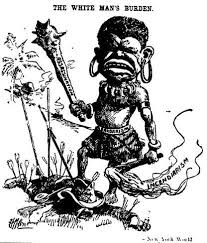
Along with exposing white colonial perceptions of civilization, Soyinka turns the very concept right on its head. Elesin’s son, Olunde, whom Mr. Pilkings sends to medical school in the west, challenges the western world’s perceived civilization in a conversation with Mr. Pilking’s wife. He says, “By all logical and natural laws, this war should end with all the white races wiping out one another, wiping out their so-called civilization for all time and reverting to a state of primitivism the like of which so far only existed in your imagination when you thought of us” (Soyinka 53). Olunde tells Mrs. Pilkings that white people will eradicate each other through war, destroying each other’s societies until they’ve reverted to a state of “primitivism.” He scorns the western idea of technological and cultural superiority by referring to the developed world’s “so-called” civilization, therefore revealing the constructed nature of the idea of western civilization. African tribal culture is indeed another example of civilization despite being excluded from the colonial definition. Olunde also refers to primitivism as “something which so far existed only in [the colonists’] imagination when they thought of [the African natives].” Again, he presents the notion of African primitivism as a figment of western imaginations, a mere construction, something which exists solely in the mental space of those who believe it. African inferiority or savagery is an invented concept used as a tool for spreading colonial ideology because it served as a basis to excuse the egregious acts of the colonizers. Soyinka is aware of this. He causes this pervasive and incorrect ideology to stop with him, as he recognizes its inaccuracy and its harm. In turn, he depicts it as such in his play, thus subverting traditional conceptions of civilized and savage to expose the manipulation of the colonizers.
Similarly, Equiano exposes western brutality to subvert common misconceptions of Europeans as being technologically and morally superior to those they colonize. In The Interesting Narrative, Equiano depicts African slaveholders as relatively humane compared to the animalistic brutality of the white men in the European slave trade. Of the Africans, Equiano says, “I must acknowledge, in honor of those sable destroyers of human rights, that I never met with any ill treatment, or saw any offered to their slaves, except tying them, when necessary, to keep them from running away” (Equiano 51). He doesn’t display complete approval of his African slave masters, still referring to them, quite harshly, as “destroyers of human rights” but he is much less accusatory of them than of his white slave masters. He claims that he wants to “honor” them for never using “any ill treatment” against him, except for slight efforts to keep their slaves contained. This is a stark contrast to the language Equiano uses to describe his experience with white slave masters. He describes being kept in terrible conditions “filled with horrors of every kind” (Equiano 56). “I had never seen such instances of brutal cruelty,” Equiano writes, “and this is not only shrewn towards us black, but also some of the whites themselves” (Equiano 56-57). The tone Equiano uses to describe white slave traders is very critical. He uses words like “brutal” and “cruelty” to describe the inhumanity he faces as their captive. Contrasting the African slave holders, who are nice even to their slaves, Europeans aren’t even nice to each other, according to Equiano. He creates an overall image of Europeans as cruel, ruthless, and uncaring—all qualities that would commonly be associated with the word savage but excluded from conversations about a civilized society. In this way Equiano exposes the absurdity of these classifications, as, in his experience, Europeans do not live up to their own conception of the word civilized despite celebrating their civilization and using it as a justification to invade and exploit those they deem lesser based on these arbitrary categories. Equiano subverts common notions of civilized and savage to expose misuse of these ideas in colonial endeavors.
Equiano and Soyinka expose the hypocrisy of the western world’s definitions of civilized and savage, revealing the backwards thought that drove colonial endeavors and continues into the modern day. As both Soyinka and Equiano depict in their writing, colonization and the slave trade is based on the idea that lesser developed nations are primitive, their people savage, and they are therefore are insignificant compared to and in need of policing by developed western nations. Even though colonization exists on a much smaller scale nowadays, it’s founding concept is more slowly to recede. As stated in the article “Let’s Talk About Neo-Colonialism in Africa,” Mark Langan warns of the “potential regressive impact of unregulated form of aid, trade and foreign direct investment in relation to poverty reduction and wellbeing in African Countries” (“Let’s Talk”). Even intervention by those trying to do good (such as reduce poverty) has the potential to wreak havoc because, to put it in simple term, things go wrong when one tries to help another because they think they are better, stronger, and more capable of dealing with the other’s business. The western world cannot save other nations from their own culture. That’s not to say that wealthy countries shouldn’t offer aid to their international brothers suffering from poverty or scarce resources; Langan only warns about “unregulated” assistance. However, the colonial dynamic between developed and lesser developed—or, rather, different—nations will remain as long as people continue to view the western world as civilized and third world nations as uncivilized based on dated, arbitrary distinctions.
Works Cited
Conor, Liz. “Dove: Real Beauty and the Racist History” La Trobe University. https://www.latrobe.edu.au/news/articles/2017/opinion/dove-real-beauty-and-the-racist-history. Accessed 26 Sept. 2020.
Equiano, Olaudah. The Interesting Narrative and Other Writings. New York, Penguin Group, 2003.
“How Many Countries?” Infoplease. https://www.infoplease.com/world/diplomacy/how-many-countries. Accessed 26 Sept. 2020.
“Let’s Talk About Neo-colonialism in Africa.” London School of Economics and Political Science. https://blogs.lse.ac.uk/africaatlse/2017/11/15/lets-talk-about-neo-colonialism-in-africa/. Accessed 26 Sept. 2020.
Soyinka, Wole. Death and the King’s Horseman. Norton, 2002.
“The White Man’s Burden.” YesterYear Once More. https://yesteryearsnews.wordpress.com/2011/01/07/the-white-mans-burden/. Accessed 26 Sept. 2020.

 Sprockets and Springes