Welcome to Studies in English! For the Fall 2025 semester, we’re meeting in Memorial 304 from 8:40-9:55 AM on Monday and Wednesday each week, and on Fridays in the same classroom from 9:05-9:55 AM.
Professor Nic Helms (they/them) (nrhelms@plymouth.edu)
I’ll be in touch daily this semester via email and MS Teams (an Office 365 app available in my.usnh.edu). For drop-in appointments, I’ll be in my office in Ellen Reed 14 (top of the main stairs on the left) on Mondays & Wednesdays from 10:00-11:45 AM. If you’d like to schedule a meeting for another weekday, contact me.
I try to respond to all communications within twenty-four hours, except on weekends. (I treat the weekends as days of rest for me and for you! If something breaks over a weekend, let me know, but don’t worry: it can always wait until the following Monday.)
EN 1600: Studies in English (4 Credits)
Catalog Course Description: Required of all English majors. Acquaints students with fundamental concepts such as text, genre, author, period, nation/place and reader/critic as they apply to underlying philosophy and material practice in the discipline of English. Not open to students who have earned credit for EN 2500. Falls and Springs. (QRCO) (WRCO)
Prerequisite(s): none
Reading Schedule
What does it mean to be an English major? How do English majors read, write, think, argue, conduct research, analyze evidence, and draw on other disciplines? What kinds of career paths and futures have English majors tended to pursue and why? How do the intellectual habits, skills, and experiences of the English major contribute to these futures?
Responding to these questions, this course introduces students to the major debates, theoretical concepts, and objects of study that animate the field of literary studies today. Throughout the semester, we will examine foundational concepts such as author, text, subject, ideology, and canonicity. These concepts will enable us to practice the method of close reading, engaging in debates related to unreliable narration, psychoanalysis, representations of nature, and the construction of gender, sexuality, race, class, and disability. We will compare our close readings with the newer method of distant reading, experimenting with the techniques of data collection, visualization, and analysis in literary studies. In the final weeks of the semester, students will synthesize and draw on their theoretical knowledge and analytical skills to develop their own contributions to contemporary debates in literary studies.
This is a Writing Connection (WRCO) course in the General Education program.
Here is the General Education Description of WRCO courses: In order to communicate effectively, students need to learn the conventions of their own discipline or profession. They need to learn how to write like an educator, a social worker, a biologist, a historian, or a literary critic, for example. Students take a three- or four-credit Writing (WRCO) course within their major that contains significant writing experiences appropriate to the discipline. These experiences are based on Writing Across the Curriculum activities such as freewriting, outlining, writing multiple drafts, responding to feedback, and creating a finished product. In addition to extending the process of developing writing skills, WRCO courses also emphasize writing to learn in the discipline.
This is a Quantitative Reasoning in the Disciplines (QRCO) course in the General Education program.
Here is the General Education Description of QRCO courses: Mathematics finds application in all fields of scholarship. All disciplines make use of quantitative reasoning in some way and to some extent. Students take a three- or four-credit Quantitative Reasoning course specified as required for their major. This course may be taught within the major discipline or not. It might teach quantitative techniques used as primary or secondary tools within the discipline or might be a course in which students of less quantitative disciplines come to deepen their appreciation of the relevance of quantitative reasoning to us all.
QRCO Assignment: Complete a distant reading project (QRCO) in which you employ “distant reading” methods to examine broad canonical and textual trends across literary history. This project will culminate in a critical reflection in which you evaluate the method of distant reading, particularly with respect to close reading. The goals of this project are to: (a) analyze literary data and large-scale textual trends, (b) evaluate emerging data collection techniques and research in literary studies, (c) compare the methods of close reading and distant reading in literary studies. Details to follow.
Habits of Mind
The General Education program at PSU focuses on developing the following Habits of Mind:
- Purposeful Communication
- Problem Solving
- Integrated Perspective
- Self-Regulated Learning
Click here and scroll down for detailed descriptions of these Habits of Mind.
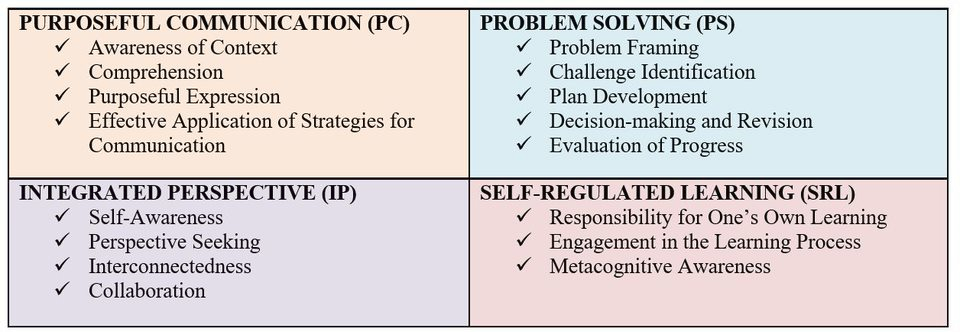
As a course in the General Education program, Studies in English focuses on developing Integrated Perspective, a habit of mind characterized by the recognition that individual beliefs, ideas, and values are influenced by personal experience as well as multiple contextual factors—cultural, historical, political, etc. All human beings are interconnected through their participation in natural and social systems. An integrated perspective recognizes that individual decisions impact the self, the community, and the environment. Students will acknowledge the limitations of singular points of view and recognize the benefits of engaging with and learning from others in order to integrate multiple perspectives for effective communication, problem-solving, and collaboration.
Assignments in this syllabus will identify the Habits of Mind being developed by the activity. While the nature of this course primarily focuses on Integrated Perspective, assignments will also ask you to develop Purposeful Communication and Self-Regulated Learning.
Student Learning Outcomes
Upon completion of this course, you will be able to:
- Articulate your individual values, purpose, and goals as an English major
- Identify, describe, and interrogate the underlying assumptions, methods, concepts, and debates that characterize the field of literary studies
- Understand, assess, and appreciate the different ways to read and interpret texts
- Develop and execute original arguments about literary texts and traditions
- Identify and describe the relevance and resonance of the discipline’s methods, skills, and concepts, especially as they relate to textual analysis, contemporary intellectual debates, and the professional world
- Effectively use a range of strategies, such as outlining, drafting, and revision, to navigate the writing process in the discipline
- Contribute to this course and to the field in ways that I, the professor, could not have anticipated at the beginning of the semester
Goals for all PSU Literature courses:
- Use cultural, historical, and aesthetic contexts to inform their understanding of all kinds of texts
- Display analytical skill in their written responses to texts
- Write fluently and understand writing as an artistic and/or intellectual process
- Understand the conventions of literary genre as creative writers and critics
- Capably use research to accomplish their reading, writing and thinking goals
- Understand the role of emerging digital technologies in writing, literature, and communication
Required Texts
Jeffrey Nealon and Susan Searls Giroux, eds. The Theory Toolbox. 2nd ed. (2012) ISBN: 978-0742570504
Shakespeare, William. Romeo and Juliet. Eds. Dr. Barbara A. Mowat and Paul Werstine. (2004) ISBN: 978-0743477116
 Sprockets and Springes