Who doesn’t love a good mix of literature and music? This question guided me in deciding what to do for our second project of Rethinking Medieval and Renaissance Literature. I went back and forth between a few ideas before landing on a spotify playlist based on my blackout poem I made from Margaret Cavendish’s “It is Hard to Believe There Are Other Worlds in this World.” I originally wanted to recreate the blackout poem out of song titles for the playlist, but unfortunately there are not enough songs for that! Instead, I made a custom album cover that has the poem on it.
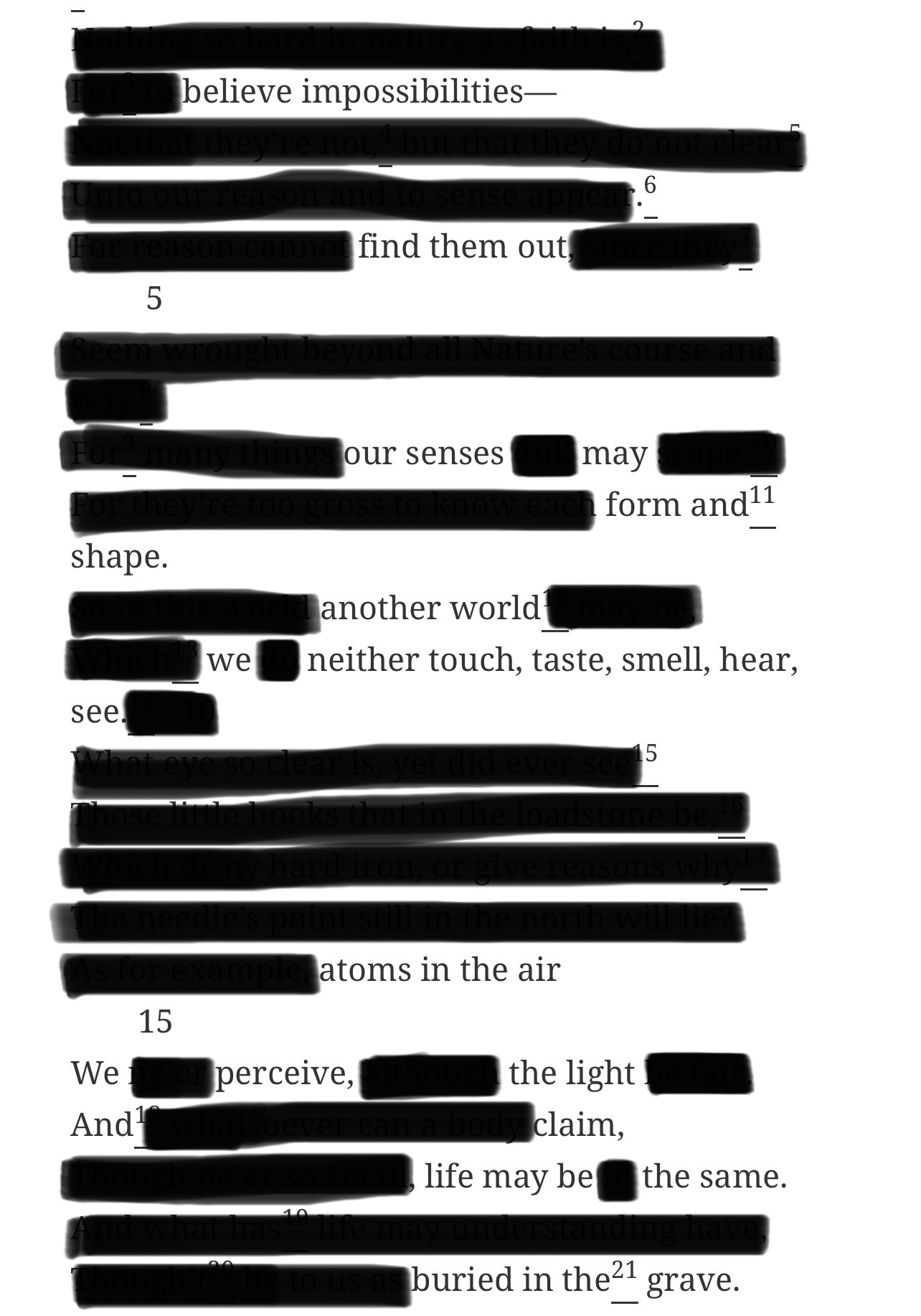
Shown below is the blackout poem:
Before I analyze the poem and the playlist, I want to first briefly dive into the meaning behind Margaret Cavendish’s “It is Hard to Believe There Are Other Worlds in this World.” This specific work of hers explores how limited perception is. Throughout the poem she argues that just because we can’t see something, doesn’t necessarily mean it doesn’t exist. As Liba Kaucky mentions in their analysis of the poem, “She [Margaret Cavendish] even calls the senses “dull”, and lists all the five senses (touch, taste, smell, hearing and sight)[xxi]. Thus, in this poem, Cavendish puts forward the argument that we can lack knowledge of, and be very dismissive of, many possible worlds because they escape our senses” (Kaucky). Cavendish pushes the readers of the poem to imagine that other worlds might be surrounding us all the time, whether they’re microscopic, spiritual, or undiscovered. With this poem being written in roughly the 1600s, she was thinking ahead of her time.
Some people tend to assume reality ends where our senses do but Cavendish believes that true knowledge requires curiosity and imagination, so instead of accepting surface-level appearances, we need to look beyond and question what lies beneath them. Liba Kaucky further makes the point that “there could be spirits and souls which are beyond our understanding and that have been overlooked, especially given how much phenomenon cannot be explained” (Kaucky). Overall, the poem is a reminder that the world is a lot more big and mysterious than we realize and to understand it further we need to be open to possibilities beyond what we can see or measure.
Diving into the blackout poem…
When I was going through Margaret Cavendish’s poem to make my own blackout poem, I wasn’t sure at first what I was looking for. I ended up just picking the words/phrases that flowed the best and by the end of it I really liked how it turned out. To further explore this: This blackout poem further touches upon Cavendish’s idea that reality reaches beyond what the senses can detect. I kept Cavendish’s curious tone, however my poem is more hopeful and investigative. I focus more on urging the reader to go out and seek things rather than Cavendish’s take of pushing the reader to think. I took it from questioning to more direct statements. Below is a line by line analysis of my blackout poem.
Believe impossibilities, / Find them out = This encourages curiosity and discovery. Don’t succumb to the people who tell you something isn’t real or isn’t possible, explore on your own.
Our senses may form and shape another world, / We neither touch, taste, smell, hear, see. = Our senses create only one version of reality, not necessarily the full truth.
Atoms in the air, = A visualization of another world, being, or form existing around us. This reflects more of a scientific thinking emphasizing that tiny particles can exist even though we can’t see them which shows that invisible things can still be real.
We perceive the light = It matters how we choose to perceive and believe things. Also, we accept light even though we can’t physically see or touch it so who’s to say there can’t be invisible truths?
And claim life may be the same, / Buried in the grave = This takes into consideration how these other worlds or existing forces “live” and whether these beings get buried like us or could they be immortal. This also puts out the possibility of what happens after death and how what is unknown around us could be an answer to that.
Playlist/Song Analysis
Saturn – Sleeping At Last
This was one of the first songs I chose because it really emphasizes the beauty of existence. It reflects the blackout poem’s idea that human understanding is small compared to the vastness of existence so why limit ourselves? The poem urges readers to “believe impossibilities” while the song invites listeners to face the unknown with wonder and humility.
Holocene – Bon Iver
I thought this song fit because Bon Iver is singing about realizing one’s insignificance in a larger world which mirrors the poem’s acknowledgment that what we see is only a fraction of reality and a small part of what is out there. This song has an emotional quietness that embodies exploration and wonder.
Afterlife – Arcade Fire
This song specifically fits in with the last lines of the poem about life and being “buried in the grave.” With this song Arcade Fire is wondering what remains after death, which aligns with my interpretation that other worlds or forms may continue to exist beyond physical life.
Ghosting – Mother Mother
This song embodies the idea of presence without visibility, such as someone existing but not fully seen or acknowledged. This parallels the poem’s idea of unseen truth and realities surrounding us despite lacking visibility and physical form.
Particle Man – They Might Be Giants
I will be honest, this song sounded goofy to me at first but listening to it more I understood that the song is humorously playing with microscopic imagery and invisible figures which reflects the poem’s reference to “atoms in the air.” This emphasizes that even the smallest forms have significance even if we can’t detect them fully. And also…who is Particle Man? We should figure that out…
No Choir – Florence + The Machine
This song takes a bit of a different route with focusing more on inward discovery. Through the quietness and peacefulness of the song and lyrics it reminds listeners that not everything meaningful is loud or visible, which goes with the poem pretty well in my opinion.
Mystery of Love – Sufjan Stevens
This is one of my all-time favorite songs. This song echoes the idea that meaning often exists beneath what we can see or explain and reinforces the poem’s shift toward seeking unseen realities (especially emotional and spiritual ones).
Space Song – Beach House
Another one of my favorite songs, this is actually the first one I thought of for this playlist. It has this distant and emotional vastness feel to it and is similar to the poem’s push to imagine beyond what senses seem to confirm. It is very dreamy sounding and has an other-worldly tone to it.
Myth – Beach House
Another Beach House song! This one deals with the tension between what is seen and what is hidden. A lot of the lyrics speak to building meaning beyond what reality immediately offers. The song also has this ambience that mimics the distant and atmospheric, almost untouchable, feel of another world that could be out there beyond perception.
Motion Picture Soundtrack – Radiohead
This song is very whimsical and brings on a feeling of wonder. It matches the poem’s ending take on death and uncertain aftermath. Once again connecting to the line “buried in the grave,” suggesting that what comes next is unknown, haunting, or unreal.
All Things End – Hozier
In this song Hozier reflects on impermanence and transition, connecting to exploration and figuring out what lies beyond endings. I think this song deepens the poem’s emphasis on questioning what remains beyond perception or physical life.
Unknown / Nth – Hozier
This song fits the idea of searching for answers that remain invisible or incomplete…once again searching for the unknown. The emotional intensity of the song parallels my poem’s urgency for the reader to “find them out,” speaking of the impossibilities and unknown while also battling that question of…are things better left unknown?
Overall, I had a lot of fun analyzing Margaret Cavendish’s “It is Hard to Believe There Are Other Worlds in this World,” creating my blackout poem, and taking the time to make the playlist. I decided to do this for my project because not only is it a new way of interpreting things but some people understand music best so why not mix it in with literature? Literature and music work very well together in pushing us beyond what is familiar and comfortable. Margaret Cavendish encourages us to stretch beyond what our senses confirm and my blackout poem urges action. We must go find the impossibilities rather than accept limits. As Roger Cahak notes in his article that I read, ““…we thrive on sameness, repetition, and ritual. We crave certitude, even though it’s often a mirage fueled by wishful thinking. We live a life of vanilla in fear of adventure, exploration, and discovery. We know what we know, and we don’t want to know anything else…We surround ourselves with those who have the same beliefs, thoughts, interests, and delusions. We sanction the voices that tell us what we want to hear. We refuse to stray from our cocoon of tedium” (Cahak). It’s okay to stray away from what you know and take an idea and run with it. If there are other worlds, beings, or forms why not be the one to discover them? In a way, this project is a step outside of that cocoon Cahak mentions. By redefining Cavendish’s poem into something new and mixing in the music with it, I helped to emphasize that discovery happens when we step into uncertainty, listen closely, and wonder.
Works Cited
Author Poems and Fancies Research Assistant. “It Is Hard to Believe That There Are Other Worlds in This World.” Margaret Cavendishs Poems and Fancies, 5 May 2019, library2.utm.utoronto.ca/poemsandfancies/?p=892#easy-footnote-35-892.
Cahak, Roger. “What’s so Scary about the Unknown?” Psychology Today, Sussex Publishers, 3 Feb. 2023, www.psychologytoday.com/us/blog/vitalogy/202302/whats-so-scary-about-the-unknown.
Kaucky, Liba. “Chapter 4: Possible Worlds in Cavendish’s Poems.” Chapter 4: Possible Worlds in Cavendish’s Poems, 11 Sept. 2020, thefeministmargaretcavendishcircle.blogspot.com/2020/09/chapter-4-possibleworlds-in-cavendishs.html.

 Sprockets and Springes