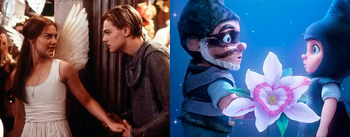
Over the years, there have been many different adaptations of Romeo and Juliet, and more often than not they maintain a theme of tragedy as the original story did. But one specific adaptation that “. . . creators make significant changes” to while still keeping enough key ideas to be able to identify it as an adaptation of Romeo and Juliet, is the 2011 movie Gnomeo and Juliet (Rebecca Rowe, 1). This version of Romeo and Juliet is known for leaving the tragedy and becoming a comedy. Gnomeo and Juliet uses the portrayal of characters to change the genre from a tragedy to a comedy. Changing characters such as Romeo, Juliet, the Nurse and Friar Lawrence in different ways to make them more funny and lighten the tone of the original story of Romeo and Juliet.
First and foremost, taking a look into the main characters of Gnomeo and Juliet, Gnomeo himself brings comedy into the movie. Honestly, Romeo and Gnomeo seem to have common characteristics, as similar as they can be for their times. Both are often seen as “set apart from other leads in Shakespeare’s” works, because of their “rashness of youth” (David Blixt). Being overactive, always thinking and moving kind of characters. Gnomeo is the type of character to wander and do his own thing, he is the type of person who “is a cocky, self-assured gnome who first looks for adventure.”(The Shakespearean Student). We also see this in the original Romeo in moments such as him risking going to the Capulet’s to see Rosaline, and then continuously as he seeks a relationship with Juliet even though it contains numerous risks. Gnomeo maintains]ing these qualities brings happiness and fun to the film, purely through his cockiness and attitude, leading to the film having a lighter tone. Through Gnomeo’s energy, attitude, and commentary is how his character brings comedy to the movie.
In Gnomeo and Juliet, a new version of Juliet actually leaves her garden, and she leaves it frequently, which then leads to an addition of comedy because she has different interactions with characters that are only possible due to her leaving. In the original Romeo and Juliet, Shakespeare’s Juliet does not have many interactions with anyone besides her parents, Nurse, Friar Lawrence, and Romeo and even those tend to be few and far between. Most scenes with Shakespeare’s Juliet we see her inside of her bedroom and she is usually alone, filling her scene with a soliloquy. She only ever leaves to marry Romeo and then to die for Romeo, so overall, when she leaves her home it is for Romeo and not for herself. But in Gnomeo and Juliet, she herself states that she doesn’t want to “stay tucked away on [her] pedestal all [her] life”, in fact the first time we see her, she is leaving her garden to seek out a flower for her garden. We then get to watch as the adaptations Juliet begins to interact with Gnomeo and she continues to be headstrong by standing up for herself, not letting the fact that he is a blue gnome from the garden next door, scare her away from the connection that she feels with him. In the end, due to the fact that in this adaptation Juliet is given more freedom, she then has more interactions with characters; this then leads to a lighter tone and more room for humor and comedy in the film.
Featherstone seems to resume the role of Friar Lawrence from the original Romeo and Juliet, in the adaptation Gnomeo and Juliet; he continues to be one of the main factors used to bring Gnomeo and Juliet together, to make their love story happen. But instead of being a Friar who wants to get them together to end a feud, Featherstone works to get the two together purely because he believes in their love. Throughout the film, Featherstone provides immense amounts of comedy through his actions and commentary. Immediately when introduced, the fact that he’s a flamingo makes the audience laugh. Then we start to see how he tends to be oblivious to what is happening around him. When he accidentally scares Gnomeo and Juliet in the abandoned garden without realizing that he is the reason behind Gnomeo and Juliet being scared, he hides with them, assuming there is another reason for them hiding. Featherstone even responds to Gnomeo when he wonders, “Do you think I scared him?,” Featherstone answers him by saying, “Oh, definitely. I know I’m scared,” not understanding that he was the threat Gnomeo was trying to scare (Gnomeo and Juliet). Featherstone is the character that everyone loves and there’s no way to hate him due to his personality. Whereas Friar Lawrence could be controversial, especially when pushing a love story onto two children who have no idea the reality of their situation. Featherstone continues to provide funny commentary when Gnomeo and Juliet are trying to explain reasons in which they can’t be together, their biggest reason being, “He’s a blue! And she’s a red!.” Featherstone makes a comeback by declaring, “And I’m pink! Who cares?!,” this is his way of telling them that they are being stupid for letting their feud get between them, but also breaking up the seriousness by saying it in a way that brings humor into the scene (Gnomeo and Juliet). We see many funny moments like this from Featherstone all throughout the movie, bringing out the funniness in the film and making it more into a comedy than other adaptations.
Throughout the span of the movie we have many interactions with the character Nanette, who plays the role of Juliet’s friend and also seems to be some form of caretaker; seeming to play the role of the Nurse from the original Romeo and Juliet. In the book, the Nurse is known to be a sort of guide for Juliet, helping her navigate her newfound relationship with Romeo; making the base of her character to be someone who is impassive and doesn’t showcase their emotions very much. But in Gnomeo and Juliet, Nanette is portrayed as someone who tends to be unaware of what is going on in their surroundings, and is overly filled with emotions. She is often shown as daydreaming and being a hopeless romantic, she also doesn’t pick up on Juliet attempts of trying to be subtle, especially when Juliet is sneaking out and screams after Juliet, “Take care! I’ll tell your dad you’re doing your hair!” (Gnomeo and Juliet). Nanette is being really sweet and caring by trying to cover for Juliet, but is accidentally making it worse by screaming after her when Juliet is trying to remain unseen, which only adds to the comedy. Throughout this movie we can see that Nanette is no longer meant to be a stoic caretaker, she is now an oblivious romantic which is just another way in which the movie turns tragedy into comedy. We even see Nanette have her own love story, and with Paris of all people. So not only is she seen in a lighter and warmer way due to her dramatic use of emotions, but then the audience is left to laugh about the fact that Nanette, the role of the Nurse, gets with Paris, the guy supposed to be set up with Juliet. Between those two things, there is a huge increase to the comedic factors in Gnomeo and Juliet.
Last, but certainly not least, is how the movie actually incorporates William Shakespeare, the author of Romeo and Juliet, into the film. Shakespeare appears when Gnomeo is led through a series of events that carries him away from his garden and into a local park, and he finds himself on top of the William Shakespeare statue having a conversation with him. Shakespeare explains how Gnomeo and Juliet’s adventure reminds him of his own play, Romeo and Juliet, and how their story ended in tragedy and how he thought the same was most likely going to happen to Gnomeo. When Gnomeo questions that it ends when “they both die,” he says that “It’s rubbish” and “There’s got to be a better ending than that,” which kind of acts as the turning point from which the ending went from tragic to comedic(Gnomeo and Juliet). Of course Shakespeare, lover of death in his texts, replies to Gnomeo with, “but I like the whole death part better” (Gnomeo and Juliet). This adds to the comedic factor by making it so obvious that Gnomeo and Juliet is an adaptation of the original Romeo and Juliet, but also realizing that there could be change and Shakespeare even recognizes that he could go back and change the way the story was written; just him to turn around and declare his love for the way he killed off both characters to display their love for each other. Romeo and Juliet is known as a classic piece of text in history and has been made into many different versions of adaptations, most focusing on the genre of tragedy in the tale as the original story does. But in this adaptation, Gnomeo and Juliet, we see characters such as Gnomeo, Juliet, Featherstone, Nanette, and Wiliiam Shakespeare himself, use energy and commentary to convert the genre from something sad, depressing, and full of death into something more happy, fun, and charismatic, changing its overall genre from a tragedy to a comedy. Gnomeo and Juliet “[is a] perfect [example] of how children’s media adaptations of adult canonical literature can play with genre” and still be able to tell us the story of Romeo and Juliet (Rebecca Rowe, 2).
Works Cited
Blixt, David. “Shakespeare’s Romeo and Juliet: Comedy Subverted, Tragedy Reinvented.” Ignorance is Blixt, David Blixt, 1 September 2023. Shakespeare’s Romeo & Juliet: Comedy Subverted, Tragedy Reinvented – Ignorance is Blixt. Accessed 2 November 2025.
“Gnomeo and Juliet”. Directed by Kelly Asbury, Rocket Pictures, 2011. Accessed 25 October 2025.
“Review: Gnomio and Juliet.” The Shakespearean Student, 30 April 2021, https://shakespeareanstudent.com/2021/04/30/review-gnomio-and-juliet/. Accessed 6 November 2025.
Rowe, Rebecca. “‘There’s Got to Be a Better Ending than That’: Enacting Agency in Film Adaptations of Romeo and Juliet for Children.” Adaptation, vol. 17, no. 3, 2024, pp. 365–79, https://doi.org/10.1093/adaptation/apad013. Accessed 25 October 2025.
Shakespeare, William. “Romeo and Juliet”. Folger Shakespeare Library, 1991, 2011.

 Sprockets and Springes