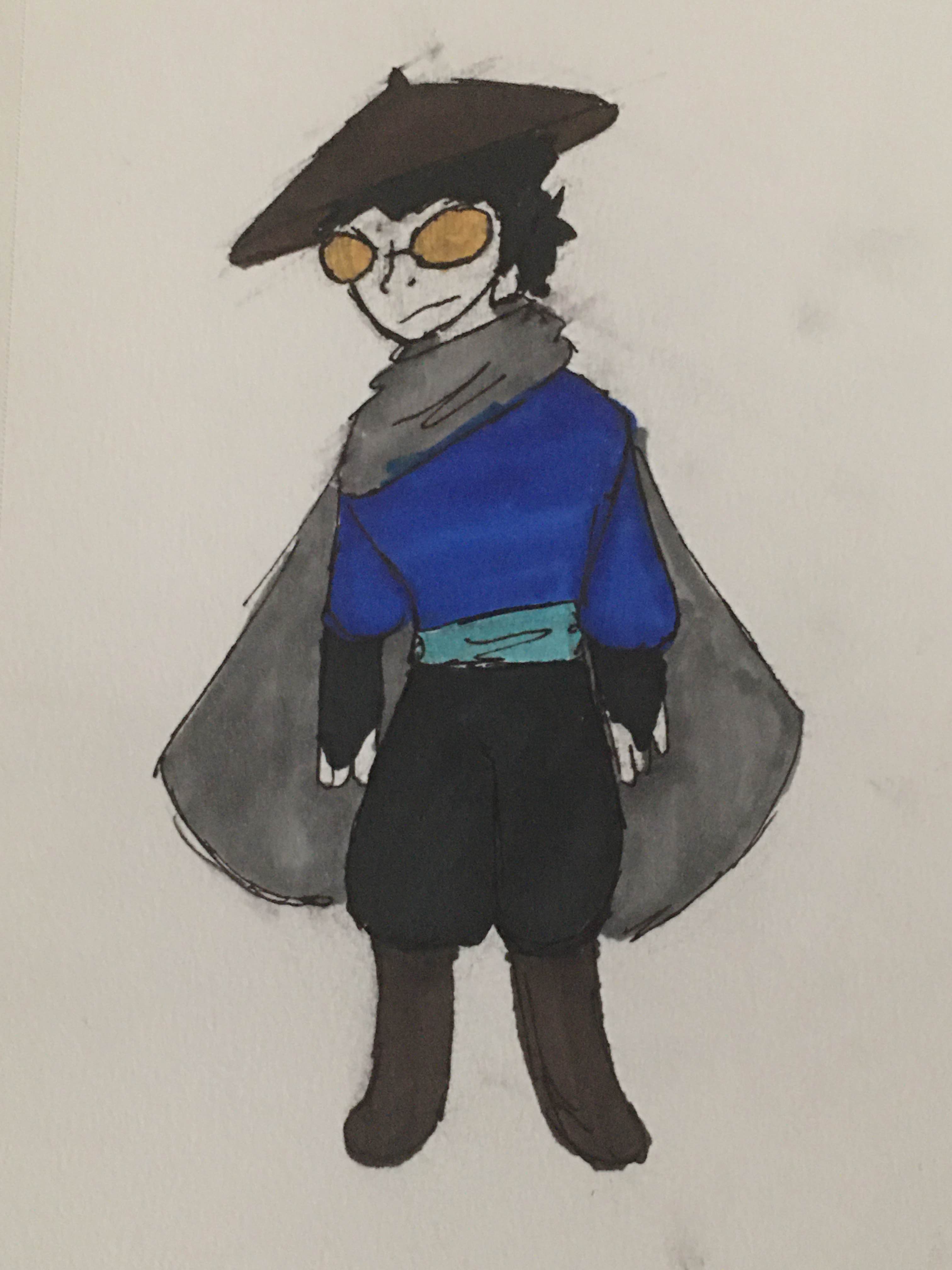
I was extremely enamored by the puppets used in the Kabuki Theatre video we watched for class. I’ve been a theatre kid for a very long time, and I had never seen this type of theater before, and it just really stood out to me. The style of the puppets used and the way the puppeteers used them stuck in my mind and that’s why I decided to draw Mizu as one of the Japanese theater puppets. I thought that it would be very interesting to see the Blue Eye Samari story on the stage with puppets. While looking at the puppets on the Japan Objects by Larsen B for references the seventh image really stood out to me and I used that as my main reference when drawing I also studied the puppets used in the YouTube video by UNESCO. It was actually pretty hard to replicate the style of the puppets for me due to my art style being so distinct. I also noticed that the puppets used in the theater have very distinct builds, especially the shoulders being very broad and the waists being very small, and I learned that’s because the puppets are mostly just a head, feet, and hands while under their clothes is just some wire. I used both the Fandom Wiki page as well as the Bitran page for references for Mizu.
Works Cited
Bitran, T. (2023, December 5). Edo Period Japan: When is “Blue Eye Samurai” Set? Netflix Tudum. https://www.netflix.com/tudum/features/edo-period-japan-guide-blue-eye-samurai
Larsen, B. (2021, June 11). What is Bunraku? How to Enjoy Japanese Puppet Theater. Japan Objects. https://japanobjects.com/features/bunraku
UNESCO. (2009, September 28). Kabuki Theatre [Video]. YouTube. https://www.youtube.com/watch?v=67-bgSFJiKc
Wiki, C. T. B. E. S. (n.d.). Mizu. Blue Eye Samurai Wiki. https://blue-eye-samurai.fandom.com/wiki/Mizu

 Sprockets and Springes