by Ryleigh Simmons
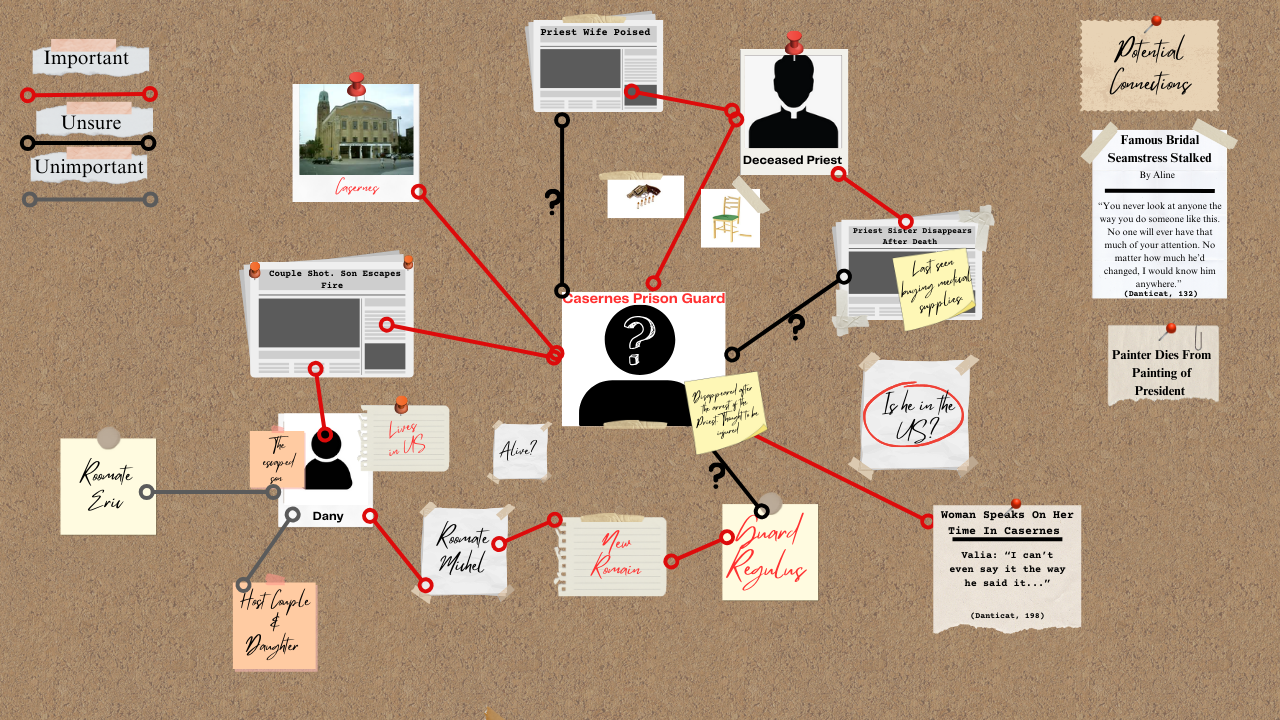
Link to the murder board if you want to see it bigger.
Before reading my response, I would like to clarify that when I refer to Ka’s father during the time he was a Macoute, I will refer to him as either the fat man or the guard. Similarly, when I am discussing him in the future, he will be referred to as Ka’s father or the father.
For my project, I chose to focus on The Dew Breaker by Edwige Danticat. At first, I had no idea what I wanted to do, but I did know I was interested in our conversation about the namelessness of Ka’s father throughout the entire book.
From there, I looked a little bit into what namelessness does for a story, and I found this really interesting quote, “The nameless characters have revealed a deeper level to the story and left the mind imagining what could be the motives and purposes of these nameless characters. All the while, John (the named characters) remains the focus (AuthorAppleton).” I thought this to be really interesting because, to me, this is saying that a nameless character makes us think deeper. It is a character that causes the reader to think even when they are not the main character. It’s as if this character is stuck in your mind as you read the entire story about other people because you are trying to figure out this one person.
I thought this to be precisely what Danticat was trying to do. By leaving the father nameless, the victims of the fat man are kept in the spotlight. However, this nameless figure is stuck in the back of your mind as you read because you are trying to figure out where he fits in. Furthermore, as Veronika stated in her padlet post, “It definitely makes him feel more complex, and honestly, it made me feel like I didn’t really know him, just like Ka doesn’t,” his namelessness makes him this complex mystery. Thus, my interest was sparked, and I knew I wanted to make a project that tried to combine the pieces of the father’s life to sort out who he is, who he was, and what he did.
Therefore, I decided to create a murder or crime board through the perspective of an investigator trying to put together a case on the guard’s crimes and figure out where he went. I originally got this idea from a previous student’s project. In their project, they made charts connecting each story’s characters in The Dew Breaker (tmacnh). I really liked this idea, but I wanted to focus specifically on the father. Thus, I decided to create a crime board centered around the Haitian prison guard because it would help me figure out who he affected and how his character was portrayed throughout the text.
To create this board, I went through the text and found direct character connections to the fat man. These connections are shown through the red lines directly stemming from the prison guard’s picture in the middle of the board. For example, the Priest, Dany’s parents, and the woman, Valia, who speaks on her tourer on page 198, are directly involved with the fat man.
The next thing I did was find second connections, characters that are connected to the fat man’s direct connections. The second connections include the Priest’s wife, the Priest’s sister Anne, and Dany. If those connections died suspiciously or disappear, they are marked as having a potential but unproven connection to the fat man with a black line and question mark. I did this because a detective would most likely find it strange the Priest’s wife died unexpectedly a short time before the Priest was killed and that the Priest’s sister disappeared around the same time the guard did.
Finally, I included everyone who lives with Dany because he almost has a direct connection with the guard. However, it is likely a detective would find these connections unimportant, so they were marked with a grey line.
The other notable addition I made was the potential connection section. Here, I placed the red herrings or the stories that reference prison guards, but we, as readers, are unsure if they are the fat man or another guard. These additions include articles on the bridal seamstress’s stalker who tortured her and the painter’s wife who left Haiti because her husband was shot for painting an unflattering picture of the president. I thought these were important to add because they showed how Danticat is purposely trying to make her readers think of connections between each story, even where there are none, which connects to my idea above that we are constantly trying to figure out the father, as he is always in the back of our mind.
I believe my project is important for many different reasons. The first reason is that it shows how the fat man and Ka’s father are completely different people. Readers are told that the prison guard is Ka’s father. Either characters outright tell us the things the man has done to them, or Ka’s father tells us himself. Sure, there are a few stories that don’t tell us exactly who their abuser was, but most of them do call out Ka’s father. However, if we were looking at this from the perspective of an outsider in the book, someone who has not been directly affected by the fat man, we are likely never to make the connection between Ka’s father and the fat man. This is exactly what I wanted my board to portray. Here, we see that the guard is the center of the board; however, he is technically on there twice. When looking at Dany’s connections, the fake detective might make note that Dany is staying with a host couple, but there is nothing important to note as they seem to be merely a barber and hairdresser. They aren’t important. Thus, I wanted to bring to your attention how, because of the namelessness, it seems like Danticat almost writes the two characters as completely different people.
Also, my project simply shows how most of the stories are connected by the acts of one person. On the board, we can physically see the lives the guard has affected and how those people have affected others. It shows the impact this man had on so many lives. For example, I chose to include the statement from Valia in my board because it really displays the trauma this man was causing these people. She even states, “She could never get him out of her head (198),” which shows the lasting damage this man has done. Overall, it gives the reader a better understanding of what Ka’s father did by setting it up in a simple format.
Works Cited
AuthorAppleton. “How Nameless Characters Enhance Story.” Author Appleton, 18 Jan. 2016, authorappleton.com/how-nameless-characters-enhance-story-writing/. Accessed 12 Oct. 2024.
C, Veronika. Why Do We Never Get Ka’s Dad’s Name? 3 Oct. 2024. https://padlet.com/nicholashelms1/the-dew-breaker-day-4-bd8w0oigsjsz37wa
tmacnh. “A Visual of Character Relations in Danticat’s ‘the Dew Breaker.’” Sprockets and Springes, 23 Oct. 2023, nrhelms.org/2023/10/23/a-visual-of-character-relations-in-danticats-the-dew-breaker/. Accessed 12 Oct. 2024.

 Sprockets and Springes