
Reflection: Why does your response to this literature matter?
For my unessay project, I wanted to do something that involved mixed media/painting. I thought that this would be a welcome change from the traditional essay that I had written earlier in the semester, and also give me some more opportunity to play around with the modernism found in the second half of this class’s works.
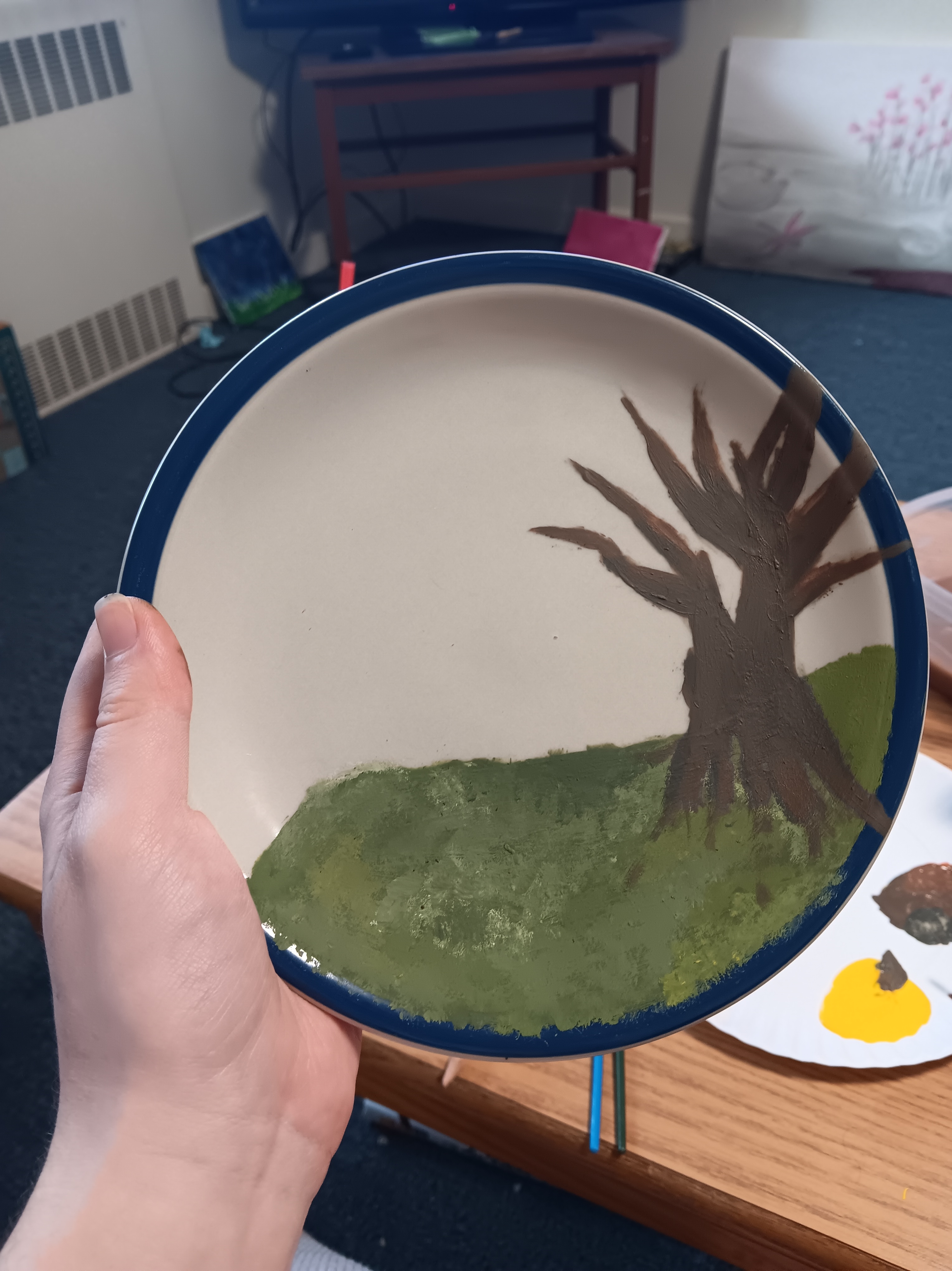
I decided to focus on the split chestnut tree in Jane Eyre for my plate paintings. I wanted to do this because I felt as though we didn’t talk a lot about the chestnut tree and particularly the really unique ecocriticism that is being made by Brontë that can also be viewed through the lens of female Gothicism and disability theory. I was eerily reminded of Janie from Their Eyes Were Watching God when reading the tree metaphors throughout Jane Eyre, though both have their unique differences which are probably borne from individual sociocultural perspectives (Charlotte Brontëas a White British author and Zora Neale Hurston as a Black American author).
I was inspired by Jane’s description of the chestnut tree on the morning of her wedding; she describes, “Next winter’s tempests would be sure to fell one or both to earth: as yet, however, they might be said to form one tree–a ruin, but an entire ruin” (Brontë, Chapter 25). During the night, the chestnut tree had been split by lightning. Brontë quickly draws this into an extended metaphor for Jane and Mr. Rochester’s relationship and future marriage. The tree becoming ‘disabled’ by lightning mirrors Mr. Rochester’s fate, brought on by the fire that rages through Thornfield Hall. One half of the relationship (Mr. Rochester in this case) has ‘fallen’ to the earth and they are ‘ruined’ in a traditional social sense. Jane and Mr. Rochester are able to reconcile their differences, however, and end the narrative as “an entire ruin” in the sense that they end up together. This creates an ecocriticism of social standards by tying the tree into a metaphor for human relationships. Brontë particularly challenges the abled, higher-class standards found in British literature and in England.
There are many literary criticisms online that talk about the ways in which ecogothic violence, disability, and nature create powerful ecocriticism that I attempted to capture in the plate paintings I completed. One critique theorizes that the fire/lightning in Jane Eyre is used in such a way that the environment creates plot elements that push forward subliminal ideas on identities like disability. In this paper, Bergan writes, “Because the environment is often portrayed as neutral and the focus in fiction remains on human experiences, ecogothic violence has the potential to act alongside marginalized figures in ways that appear accidental or objective” (Bergan 7). I found this to be very persuasive when it came to both my paintings and my viewing of Jane Eyre as a whole. To what extent did outside forces affect the characters of Jane and Mr. Rochester without them even knowing? How does the uncontrollable nature of environmental forces influence people without them so much as knowing? I believe this is a new perspective that Jane Eyre gives birth to when one can step back and look at the narrative from this sort of ecocritical lens.
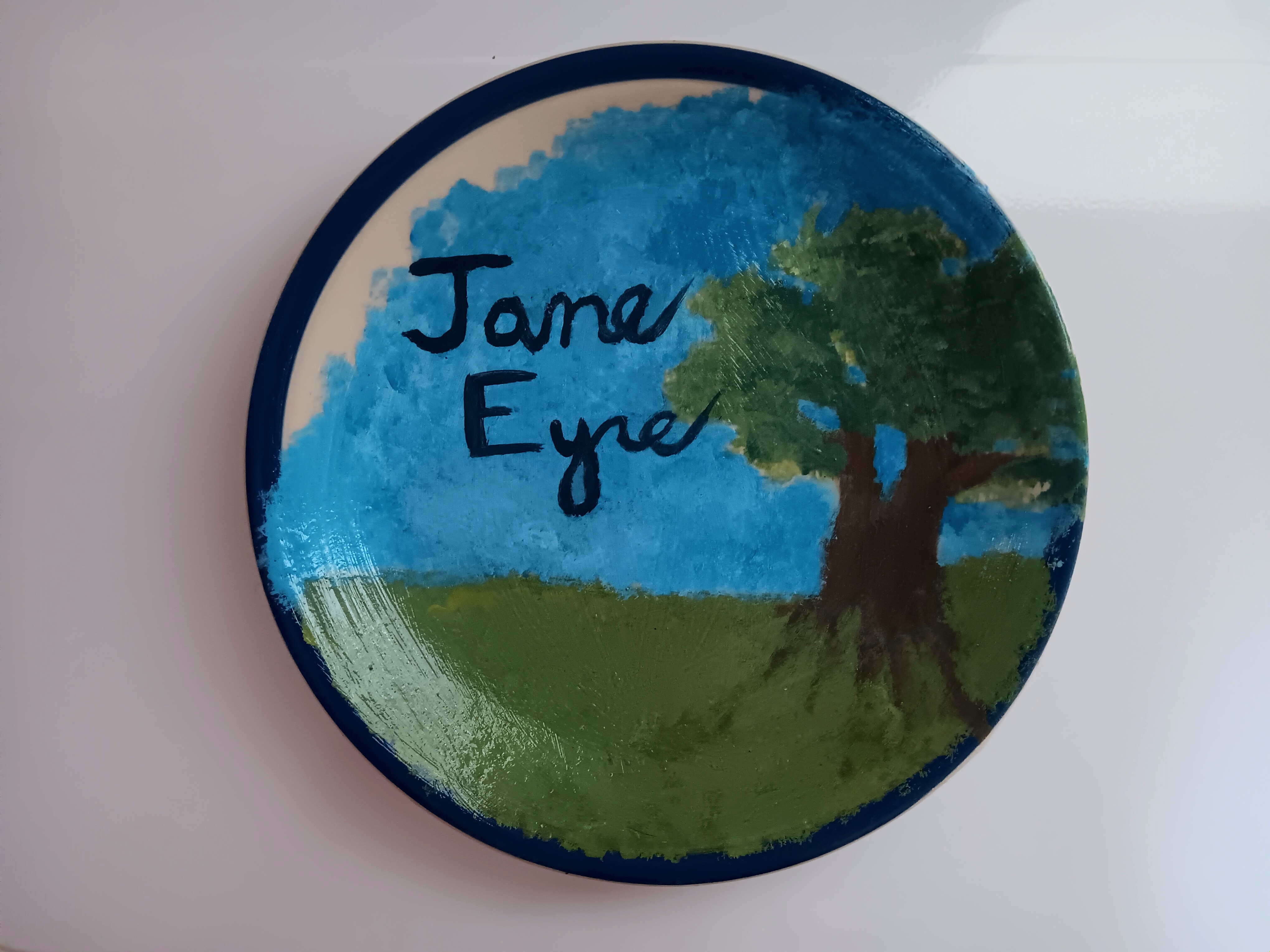
I decided that I was going to paint two plates. The first one is a general overview of the tree when it has been untouched and undamaged by the separate, withstanding force of lightning. I saw this as more of a ‘novel-cover’-like image, so I also chose to include the title on this plate.
In addition to this, I painted a second plate. This one was—from what I imagined to be—the perspective of the tree, because I believe this to be a more notable ecocritical point of view. This also perpetuates the violence in the lightning piercing the tree in half, in the same way that Jane and Mr. Rochester are cleaved in two for some time. I attempted to mirror a heart in the center of the formation of the tree, along with including a small quote at the bottom.
Having the environment mirror the mental state of given characters or foreshadow the end of the story isn’t anything new, and it certainly wasn’t new at the time Jane Eyre was written. However, I found the possibility for a deeper ecological criticism to be really interesting; this is just generally one of my favorite, contemporary lenses through which one can view older works, and seeing that it overlaps with disability studies fascinated me. The challenge of conveying my thoughts through painting was an enjoyable one!
Works Cited
Srivastava, Aparna. “Jane Eyre as a Female Gothic Novel.” Inquiries Journal, 2021, http://www.inquiriesjournal.com/articles/885/jane-eyre-as-a-female-gothic-novel.
Bergan, Mckenzie, ““Can You Tell When There Is A Good Fire?”: Haunting And Ecogothic Violence In Jane Eyre, Great Expectations, And The Moonstone” (2021). Graduate College Dissertations and Theses. 1390. https://scholarworks.uvm.edu/graddis/1390
Brontë, Charlotte. Jane Eyre. 1864.
Literary Devices: Chestnut Tree Symbolism. breatheyre.blogspot.com/p/literary-devices-thornf.html.

 Sprockets and Springes