By: G. James Farmer
PTSD or Post Traumatic Stress Disorder is an issue that affects our society. As defined by the NIMH, or the National Institute of Mental Health, “Post-traumatic stress disorder (PTSD) is a disorder that develops in some people who have experienced a shocking, scary, or dangerous event.” In the realm of storytelling, there’s quite a few to choose from, and I’ll be talking about Floch Forster from the popular TV series, ‘Attack on Titan.’
After being the sole survivor of a suicide charge against Zeke Yeager who is one of the villains, Floch wanders around the field to see if anyone else is still alive, and the only one he could find was Commander Erwin Smith, who is one of the top men in the military, and the one who ordered the charge. Floch had resentment towards Erwin for getting all of his friends and comrades killed, and permanently traumatizing him, but he had to put those feelings aside, as though all but those two died, the plan worked, as Zeke was defeated.
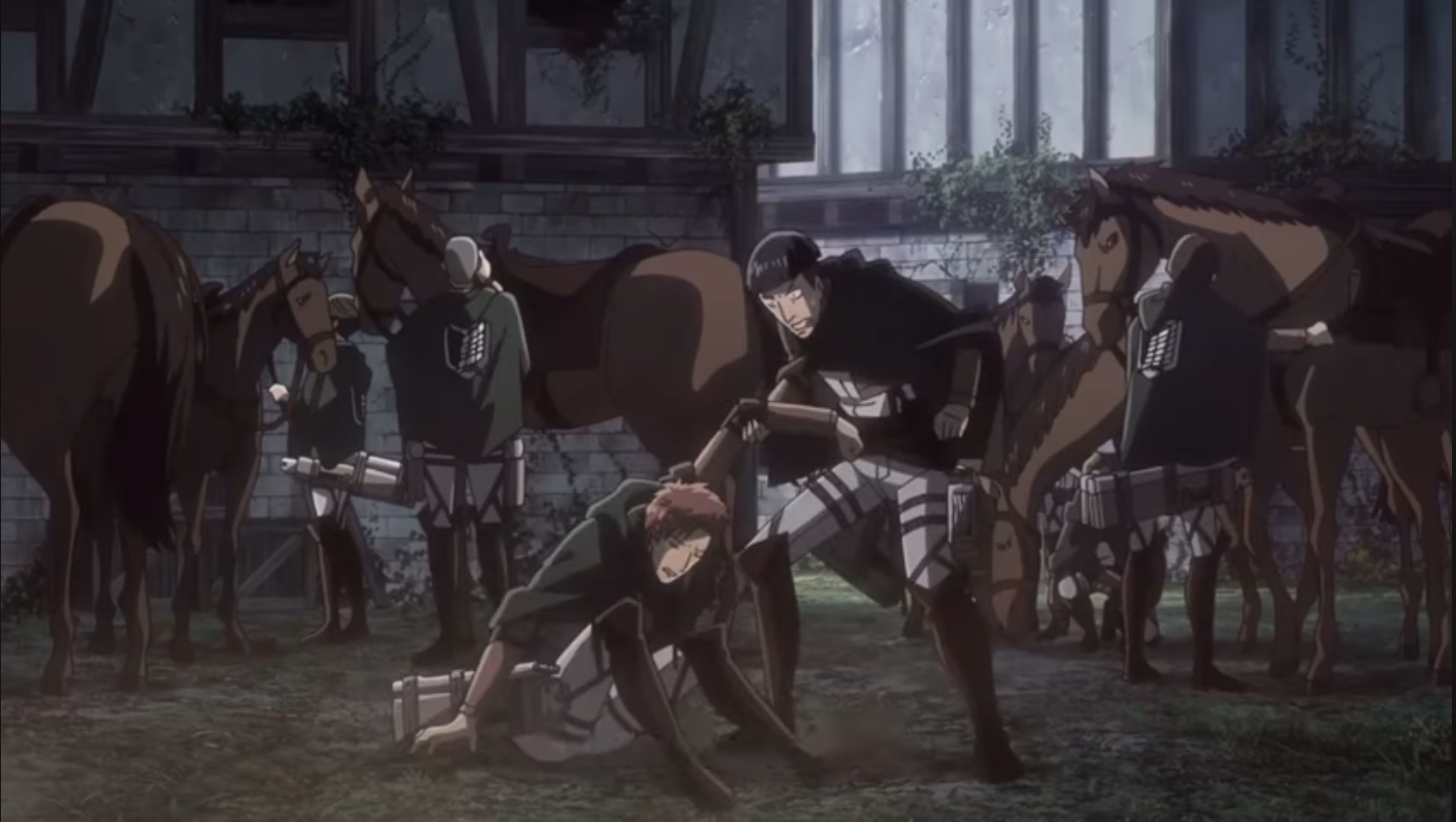
(From ‘Attack on Titan’ Season 3, episode 16, ‘Perfect Game’) Floch is traumatized, and Marlowe chastises him for letting some horses get away.
Floch carried Erwin on his back, and came to Captain Levi Ackerman, who is a top man in the Survey Corps branch, and has a serum that can save Erwin, and give him the powers of a Titan they captured, and they have one, being Bertholdt Hoover, who is the most powerful of the Titans. However, it appears that the serum will be given to Armin Arlert, a young boy who devised a plan to defeat Bertholdt at the cost of his life, and it worked. Armin’s friends Eren Yeager and Mikasa Ackerman try to convince Levi to save Armin, but Floch who is still traumatized, gives his opinion, which is that only a devil like Erwin has what it takes to defeat the Titans. Unfortunately for Floch, Levi saves Armin, and he takes Bertholdt’s life and power. It is this that turns Floch from a normal soldier who cowered in certain danger, to a cold individual who didn’t care for anyone’s feelings. This comes to fruition at a funeral for their fallen comrades, where his PTSD kicks in. One of the soldiers who died in the charge was Marlowe Frudenberg, and a girl in the military who liked him named Hitch Dreyse appears, and Floch tells her that though Marlowe was brave, he and everyone else who died regretted joining the Survey Corps, which Floch knows too well, because he gave a short speech about it before the charge, and even Marlowe agreed with him. After Jean Kirstein chastises him for being too harsh, Floch snaps, and is more stern than ever, where he has nothing but contempt for the main characters, telling Eren and Mikasa that their emotions clouded their judgment on whether to save Erwin or Armin, as they weren’t the only ones who suffered in the battle, as all of Floch’s friends are dead. As for Jean and Connie Springer, he says that they did nothing to help Erwin be revived. He finishes his speech telling them they have to tell the new recruits the truth so cowards like him won’t join.

(From ‘Attack on Titan’ Season 3, episode 22, ‘The Other Side of the Wall’) Floch chastises Eren and his friends for making an emotional decision rather than a logical one.
Despite Floch’s words, he stays in the Survey Corps, and with the others, he voyages to the ocean one year after the battle, knowing that the Marleyians, the people who tortured them (the Eldians) with Titans over the last 100+ years live on the other side of the sea.

(From ‘Attack on Titan’ Season 4, episode 23, ‘Sunset’) Floch intimidating the Marleyians into serving Eldia forever after the Rumbling started.
Over two years after finding the sea, Eren takes advantage of the fact that Floch has PTSD, and tells him his plan to save the Eldians, which is to help him get into contact with Zeke, and start the Rumbling, which will kill everyone who doesn’t live in their home of Paradis. Floch is surprised to hear that come out of Eren, but he agrees to the plan. Nine months later, Floch and the Eldian military take part in the Battle of Liberio, which is a major area in Marley where their enemies live. Floch has no regard for those who aren’t like him, as he blows up houses where people live, because they were responsible for everything he and his friends went through four years ago, and disregards Jean’s words of not killing as many people as possible. This shows how Floch’s PTSD went from at worst, hurting people’s feelings, to massacring people who had little to nothing to do with the suffering he and his people went through. Much later, he meets Zeke face to face for the first time since the suicide charge. Floch of course still hates him, but he knows the plan to save his people is too important to risk for petty revenge, so he helps Zeke get into contact with Eren, starting the Rumbling. After Eren and his army of Titans leave Paradis to kill everyone, Floch takes over Paradis as a Military dictator, and gives the non-Eldians who served them as POWs for years a choice. Submit to Eldia, or die. When Jean questions Floch’s cruelty, Floch tells everyone that he knew about Eren’s plan all along, and now that the plan succeeded, the non-Eldians’ homelands will be destroyed forever. A Marleyian cursed Floch out, so Floch repeatedly shot him in the head. Jean who never liked the idea of killing humans is traumatized, and Floch trying to comfort him tells him that he has no need to fight anymore, and live the peaceful life they all dreamed of in military training. Floch is of course trying the peaceful method of recruiting a veteran to his side, but his PTSD kicks in slightly, as he’s happy that their descendants won’t go through what they did, and don’t have to live in a world where everyone hates them, and wants them exterminated.
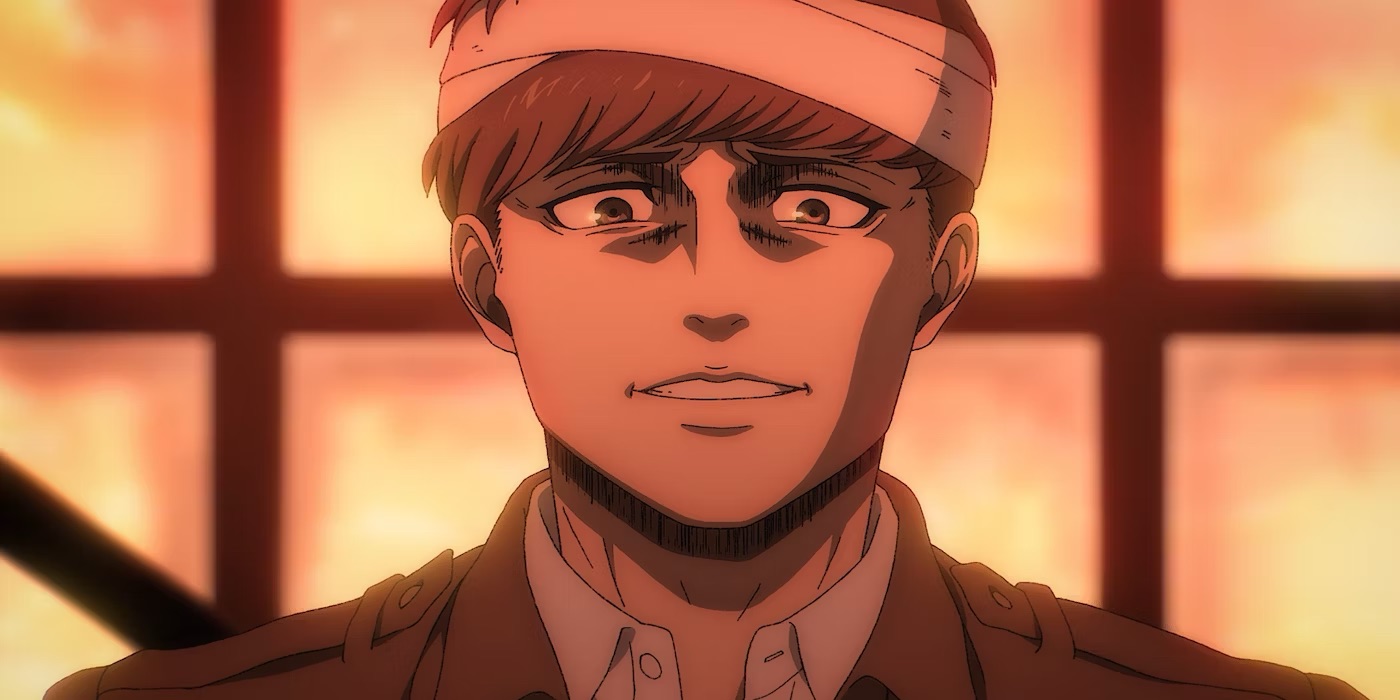
(From ‘Attack on Titan’ Season 4, episode 23, ‘Sunset’) Floch smiling at Jean and Mikasa, telling them that they don’t need to fight anymore, and they’ll finally be free from Marley’s persecution.

(From ‘Attack on Titan’ Season 4, episode 27, ‘Retrospective’) Floch remembering Erwin’s last words as he prepares to charge his enemies and former comrades.
Then, we get into Floch’s last battle. After the Rumbling started, Eren’s friends Mikasa, Armin, Connie, and Jean teamed up with Commander Hange Zoë and Levi with surviving Marleyian warriors to kill Eren, and stop the Rumbling. Once Floch finds this out, he orders their deaths. Unfortunately for Floch, his recruits are no match for them, as they die left and right thanks to five of the enemies having Titan powers, along with another having superman abilities. Suddenly, the PTSD kicks in again. Floch is going through the exact same situation he was in four years ago, all of his friends and comrades dying in front of him, but with him being the leader, and instead of against a known enemy, it’s against people Floch called comrades just before he discovered their betrayal. It is in Floch’s last action he remembers what Erwin told him before he died. “My soldiers rage, my soldiers scream, my soldiers fight!” Floch did all of that, and he was just about to destroy the boat that would have been used to go to the mainland, and get to Eren, but just before he could fire the missile, he gets shot in the arm, and falls into the ocean. Once the main characters reach the mainland, they are about to take off in the plane the boat had to reach Eren, but to their shock, Floch is still alive, and he shoots his gun all over the place, until Mikasa stabs him in the throat, killing him. In Floch’s last words, he cries to Hange and Jean telling them that if Eren dies, everyone on Paradis will be killed, saying what he said about Erwin, that their devil is their only hope of survival.
Just from season 3, we can see how Floch’s PTSD changed him. When we first see him, he seems like a normal teenager who happily joins the military out of patriotism. However, he learns the harsh truth of war the hard way, and after seeing everyone he cared about die in an instant, he puts a lot of pressure on himself to give their deaths meaning. Both from his pleas to have Erwin saved, and his harsh words to the main characters, Floch is a victim of the effects of PTSD has on war veterans, and he only continues to stay so he won’t let his friends die in vain. Floch’s PTSD develops into something more dangerous four years later, as he shows no mercy towards the Marleyians, as he believes every last one is responsible for what happened to him, his friends, comrades, and ascendants for the last 100 years, so he endorses global genocide against everyone outside of Paradis, but even starts threatening to kill people who merely disagree with he and Eren’s methods of saving their people. Before the Rumbling started, Floch knew of poisoned wine that was spread throughout the military, but he let it happen, as they were a threat to Eren’s goals.
I’m not the only one that thinks this, as in 2022, Eve Ergler of Penn State University wrote an analysis of Floch, and also said he has PTSD. She says stuff similar to me, but also adds this bit of information.
“Floch is against the plan (the suicide charge against Zeke) but has no choice in the matter since everyone would share the same fate regardless of if they participated or not. Fans tend to forget that Floch is only 15 years old when this event occurs, so of course he wouldn’t want to participate in this suicide mission. The mission ends ironically with Floch being the only surviving recruit outside of the walls, which leaves him with survivor’s guilt and PTSD that develops his character later in season 4.”
To end things on this, Floch Forster has one of the worst cases of PTSD. Just one tragic event changed the course of his life which made him into a cold man who wants to save his people by any means necessary, and if it means non-Eldian extermination, or even the deaths of fellow Eldians who are in the way of the cause, then so be it.
Though almost never as bad as Floch’s, PTSD in the real-life military has existed for a long time, but was very well documented in veterans who served in the Vietnam War, as well as other major wars the United States took part in such as Afghanistan and Iraq. According to the U.S. Department of Veterans Affairs, PTSD in veterans has gotten much worse over the years, going from 3% of WWII veterans reporting they had PTSD sometime in their life, to 29% of Iraq war veterans saying the same. According to that same report, cases may be underreported due to the veterans dying before they could say they had PTSD.
Most of the time, PTSD in veterans starts from a scary or tragic event, whether it be stuff that happened to you, or what you did to the enemy. As for Vietnam, the army spent a lot of time in the jungle, getting gunned down by the Viet Cong, and sometimes, massacring a village. On the other hand, if captured, their experience can be similar to what happened to the character John Rambo from ‘First Blood.’ It’s a sad thing to see, and the panic attacks they get sometimes are a sign that it may never go away.
So in conclusion, it’s a problem that affects society, and it also influences storytelling, whether it be Rambo, Floch, or a bunch of other cases on the matter.
Links:
“Post-Traumatic Stress Disorder.” National Institute of Mental Health, U.S. Department of Health and Human Services, http://www.nimh.nih.gov/health/topics/post-traumatic-stress-disorder-ptsd. Accessed 18 Apr. 2024.
Ergler, Eve. “The Excellence of a Well Written Character.” Penn State Altoona Collegiate Review, 29 Apr. 2022, sites.psu.edu/altoonacollegiatereview/2022/04/29/the-excellence-of-a-well-written-character-floch-forster-analysis/.
“Va.Gov: Veterans Affairs.” How Common Is PTSD in Veterans?, 24 July 2018, http://www.ptsd.va.gov/understand/common/common_veterans.asp.

 Sprockets and Springes