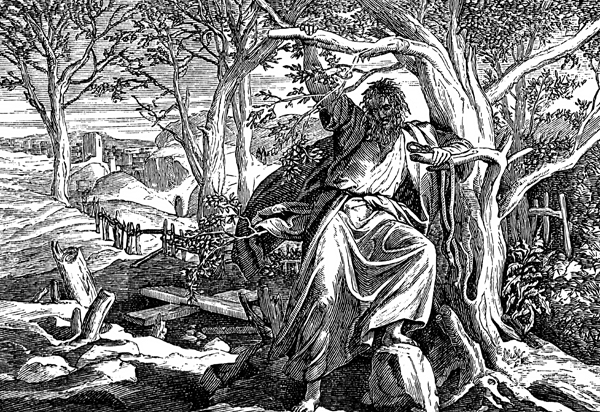
Judas’ story ends in him hanging himself. His deviation from God, betraying Jesus left him empty, but did he choose this path?
After selling out Jesus with the fateful “kiss,” Judas tries to repent. Though, the betrayal of Jesus ends in the suicide of Judas; due to his overwhelming guilt. Judas’ story is often the staple of betrayal; regularly preached as he was overtaken by sin, but also that Jesus knew very well of Judas’ fate as a consequence.
“Judas was so totally trapped in the darkness and corruption of sin that he became a willing instrument of Satan.” – Grace To You
“Jesus knew that Judas would betray Him. And yet He chose Judas as a disciple and kept him near. The Bible doesn’t say why, other than Jesus knew that God had a plan.” – Compelling Truth
“… any objective look at the evidence sees Jesus as knowing He was going to be betrayed, specifically predicting who the offender would be, and pronouncing doom upon His evil betrayer.” – BlueLetterBible.org
With Jesus knowing of Judas’ actions that would lead to his crucifiction, it seems fitting that it was all apart of a greater plan. However, if Jesus knew all along, does that mean Judas lacked free will or that God had a predetermined path for all?
A Simulation
Free will is entirely more debatable each day as artificial intelligence and technology continues to develop faster and faster. Living in a simulation as far as we know, is entirely possible. Many scientist have been asked to weight their opinions on the subject; and in an interview with Neil deGrasse Tyson, Larry King asked Tyson to speak on the question: “Are we living in a simulation?” Like the rest of us, Tyson doesn’t have the answer and probably never will, but says, “I find it hard to argue against that possibility.”
So, free will is questionable even when taken out of a biblical or fictional sense. It is the idea that we chose to get out of bed each day, chose what we’d wear, who we’d talk to, and so on.
The interview ends by King asking, “So what difference does it make if I’m programed by someone? Cause I don’t know it.” Which is valid. Not knowing of some hypothetical creator and programed fate leaves us with as much free will as we’ve always had; but if someone had the power to choose our path, such as a higher power, does that make us creatures of free will?
And if we don’t have free will, what happens then when we try to create it?
Modern Day Fiction’s Free Will Variables
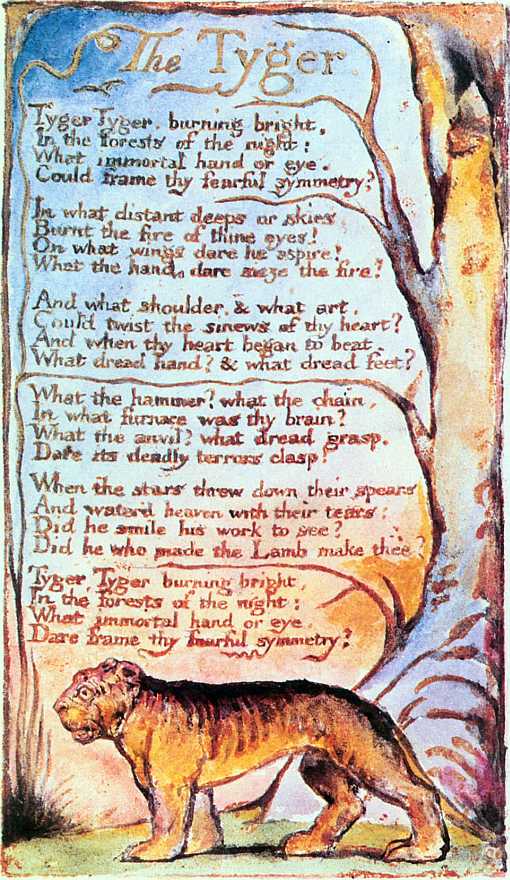
There are many stories that consider the idea that there is either a lack of free will or a “higher power” in place. Take for example, Mary Shelley’s Frankenstein (1818) vs. The Tyger by William Blake:
Frankenstein follows Victor Frankenstein’s creation of his monster – a being that is powerful, more powerful than man. It is considered an abomination and it’s strength makes it a freak of nature. After the completion of the monster, Victor recognizes his lack of strength and health, “I had worked hard for nearly two years, for the sole purpose of infusing life into an inanimate body. For this I had deprived myself of rest and health.” (Shelley) His declining health differs a lot from an “all powerful” creator, he’s weak and believes his efforts have only created a monster. One that no God would have made.
The idea of what God creates and what Victor learned to create is referenced throughout Frankenstein by Mary Shelley bouncing back and forth between the use of the term creature and monster. Where creatures are the individuals Victor praises, often gentle or well created people, and monster being used as a description of Frankenstein’s creation. Victor as well as others who learn of its existence refer to it the same, a wretched creation. A monster.
Contrasting Victor’s creation, The Tyger by William Blake, describes the beauty and power that is the tiger. It’s is described as forged,
“What the hammer? what the chain,
In what furnace was thy brain?
What the anvil? what dread grasp.
Dare its deadly terrors clasp?”
– From “The Tyger” by William Blake
Created by one daring to “seize the fire,” the tiger would have been considered a creature (by the overall description of the tiger in the poem) to Victor – even though there’s imagery of a crafted creature, like Frankenstein’s monster. So, this creation by presumably God, is one that only could be perfected by the right hands. Victor’s monster vs. the tiger is the free will vs. the higher power. When learning of his ability to create life, Victor is unable to perfect it. Considering that christianity surrounds this story – in terms of constant references to the monster as being the devil and wretched – it begs the question: would the concept of religion and the concept of a simulation tie together?
Judas and Victor’s Predetermined Fate
“My mind is in the darkness now, my God i am sick, ive been used and you knew all the time God! I’ll never ever know, why you chose me, your crime, your foul bloody crime!”
– “Judas Death,” from Andrew Lloyd Webber’s Jesus Christ Superstar.
Judas’ life ends in torment, questioning why he was “chosen” for such sinful choices, he thought were his own. Though, it could be argued Judas chose to sell out Jesus on his own free will, and what knowledge Jesus had was simply knowledge and not power to choose Judas’ actions. Which would mean Jesus didn’t want to interfere with a predetermined outcome, or that God told him not to. Though, in the musical Jesus seems angry at his inevitable crucifiction and eggs Judas on:
[JESUS]
“One of you here dining, one of my twelve chosen
Will leave to betray me –[JUDAS]
Cut out the dramatics! You know very well who –[JESUS]
Why don’t you go do it?[JUDAS]
You want me to do it?[JESUS]
– From “The Last Supper,” Jesus Christ Superstar
Hurry, they’re waiting”
Victor on the other hand, desired to learn more of the secrets of life by creating it himself. His failed creation he sees a sin, he seeks to destroy. Though, his creation seeks to do the same to him, two damned beings until one could emerge on top; but in the end neither does. Victor dies due to his desire to destroy the monster, and falls ill. His creation stands over his body in the end and admits he’ll live out for a short time before submitting to death. Victor if he’d prevailed would’ve been left with a wasteland – a dead family, wife and friend. By the theme of Christianity in the book, his creation was a sin, and he was predetermined to suffer for his action. Yet, Judas suffered the wrath of God – his free will stolen before he knew; and Victor was limited in free will because of the theorized repercussions of creating life.
Though through the eye of the creators of Frankenstein (Mary Shelley) and the Musical, (Andrew Lloyd Webber) there could be a different perspective that’s important. Victor Frankenstein a man written by Shelley, a woman in 1818, could have been influenced by real world monstrosities. Victor’s view of those around him, especially his cousin Elizabeth, is “malleable.”
“Her figure was light and airy; and, though capable of enduring great fatigue, she appeared the most fragile creature in the world. While I admired her understanding and fancy, I loved to tend on her, as I should on a favourite animal; and I never saw so much grace both of person and mind united to so little pretension.”
– From Frankenstein, Mary Shelley
This description of Elizabeth that Victor uses is less than human. Though he believes her a special creature and says he loves her, he’s not describing someone of strength or similar stature to himself. A theory could be that Mary Shelley is Victor’s “higher power” in this novel; with her ability to limit Victor’s free will. His views of Elizabeth, relate to the nineteenth century’s misogyny towards woman in real life, and a statement of men’s actions could have been being toyed with by Shelley.
Which would explain a certain lack of action by Victor in the novel. His embarrassment of creating a monster let a young woman named Justine die in the first volume of the novel. Not confessing about his creation or speaking up against her execution.
Judas in Jesus Christ Superstar on the other hand is written as a more redeeming and just character. Webber chose not to interfere with the story of the betrayal, but instead to tell it from Judas’ point of view; understanding his actions by his reasoning. Judas’ first line in the musical is “My mind is clearer now,” it is a subtle homage to his predetermined fate. The idea that Judas was used to betray Jesus and would be punished for it.
All I ask is that you listen to me.
And remember, I’ve been your right hand man all along.”
The very beginning of the musical is a call to Jesus by Judas, to change the path that Judas can see is risking all of their lives, “and they’ll crush us if we go too far. If they go too far. Listen, Jesus, to the warning I give. Please remember that I want us to live.” (Webber)
Free will is questionable for Judas and Victor. They seemed unliked by the powers that loomed over them, and needed to achieve a greater goal. Whether it be to show the power of Christ or the misogyny of man, they lacked an ability to act against redeeming themselves as they believed they could have. If they were just characters set up by looming Gods, what can we take away?
Creation
Both Judas and Victor wanted to create life that was better, and improve life for the betterment of those around them. Judas worried about the fate of the apostles and the circle that followed Jesus. He knew that there was poor and those who needed saving. Those who needed more than their group had. Victor wanted to craft life that brought out new secrets like the mad scientists in fiction who want to do something radical, that could be risky, but change mankind for the better. Judas and Victor though both failed in executing betterment. They fought against the sin they saw and drowned in it.
Creation is a biological goal, to carry on and protect your kind. Christianity however, in fiction and in a biblical sense, tells those not to “mess” with it. Judas was not meant to act against the will of God, Victor was not meant to create life in a new way, both were punished for it and the idea of free will in this sense is that: power is in place, to function like a simulation, with rules in place to keep mankind safe. Though, the simulation doesn’t allow for questioning it’s rules, or for criticism.
It is free will and it is creation, predetermined. Hand crafted to be perfection. Though, in the context of Judas’ fate and the story of Frankenstein you may wonder, “what immortal hand or eye, dare frame thy fearful symmetry?”
Cited:
“Did Judas Repent?” Grace to You, 24 Nov. 2023, http://www.gty.org/library/bibleqnas-library/QA0115/did-judas-repent.
“What Prompted Judas to Betray Jesus? How Did Judas’ Betrayal of Jesus Unfold?” CompellingTruth.Org, http://www.compellingtruth.org/Judas-betray-Jesus.html. Accessed 17 Mar. 2024.
Stewart, Don. “Did Jesus Know That Judas Would Actually Betray Him? By Don Stewart.” Blue Letter Bible, Blue Letter Bible, 9 June 2020, http://www.blueletterbible.org/Comm/stewart_don/faq/does-god-know-everything/34-did-jesus-know-he-would-be-betrayed.cfm.
Shelley, Mary Wollstonecraft. “Frankenstein; or, the Modern Prometheus.” Frankenstein or The Modern Prometheus, pressbooks.pub/frankenstein/. Accessed 17 Mar. 2024.
Blake, William. “The Tyger by William Blake.” Poetry Foundation, Poetry Foundation, http://www.poetryfoundation.org/poems/43687/the-tyger. Accessed 17 Mar. 2024.

 Sprockets and Springes