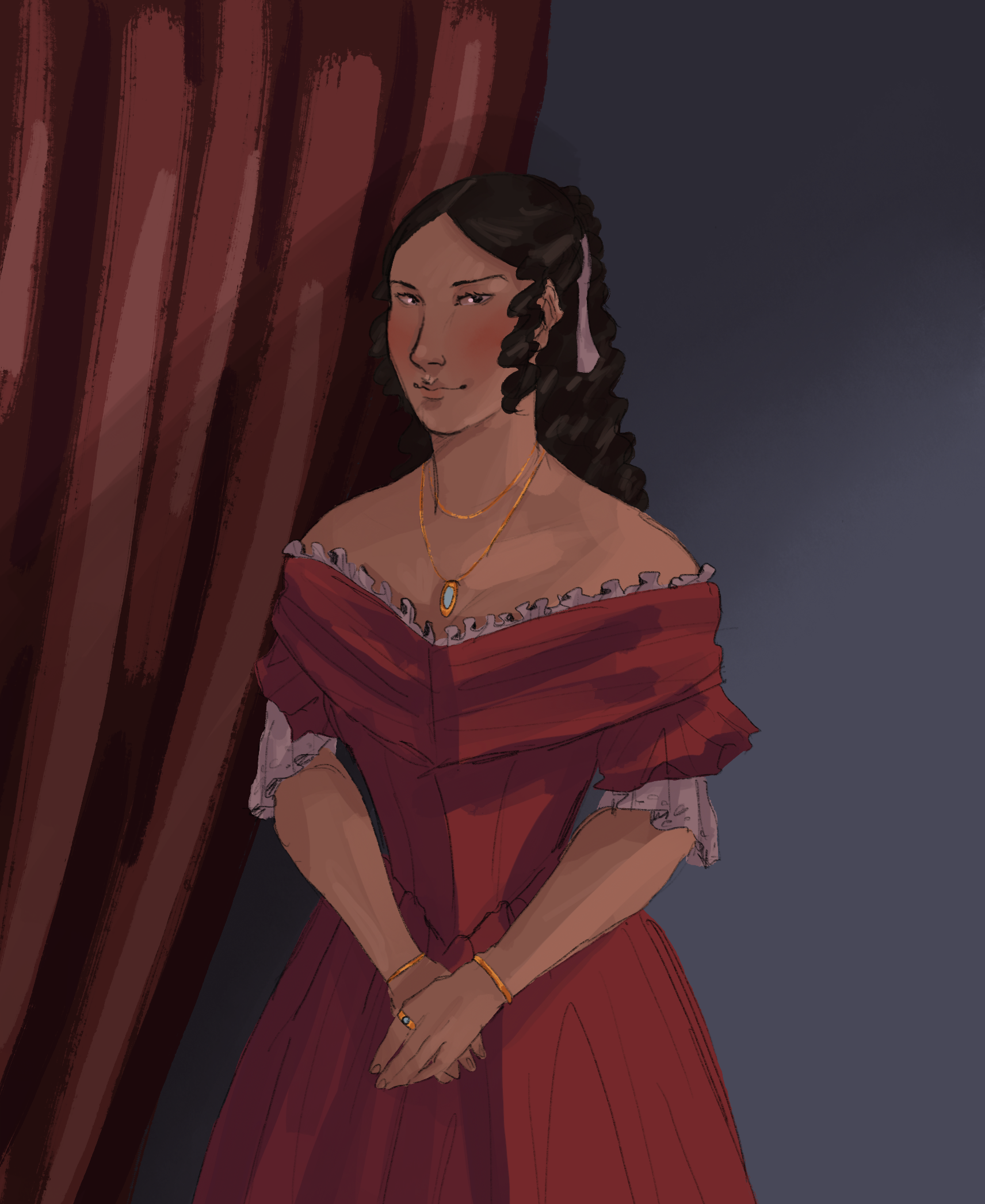
For my project, I wanted to draw Blanche Ingram in a way that was accurate to her book description. In class, we discussed how in every adaptation of Jane Eyre, Blanche is cast as a blond white woman. However, her physical description in the book differs greatly. I also thought it would be fun to take the same challenge Jane did of trying to draw her based on only a few descriptors alone, and get into Jane’s head. In a sense, I put myself in Jane’s shoes like when she was sketching Blanche. Except I added more color, detail and a background, just for fun.
First, I focused on Blanche’s “silhouette”, or vague physical features. Jane describes Blanche as having a “Grecian neck” with sloped shoulders (Brontë 187). For inspiration, I looked at Greek statues of women to determine what Blanche’s physical features should be. I referred to this website. I observed that female Greek statues have soft and round shoulders, with a long neck and round jawline. This matches with Jane’s description of Blanche having “soft” features. I also found that the drawings of Victorian women on Byron’s Muse Blog had similar features to the Greek statues and what Jane was describing. From these sources, I felt I had a better visual understanding of how to execute Blanche’s appearance.
Some of Blanche’s physical features were fairly easy to imagine and did not require lots of imagination. The most difficult part was her skin tone, which is described as being “as dark as a Spaniard” (Brontë 201). I felt like this alone was a can of worms relating to colorism and racism. I pictured this to mean any skin tone slightly more tan or darker than the classic porcelain white. I presumed if Blanche was very dark, she probably would not have had the wealth and status she did at this time in England. The lighting in my drawing makes it a little harder to tell, but I opted for a mid-tone. For Blanche’s eyes, they are described as “oriental” and “dark”, so I just made them black.
For Blanche’s hair and dress, I had to do a little more research. All we get is a “gold bracelet and diamond ring” (Brontë 187). I looked into what wealthy Victorian women might have worn, and read an article about European, Victorian dresses. It described small waists with intricate dresses and a pronounced bust. I particularly liked the painting on this page, Louise d’Orleans, Queen of the Belgians. While it depicts a French lady, I figured England and France were not too geographically separated and could influence one another. I felt the dress in the painting reflected Blanche’s class. For her “raven ringlets”, I used that same article to see the tight ringlets represented. I personally knew I would struggle to draw them accurately, so I opted for less detailed ringlets.
I also came to this depiction based on what Jane said Blanche was not. Jane describes herself as looking the opposite, and I assumed Jane to look like Charlotte Brontë since the novel is based on her life. Therefore, I looked at a portrait of the Brontë sisters to get a better picture. They had modest dresses on and pale skin, so I made sure my drawing of Blanche had the opposite. I gave Blanche slightly softer features than those I observed. However, I opted for similarly pink cheeks, because I thought it was cute.
An accurate interpretation of Blanche is important because every adaptation in contemporary society portrays her as blond and white. This shows how society today views sophisticated and rich people as primarily white and blond. It reinforces a white-centric view of the world and a particular beauty standard. While we cannot say definitively what ethnicity Blanche was, there is evidence to suggest she was not white. It is as if to say that anything not like white features are not something to be envious of, as Jane was in the novel.
Furthermore, art can provide a way for readers to visualize a character. It may be hard for people today to imagine clothes or hairstyles of the 1850s. Even physical descriptors represent something about a character, and it shows us what was valued and considered beautiful and proper during that time. It adds a layer of understanding and fun experience for a reader. Ultimately, I get more out of this than anyone, since this exercise required close reading on my part.

 Sprockets and Springes