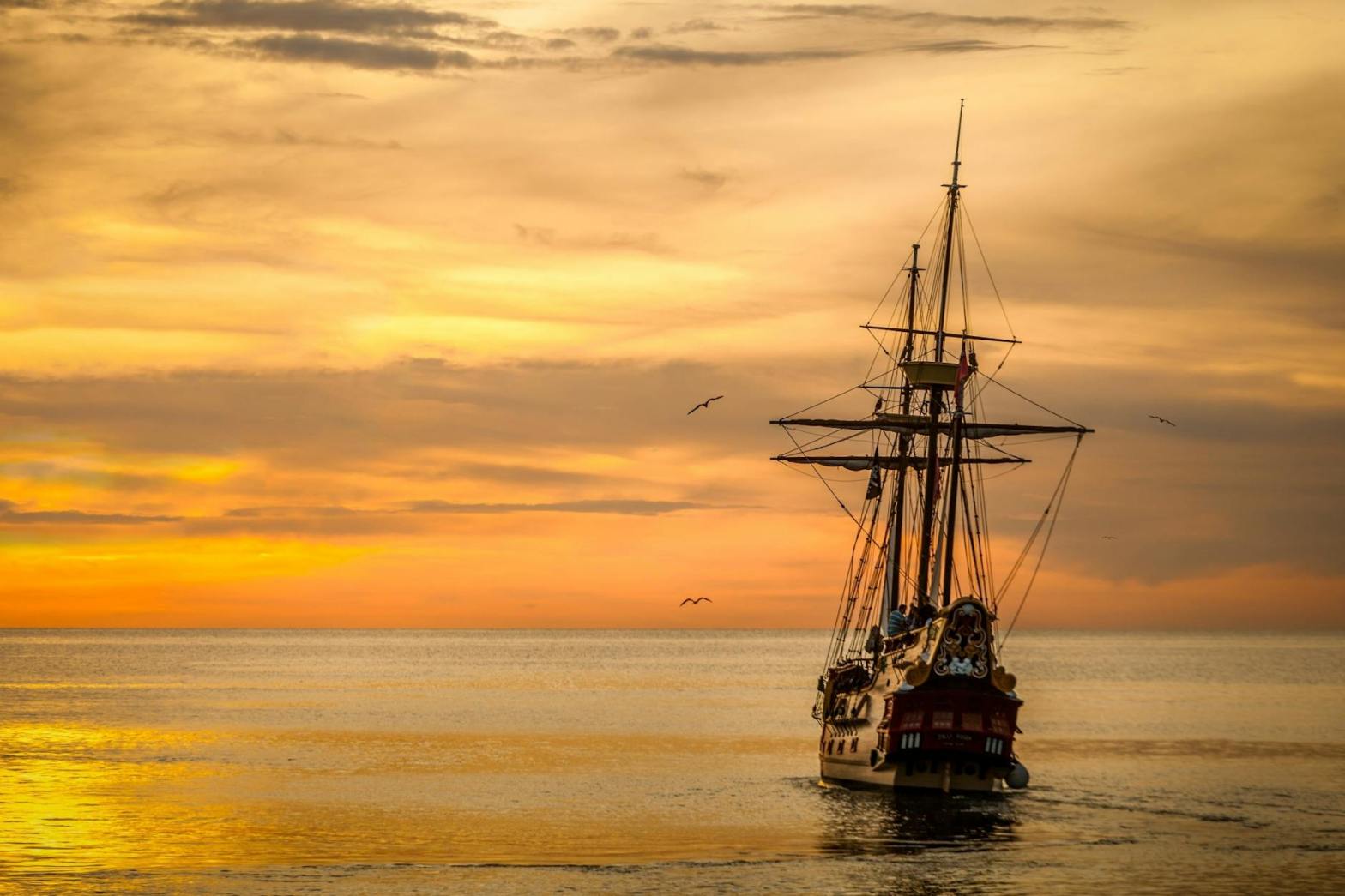
Was a story most could recite
in Darborough town, off Cornwall’s coast—
a ghost tale told, every Halo’Eve.
It went like this, by most:
T’was a perilous, storm wrecked night.
The black wind howled like a strangled cat;
wave crests reared in violent armies;
the deviled rain ran grim and fat.
The men knew of no way to lose
the treacherous leeward shore. The galloping sea
had driven them in, and in. The squall
snatched storm sails from their clews clean,
and ravished the mizzen from yards and stays,
with a crack like a crocodile masticating
bones. Cacophonous currents whipped and wrestled,
in such havoc the poor rudder was taken!
This sea filled the ship’s well so steeply,
no ‘mount of pumping, no ‘mount of pails
tossed, would’ve set the machinery to rights…
The ludicrous waves popped all her nails.
The flashing jaws of the shredded shore
were finally sighted. The sea dragged ‘em nearer,
closer onto the cackling rocks:
the breakers’ booms crashed severer.
The crew succumbed to madness,
as sailors do, when faced with fate.
They scattered like rats, eyes crossed with panic,
feet slapping on the swollen wood—each faster than their mates.
Some went up the rigging–were plucked off by wind,
tossed far into a green and broiling hell.
Some jammed their best on, silks and long coats,
ribbons all skewed, as they rampaged on to where the liquor did dwell…
They killed the shaking guards with fisticuffs and marlinspikes.
They hauled flasks and chugged bottle tops, drooling.
Then the great crack of ship bone came grinding on sharp rock,
All began halloo-ing, singing, their slow death unspooling…
But the Captain was quiet, as belowdeck as he could be.
He put belongings in a flour bag, hoping with all might
the fate due to his crew, would himself so pass by!
Yet it seemed impossible the Captain would attain such respite.
The great Marianne was raked, and raked again.
By hand of criminal rocks the hull buckled;
she broached too with a scream,
down on her side like a war horse trapped shackled.
The carnivorous waves leapt with ghoulish whoops
and shark-ish teeth to tear her more,
and feast upon her famished form.
The men alas were scattered, and lifeless one and all…
They bobbed like corks in senseless migration,
away from the wreckage, as the sea traveled faster
under their folded legs. Their bodies with rum were bloated;
and with salt water wings, their spirits fled mortal masters.
In the wee dawn, the ivory sky hung
like a blood-drained skin. Guilty, gossamer wind
lay low on the bruised ocean,
daring not to disturb yesternight’s sins.
The blanched water was caught in bloodied nets;
splinters, ship ribs, split-ed backstays;
broken knives of black bottle glass. All who passed by
crossed their chests and went quick away.
But come the eve, darkness filled
the rugged coast, and depressed the gaping sky.
The moon opened her livid light upon the coast,
and set to the rocks white fire.
So it then happened that a strangeness came about,
to anyone who misfortune lead
to tread that wreckéd coast
past the hour of bedtime said.
I heard the tale of this strangeness
at Changeling’s Pub in the dim.
A fisherman told it in solemn whispers,
and for an hour I was captured, listening to him.
“You know the tale of poor Marianne?”
I muttered I did, with uneasy laughter
He nodded all grim, and then said,
“But I bet you don’t know… ‘bout what happened after.”
I went cold as the grave,
drank no more from my pint,
just nodded him on
with a low, growing fright.
“I was a travelin’ late along the shore,”
the fisherman growled. “Full moon was nigh,
and the wind raised her voice in the sand.
But the deep sea lay still, un-mixed by her sighs.
The tide was out as far as God could throw it,
and un-fingered dunes stood rigid, withheld.
Clumps of weed lay dark amongst the milky shells;
I thought—what feasts the birds twill have, come hence the mornings’ bells!
As I walked, the sound of my feet
and the passing of my breath were sole companions.
Soon in far water, though, I saw the nightly peace was stirred:
splashes so sharp, and crests so high, the ocean raised battalions!
I began to pace a little faster.
Then without warning, a howling wail
spiraled from the sandy dales. It froze my blood, it quit my heart,
I fell unto my knees and prayed
The wail repeated, the waves smashed fiercer,
oh how I did shake! My bones rattled
like glass marbles in a jar. I strained to make out
by the water’s low and seething edge—what battled?
What pitiful creature had I been assailed?
The white moon lightened her torch of white,
For seconds my gaping eyes were blinded,
but then from the shadows uprose a devilish sight:
a woman in fishing nets and a wet cork hat;
two arms writhing, two brows one glare;
long, dripping fingers spread high and
her beady crown gushing with the blackest of hair.
Her red sea glass eyes rolled and sparked: ‘beware!’
She screamed in that inhuman peal.
‘Beware by the edge of the full moon’s water.
Beware of my cursed waters a graspin’ at yer keel!’
She rang her hands with the strength of a killer,
shrieked: ‘thou shalt become great Satan’s slaughter!’
In such a raging passion. As she loomed larger
on the distant edge, she appeared to crafted of water.
Weeping tears of terror, I sprung up from my stupor,
and tore off down the shore as fast as I could…
Never again did I walk after dark
Incase the water witch again yonder stood!”
The fisherman then lowered his voice.
eyes burning bright and serious.
“You see the sinner was the sea:
a dangerous witch, I ain’t delirious.
She dragged Marianne under
and raised a storm,
she shred their ship, killed all crew.
Sinners must pay, they must reform!
They must forever be inflicted to God-given penance
by telling their tale in shame
warning the sailors of their evil ways
forever ’til God lifts blame…
So if ye wicked deed did do,
collapse on both knees,
pray for redemption,
make loud your pleas.”
For weeks did I think on this tale
and resolution came, one dreary night
that I myself should see
if the fisherman’s tale was right.
Black rain and thin winds
followed me down to the shore.
The tide was out, far as the tiny moon.
It was there that I waited, many hours ‘fore dawn.
Soon a strange stirring was heard in the waves;
I shook off my weariness, put one hand to my ear—
straining my sight in the dim for her shape…
and yes, soon enough, did the wailing come clear.
It curdled my blood,
that ear splitting sound.
T’was the yawp of daemons!
Cruel and profound.
I stumbled to my knees,
both hands clasped near
to my heart as I prayed
with all might, that witch’d not appear.
Yet the wailing grew louder and fiercer,
and through the noise words formed from the cries:
“I am Amaryllis, Goddess of the Old Sea.
For the love of all truth, open yer eyes!”
I did as I was told, but not because I wished,
and before yonder sand
where the shallows crept nigh—
I let free a wild whoop—a figure did stand!
“Hold still, little man,”
a marvelous voice did speak.
“Meet my eye and listen close,
if it is the truth ye seek.”
So I trembled and I waited,
fearfully in awe. Her back bore fins
for wings; oiled hair in different lengths;
old trousers patched with serpents’ skin…
Her crown was made of clicking bones and—
“I once ruled the sea,” said she,
in that rumbling, deep sea voice.
“Then lost it to great Poseidon, he,
after a gruesome battle lasting thrice your years,
banished my powers from this watery world
and cursed me to the edges of his kingdom,
where I was to watch his ships to this shore he gently hurled.
Ships full of stolen gold and greedy men;
ships he daren’t let his great sea ruin;
ships of loot and slaves;
ships carrying conquerers and crew in.
Yet before the sea was so ruled,
no ships of such intent were let to pass.
The oceans’ roads were peaceful,
the good sailors only, allowed to trespass.
So now in my tiny prison at the ebbing tide,
the only power I can claim,
is the wrecking of the ships Poseidon keeps safe
across seas I can’t reach: ships for bad deeds are to blame.
This way do I punish him
and make consequence for his curse.”
“Then why?” I cried, “do people tell such stories—
nothing of what you spoke, quite the hellish reverse!”
“My wails chill their mortal bones, but
when I spoke with dignity they scoffed. They dislike my tale
they blame all on me, they whisper of madness.
Yet the day I rise, and my power prevails,
they’ll no longer have to watch me work
myself like a servant each day
to combat Poseidon’s gross powers.
I’ll be gone, the fears they had will be nay.”
So I remembered the great Goddess’s story,
and returned home unsettled inside,
thinking to myself
all the ways the fisherman had lied.
My poem opens with the telling of a well known tale, and then we get two very different stories regarding the aftermath of said tale, in order to explore what narratives we believe depending on who gets to tell them; ideas of what we decide is human or not and why; and a critique of the misogyny that was just normal during the 1800-1900s (as we see in Aude Fauvel’s article on sexism in psychiatry at that time—which tells us a lot about how women, their emotions, and minds were treated by the general society, for it to trickle down into the unethical pathologizing of women by male psychiatrists).
I was particularly inspired by Shelley’s Frankenstein, and the intersection of narratives in that story, and the conflict and moral questioning that brings up for the characters. The last section of my poem where we meet goddess Amaryllis and hear of god Poseidon, was referencing the romantic era poets influence and fascination with Greek mythology. Yet instead of the tale being hero focused, we hear the tale of a defeated goddess who is working daily—more like a peasant than a queen—to revenge the god who unrightfully stole her throne. The writing style of my poem is heavily influenced by Coleridge’s “Rime of the Ancient Mariner”, and has the abcb rhyming style common in many ballads. I kept the word choice fairly contemporary, though I do have references to that 18th century – 19th century poet voice, yet also emphasizing my own voice/style in it because I wanted show my 2024 perspective on these classic themes of ghosts, repentance, tall tales, and seeking truth.
“The Haunt of the Marianne” begins with the apparently well known local story of Marianne, a ship, being destroyed and sunk off the coast local to where my main character resides. Then, through a telling from an old fisherman, we discover that not only was it a normal shipwreck, but that the sea is a criminal and sinner, and appears in female form as a terrifying ghost, doomed because of her sin of ruining ships, to continue to torment passerby’s with wails of repentance and warning. These superstitions the fisherman spouts as if they are the god-given truth, were strongly informed by my reading of R. Bruce Macdonald’s book, Never Say P*g, a collection of Euro-centric superstitions sailors (through the medieval times to now) have sworn by. Superstitious beliefs that are rampant with the degradation of women, saying women are witches, bringers of bad luck, conjurers of storms, et cetera.
My main character hears this story, and nearly believes it, because it is very convincing, but something about it doesn’t feel right. He eventually decides to go out to the beach at night to see if the tale is true. He hears the ghostly cries, but instead of a wild sea-woman ghost, he encounters a wise goddess Amaryllis, who tells him the true story of what happened after the ship wreck. The goddess once ruled the sea, but then Poseidon stole it from her and utilized the great ocean for colonization and conquest. Ever since her peaceful, equitable rule was usurped, Amaryllis takes rightful revenge to wreck as many ships as she can to punish Poseidon, and undermine his capitalist motives. My main character (who never is named, intentionally, to pose him more in the position of a reader) asks why the goddess makes that terrible wailing sound,. She says because no one listened when she spoke quietly, “with dignity”. I also want to note that the pub in which my main character hears the fisherman’s tale, “Changelings Pub”, is called so, to foreshadow that the fisherman has taken Amaryllis’s story, and changed it for another.
This epic ballad was very important for me to write, mostly because throughout most of the texts we read in class I kept seeing the same story over and over: a being trapped in some living or ghostly purgatory-like state, with a motive to either avenge the sins of others or being forced to repent for their own sins. The moral of these many stories seemed to be, ‘sin is evil, and someway you’ll be forced to pay’—while not often critiquing and/or questioning these ideas of sin, of who gets to fully die, of what punishments people deserve, and who gets to punish. I endeavored to write a poem that initially followed one of these classic moral tales, but then would completely turn that familiar narrative on its head by the end, to help the reader question the way we so often we just believe what we hear the first time (like my main character), or what we hear all the time (as in fables that appear in some form over and over across a long time period and consequentially deeply inform the culture)… Yet so often there is another story, maybe a truer one.
As well as exploring the intersectionality of the different perceptions a single story can have, I show how these different narratives expose the inherent misogyny of the time, and what sort of stories were entertaining for readers (the judgment and shame goddess Amaryllis has suffered); and problematic religious ideas of the time (through the fisherman’s tale). I was interested in exploring how “sinners” in stories are dehumanized, and how a villain to one person, is not always seen as a villain to another. As well as that what we deem human or inhuman always comes from a very biased viewpoint, often instigated by a very privileged class of people, which is a subject D. Christopher Gabbard’s explores in his his article “Human”, which also informed my piece. In conclusion, “The Haunt of the Marianne”, uses a traditional ghost story in order to critique that same story.
Works Cited
Fauvel, Aude. “Crazy brains and the weaker sex: the British case (1860-1900).” OpenEdition Journals, 2013, journals.openedition.org/cliowgh/352.
Shelley, Mary. Frankenstein; Or, The Modern Prometheus. Lackington, Hughes, Harding, Mavor, & Jones, 1818, pressbooks.pub/frankenstein.
Su, Yujie. “Greek Mythology in 18th-to-19th English Romantic Poetry.” Open Access Library Journal, vol. 3, no. 8, Aug. 2016, http://www.scirp.org/journal/paperinformation?paperid=69757.
Coleridge, Samuel T. The Rime of the Ancient Mariner. J. & A. Arch, 1834, http://www.poetryfoundation.org/poems/43997/the-rime-of-the-ancient-mariner-text-of-1834.
Macdonald, R. Bruce. Never Say P*g. Habour Publishing, 2022, http://www.nauticalmind.com/118060/never-say-pg/.
Gabbard, D. Christopher. “Human.” Keywords for Disability Studies, 2015, drive.google.com/file/d/1i0ylv0K6m3Q_3CKFbkBHpaZFgwbu-3-N/view.

 Sprockets and Springes