The characterization of Ophelia, much less her ties to how society views grief in both a modern and in the context of a post-medieval era, is not often talked about outside of her impact on Hamlet’s character as his love interest for the duration of the play. During Act 3 Scene 1, briefly, after Hamlet’s famous “to be or not to be” speech where he debates killing Claudius, Ophelia arrives and, thanks to advice given from Polonius, denies Hamlet’s advances by returning the letters he sent to her. It is suspected that Hamlet knew that Claudius and Polonius were watching, and goes on a very sexist and hate-fueled tirade ending with stating that women are only good and pure if they are nuns, both unmarried and “pure.” Hamlet talks very similarly about his mother, Gertrude, often calling her a whore, and having the famous quote “frailty, thy name is women,” in Act 1 Scene 2, in his first soliloquy. This, along with plenty of other examples that mention women in the play from Hamlet’s point of view as whores, such as his mother, and pure and good, such as Ophelia. The way they portray women is a reflection of the view of general society at the time, and in part, points women’s emotions and actions solely to because they are women, and either blame it as fits of hysteria.
In the modern age, labeled as the period between 1500 and 1945, the time Hamlet was set, there are powerful and oppressing gender roles throughout society. According to Encyclopedia.com, because of the higher financial status upper-class women had, gender roles were stricter, as being able to provide for their family or growing enough crops wasn’t a burden to them. Upper-class girls were often forced to be virgins before marriage since around the 12th century and were married to older men, typically in their 20s or 30s while the girl was in her teens. Many crimes perpetrated on women by their spouses or other men were often used against them, such as spousal abuse, adultery, and even in cases of rape. The wives, often young themselves, then had the responsibility of keeping family life stable, even if that meant raising children from their husbands’ adulterous relationships (Women in the Renaissance and Reformation). Women who were able to break these norms, even if they were few and far between, had to do so under the constraints of the intense and sexist society they lived in. As outlined in Penny Richards and Jessica Munns’s “Gender, Power, and Privilege in Early Modern Europe: 1500-1700”, women had to perform to be heard and be “gendered, autonomous and unique” as emphasized in the book. Taking this historical context into how Ophelia was treated in the play makes it easier to contextualize both why she was treated by her brother, her father, and Hamlet in such a way, and why her breakdown at her father’s death was inevitable. In Act 1 Scene 3, where Laertes is leaving for France, he portrays his concern for her and Hamlet’s relationship:
“Or lose your heart, or your chaste treasure open
To his unmaster’d importunity.
Fear it, Ophelia, fear it, my dear sister,
And keep you in the rear of your affection,
Out of the shot and danger of desire.”
(Shakespeare, 1.3.17)
Laertes’s words, while he could be perceived as an older brother caring for his sister, have the same idea of purity that was common at the time. Laertes had her well-being at heart, but also the fact that she is “pure” and that her virginity is a treasure. With this knowledge, we can assume that Ophelia is younger than Hamlet, as in upper-class societies, she would’ve been married if she was also thirty. This, along with the context of the time of how women were treated and perceived in society, can give context to the root of Ophelia’s spiral.
Throughout the play, the audience sees Ophelia as a character that is constantly reacting and obeying other male figures around her, such as her father, brother, and her love interest. Hamlet, throughout the play, after discovering Claudius has murdered his father, has his mental turmoil shown to the audience from the way he interacts with the world around him, and throughout his multiple monologues throughout the play. We get a hint into Ophelia’s psyche twice, once during her rejection of Hamlet, and again after her father is killed by him. At the end of Ophelia’s confrontation with Hamlet after he leaves, she is distraught from his hurtful rant, stating:
“And I, of ladies most deject and wretched,
That suck’d the honey of his music vows,
Now see that noble and most sovereign reason,
Like sweet bells jangled, out of tune and harsh;
That unmatch’d form and feature of blown youth
Blasted with ecstasy.”
(Shakespeare 3.1.59)
This scene between Ophelia and Hamlet, while heavily debated if Hamlet truly intends to hurt her or just keep Claudius off of his trail, is less analyzed through the lens of Ophelia. Ophelia is courted by an assumed older man, the prince of Denmark whom she presumably fell in love with, who denies her after pursuing her for months and then kills her father, sending her spiraling. These depictions of Ophelia’s downfall are portrayed in a plethora of different ways throughout hundreds of years after the writing of Hamlet, in a variety of different iterations. An article by The Collector shows nine different iterations of Ophelia and her tragic death.

Most of these depictions from these nine different artists between the 18th through the 18th centuries depict Ophelia either in or around the brook she died in, showing her in both various stages of undress with an expression of melancholy. The deviant from this pattern however is Leonor Fini’s painting The Useless Dress, depicting Ophelia set ablaze in a burning dress, the phrase “useless dress” referencing both her dress that pulled her to her death in the brook and the potential wedding dress she could’ve worn if she lived to become a bride.
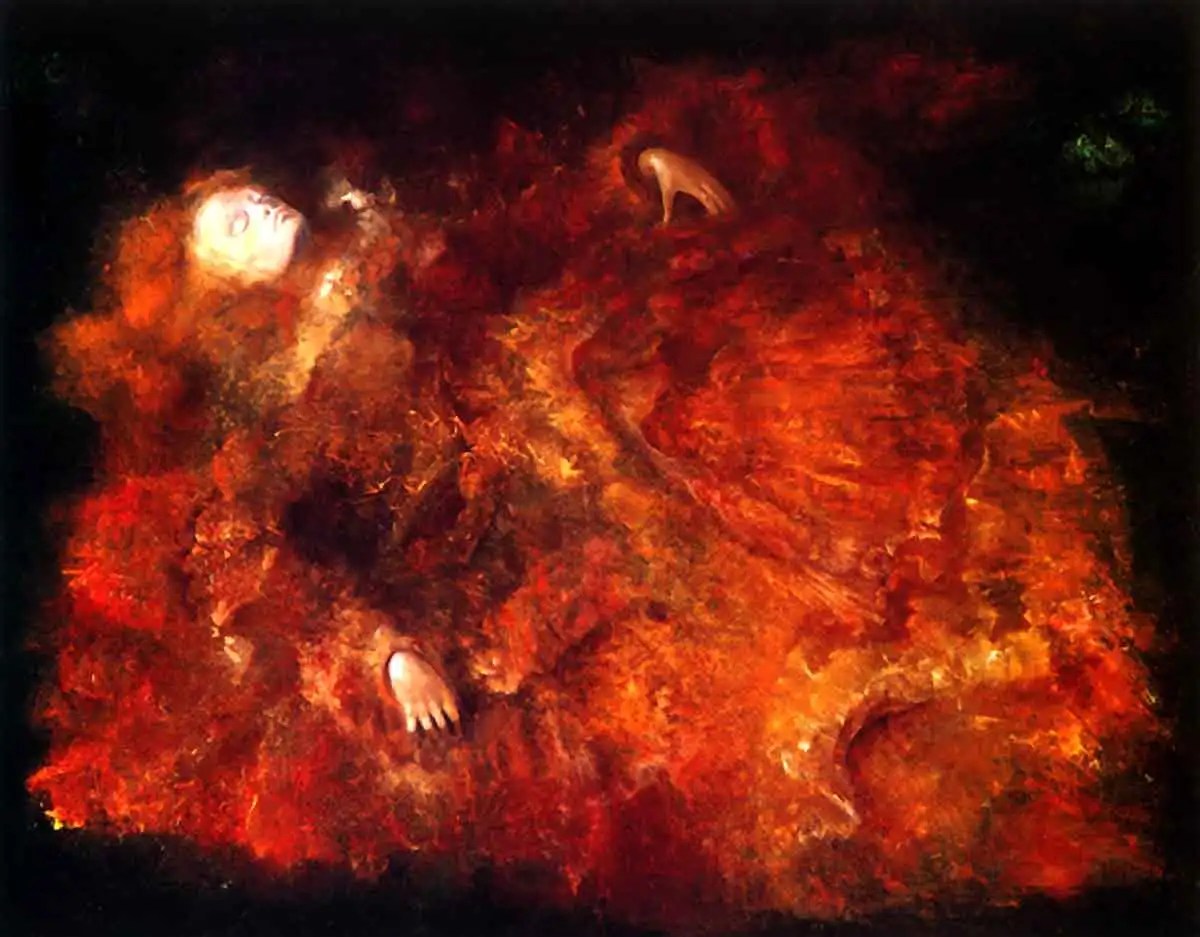
These multiple interpretations of Ophelia, from the eighteen lines Gertrude uses to describe her death, are as diverging as critical analysis of her character. A more Freudian approach is taken by Herman Rapaport, author of Between the Sign and the Gaze, interpreting Hamlet’s sexual desire for Ophelia as more of an Oedipus complex, connecting Hamlet’s dependency and frustration towards his mother and directing it to Ophelia, stating that Ophelia is both “a sexual object and a sexual demand”(Rapaport, 66). This interpretation, while understandable from the text of the play, and how Hamlet aimed his affection for Ophelia, has less reflection on Ophelia, and again uses her as a ploy for Hamlet, similar to the more exaggerated, sexual depictions of her through a more simplistic light.
Ophelia’s character can be viewed in light of the sexism of the modern age, with her as an upper-class woman having to fit into strict societal standards of how a woman of the time should act and behave. This, along with how men in the play treat her, such as her brother and father trying to protect her “purity” from Hamlet, Hamlet’s outright repugnance towards her and women in general in Act 3 of the play, and the death of her father at the hands of her former lover send her into a spiral, depicted by many artists as, while tragic, is and was romanticized heavily. This spiral into madness, hysteria, or any name critics have given to Ophelia’s demise, is a product of her environment, even if her death was suicide or simply an accident. Although Ophelia’s “insanity” is commonly used as a trope to depict madness, typically in women, in many forms of media, it should be seen as what it truly is, a young girl at the end of her rope, who devastatingly met an end by the hands of the men around her.
Works Cited
9 artistic representations of Shakespeare’s Ophelia. (2022, September 22). TheCollector. https://www.thecollector.com/shakespeares-ophelia-art/
Fini, Leonor. The Useless Dress. 1964. Weinstein Gallery https://www.weinstein.com/artists/31-leonor-fini/
Herman Rapaport. Between the Sign and the Gaze. Cornell University Press, 1994. EBSCOhost, search.ebscohost.com/login.aspx?direct=true&db=e000xna&AN=1837571&site=ehost-live.
Munns, J., & Richards, P. (2003). Gender, power, and privilege in early modern Europe (1. publ). Pearson Longman.
Shakespeare, William, 1564-1616 author. The Tragedy of Hamlet, Prince of Denmark. [London]: The Folio Society, 1954.
Steck, Albert Paul. Ophelia. 1865. Paris Musees, https://www.parismuseescollections.paris.fr/fr
Women in the Renaissance and Reformation | Encyclopedia. Com. (n.d.). Retrieved February 20, 2024, from https://www.encyclopedia.com/history/encyclopedias-almanacs-transcripts-and-maps/women-renaissance-and-reformation

 Sprockets and Springes