by Blake Carpenter
Part I – The Fallen have gathered in Pandemonium – a chaotic blend of muted fires and angelic ghouls orbiting the one and only, Satan (not to be mistaken for a twister of libidoless bears gyrating around a doll named “Nium”). The brightest and boldest demons express their grievances – amounting to modern niceties. Satan then notions, in order to “modernize” Hell, he must infect the New World with sin to expedite the future.
The Great Debate: where rifts dissect the flames
of whirling Ether, purely space. A gloom
so drained of hue that elder “lights”, in all
their dimly siphonic command, would jolt
a straight-edged rave – still dull, naturally,
but dimensions away from utter darkness.
The realm of Pandemonium had filled
its bowels of infinite bedrock
with courts dispersed through tentative voids.
These Fallen, coiled among the lightless fires,
had waned below the one amassing body.
His size was unfathomed, and wholly trivial.
But there he stood, and such he spoke,
“What fine enterprise have we here? To what
concerns my fellow Infernals?”
“Um…good Satan,” started Beelzebub,
the Lord of Flies, “Does thee seldom feel
a breeze in Hell? With all this darkened flame,
is it to be, or not to be well… fiery?”
Satan replied, “My dearest Ba’al, now what
would come of your closest critters? A blaze
that passes cinder pleases winged friends
to death. Is that a fate well desired?”
The Lord of Flies, begrudged by this foresight,
proposed a new request, “How else can Moloch
sigil their self in such a grim setting?”
Moloch, the Lord of Sacrifice and who
had just now swiveled interest from prodding
an outlying flame to and fro, drew back
his gauntlet dawning ink to the tune of:
“NO REGERTS” and, what can only be
a generous attempt at ringlet eyes.
“And ‘bout damned time we got some limper lace,”
added the Lewdest Lord, Belial.
Then raised a judge in pompous silver locks,
“Illumination guides us! Flashy garb
shall blind us! These affairs are evident.”
“AY!” declared most. His synapses refined,
Satan had seen an answer near divine:
the future, he pondered, where lamps – vivid
and stable – limely shine on trendy silk.
“I hear thy court,” Satan began, “and in
suffice I’ll aim to soften time – spill sands
and all that. The New World demands a yank.”
Part II – Satan polymorphs into various animals trying to seduce both Adam and Eve with concepts they don’t quite comprehend. It is when Eve is all alone and Satan (in the form of a snake) offers her an idea, independence, that causes her to eat the Perfect Slice of Pizza Pie in one gargantuan bite – committing the “Original Sin”.
Imagine, if you will, a boundless light
so rightly warm, fantastical vistas
of folding hills, lagoons beyond perception,
and unicorns descending from a good hover.
This – this is Paradise. A river bends
around the Tree of Life and Plenty Else.
Adam, a very naked man, lays down
to rest his bones along a bank – fatigue
is finite here in Paradise, so rest is… well,
for the Hell of it – so to speak. The Tree,
in all its cosmic colors, hung an apple –
a Red Delicious on the lowest branch,
aside a dragon egg with air-buoyant scales,
a clump of aethereal cordyceps,
the thinnest shard to parade ones and zeros,
and an endless drip of marble gold
from the Perfect Slice of Pizza Pie.
Satan was perched upon the Tree – and was
not like a bird, he was a bird: a proud
and spiteful cormorant. He spat whispers
to Adam, who had seldom raised an eye,
“Oh Agony, my second cousin once
removed from God’s arthritis! Does a soul
feel aching when he dislodges a bone –
and his own rib, no less?” Adam, a man
that wills himself, a man that simply does,
cannot fathom the plasma, nor the gore
of pain, started to snore – so loud in fact
that Satan reared his patience and took flight
along a pool of liquid lapis. Eve
was (somehow) cultivating cane around
the channel when the cocky cormorant
misjudged his landing and took a plunge.
The ripples settled on a frog attempting
to beach. He belched a soggy quill and hopped
among the stalks. Anomalous as this was, Eve
remained to farming pleasures – if doing does.
“Do you… often cut cane?” Satan said damply.
“At godset, every cycle” she replied without
a beat or frog to muse and lugged her load
on route to Adam. But what she had verged
to was an Adam-sized indent over
the shift in land. She nestled cane around
the groove but, like all ideas in Paradise,
had lost the novel figure of a “bed”
and leant against the Tree – to think
maybe, or what she thought was thought.
The Tree hissed; rather Satan, coiled frail
and snakley, hissed “Hello again…my ssweet!”
The slur pierced through Eve’s core and shot her up.
She hadn’t known, but that was fear. “The Tree
will let you feel, my dear. To rest along
their bark is just a launch of latent life.”
The head of Satan moved toward a malfunctioned Eve
proposing, “Cane is worth the work – but why
the work without a vision?” He then held
in tail the Perfect Slice of Pizza Pie
and nudged it near to her. “Eat this,
and dream your thoughts, employ your feelings.”
Eve saw the foreign food, had thought she thought,
had thought she thought again… and ate it whole.
Part III – Eve gains knowledge of past, present, and future, achieving Nirvana, but only for a moment. She begins to dwell on the love she has for Adam and, after some internal back-and-forth, decides to pick another Perfect Slice of Pizza Pie from the Tree of Life and Plenty Else and hands it to her 23-ribbed husband. Adam, only knowing “to do” things, does the polite thing of eating food that’s offered to him, but savors the slice rather than eating it whole. He, after gaining the ability to feel some, stops short of the stuffed garlic crust, and fails to acquire “empathy” in the process, explaining well… a lot…
Defining “Ecstasy” would undersell
the passion groping every nerve in Eve’s
recoiled spine, the ceaseless song her heart
impelled, and utter alinement in space-time.
It was a damn good slice, and Eve now knew.
She used her wisdom, thought of thinking,
and thought to hold this gift in guard,
to leave her husband’s baneful ignorance
intact. Then, like a two-ton wrecking Ba’al,
a feeling set in – love. A kind of love
that yields to none, a love that’s Adam-sized.
And thus, she saw the pie rebloom and took
a slice; with wisdom, she then trailed the path
Adam had left. She came to him, with pie
in hand. “Eat this – if you love me for sake
of what is true!” she said. “Of course, my Eve,”
proclaimed her husband, as he relished it slow
inching through decadent dairies, fine char
that cup Jurassic fats, a crimson ooze,
and oh… how strange? He stopped a unit short
of garlic ends swollen of sacred cheese
and where energies of empathy keep.
Adam, a nibbler, saw through Eve, or so
he thought, “I think I hate the smell of garlic.”
Then he began to explain like a man…
Author’s note/reflection:
What a dreadful joy this was to draft. John Milton’s Paradise Lost, for the unacquainted, is an epic poem – with over ten thousand lines of verse – that tells the “fall of man” genesis: Satan’s decent, Adam & Eve, “Original Sin” – that sort of thing. First published in 1667, Paradise Lost revolutionized non-thespian poetry in that it is unrhymed blank verse (unprecedented at the time) and poses satirized critics on monarchy, virtue, and most certainly Catholicism. The prose is masterfully archaic, even for the time – so much so that Milton was implored to add plot summaries before each book.
For the first project I crafted a poem in the style of Spencer’s The Faerie Queene, so naturally I gravitated to Paradise and its metric (iambic pentameter – the same as TFQ), regarding Project 2. I’m fairly new to writing satire, so P:2 seemed the perfect opportunity to exercise new brain wrinkles! One thousand two hundred plus words later and saying that my cortexes were thoroughly worked would be a paradox of authorial respect – credit where credit’s due, Milton can write a “damn good” poem, and I damn well tried.
Okay, so the process: I knew I wanted to write a satirical poem while imitating Milton’s melody, i.e. iambic pentameter. I gave it a thought, as we do, and settled on writing a satirical riff of Paradise Lost (brilliant, I know…), with the express purpose of accuracy over message. Though Of Good & Paradise does attempt to “explain” why misogyny is a rampant and deeply systemic part of everyday existence, I am by no means heralding that reality in any way deemed as “serious”, this is satire squared after all.
I had the premise, and now needed the form, the setting – inspiration of the times. For form, I am of course using Paradise Lost as the basis, but felt that further satirical work could be studied, and where I stumbled on John Skelton’s Speke Parrot and (per recommendation – thanks Nic!) Alexander Pope’s The Rape of the Lock. These pieces, with the addition of rhyme, conveniently follow a similar iambic metric to Paradise, while Pope’s is also satire directed at the title topic.
John Skelton’s Speke Parrot: http://www.skeltonproject.org/spekeparott/
Alexander Pope’s The Rape of the Lock: https://www.poetryfoundation.org/poems/44906/the-rape-of-the-lock-canto-1
For setting, I wanted strong and authentic imagery. I needed art. William Blake was my first idea, as he’s known for his illustrations of Paradise Lost, but that didn’t feel, for lack of a better term, faithful enough. After some perusing, I found the original cover engravings for Paradise Lost, by Michael Burghers– now that’s authentic! And thanks to those covers I could make lines like, “where rifts dissect the flames / of whirling Ether, purely space. A gloom / so drained… Pandemonium had filled / its bowels of infinite bedrock” or “a boundless light / so rightly warm, fantastical vistas / of folding hills, lagoons beyond perception, / and unicorns descending from a good hover.”


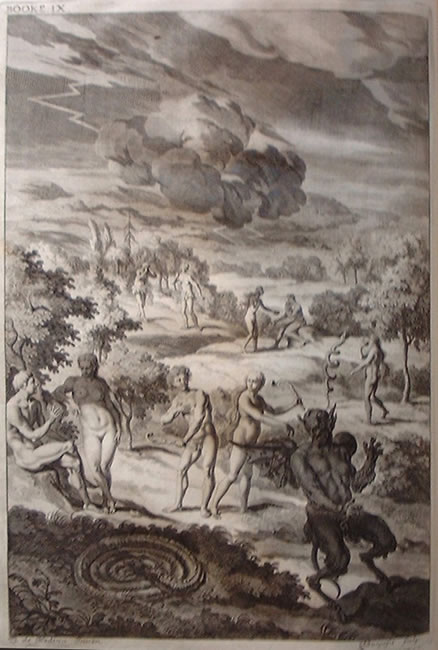
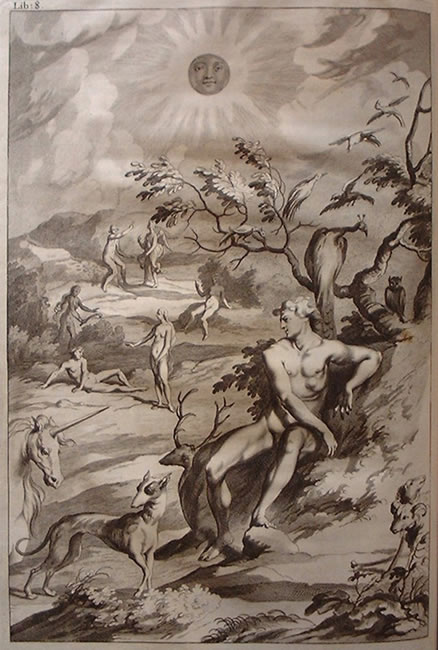
(Above: Books I, IV, VIII, & IX)
Gallery: https://paradiselostbio.weebly.com/illustrators.html
Now typically, in author’s note honor, I’d analyze my poem line-by-line to explain its intricacy, but Of Good & Paradise is the longest poem I’ve ever written for undergrade and fear the reader whose patience proceeds my own to endeavor. Instead, I’ll highlight some areas where the meaning may have gotten lost or misconstrued. Quick hits!
“The Great Debate: where rifts dissect the flames / of whirling Ether, purely space. A gloom / so drained of hue that elder “lights”, in all / their dimly siphonic command, would jolt / a straight-edged rave – still dull, naturally, / but dimensions away from utter darkness.”
This was my attempt at comparing Milton’s hellscape, where the fires are mute, to how draining natural light is in the homes of grandparents – “elders”. The “rifts” are the Fallen piling into Pandemonium.
“Satan was perched upon the Tree – and was / not like a bird, he was a bird: a proud / and spiteful cormorant. He spat whispers / to Adam, who had seldom raised an eye, / “Oh Agony, my second cousin once / removed from God’s arthritis! Does a soul / feel aching when he dislodges a bone – / and his own rib, no less?” Adam, a man / that wills himself, a man that simply does, / cannot fathom the plasma, nor the gore / of pain, started to snore”
While clearly intended to be a (subjectively) humorous interaction between Satan and Adam, this portion acts as a swift commentary on figurative literature: the weight of a metaphor.
“Adam, a nibbler, saw through Eve, or so / he thought, “I think I hate the smell of garlic.” / Then he began to explain like a man…”
The origin of the world’s first “mansplain”. Adam, who has yet to reach the “empathy” end of the pizza, assumed he knew better; thus misogyny took form and the New World was worse for it.
Works Cited:
Moe, Alison G., and Thomas H. Luxon. “Paradise Lost.” The John Milton Reading Room, 7 Nov. 2023, http://www.skeltonproject.org/spekeparott/.
“Speke Parrot.” The Skelton Project, 11 Dec. 2018, http://www.skeltonproject.org/spekeparott/.
“Illustrators.” Biography: Paradise Lost, 5 Dec. 2023, paradiselostbio.weebly.com/illustrators.html.
“The Rape of the Lock: Canto 1.” Poetry Foundation, 7 Dec. 2023, http://www.poetryfoundation.org/poems/44906/the-rape-of-the-lock-canto-1.

 Sprockets and Springes