Professor Helms
EN 3515: Rethinking Global Literature
October 20, 2023
Exploring Themes of Dis(Connection), Immigration, and Family in Death and the King’s Horseman and The Dew Breaker Through Art
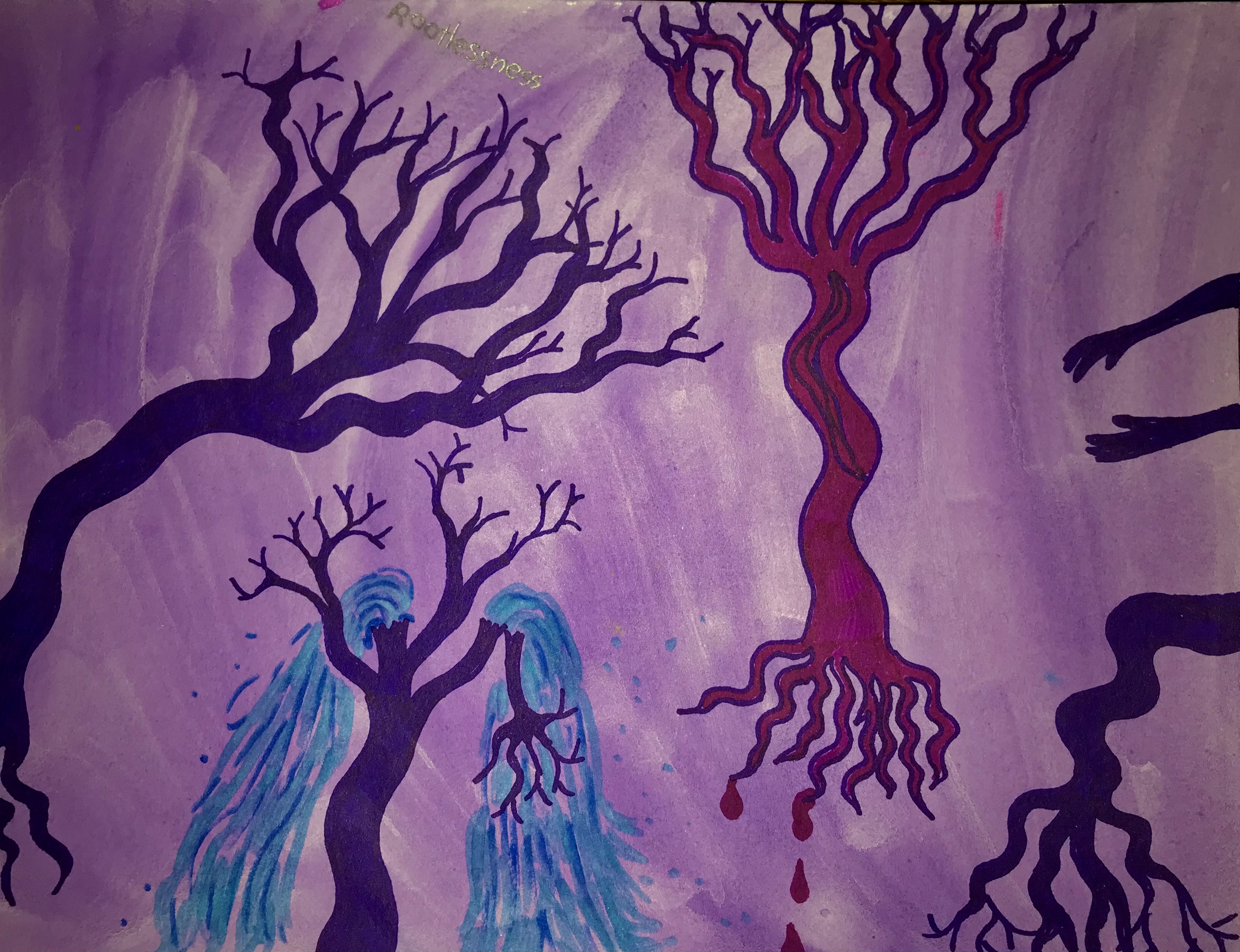
Both Edwidge Danticat’s The Dew Breaker and Wole Soyinka’s Death and the King’s Horseman explore themes of immigration, colonization, cultural identity, and family. In my creative response to these texts, I made an effort to specifically address these themes, while also providing my own interpretation and perspective. My art piece, a 20×22 inch watercolor and ink piece which I have titled “Un/Rooted” features the visual motif of trees. Trees and the idea of “rootedness” are (almost) universally symbolic of connection to family, the earth, culture, and the past. But in both Death and the King’s Horseman and The Dew Breaker, Soyinka and Danticat investigate what happens when people are are disconnected to these things: when cultures are disrupted and threatened by colonization as is seen in the 1940s-era Nigeria of Soyinka’s play when District Officer Simon Pilkings intervenes to prevent an important ritual suicide and subsequently causes an irrevocable and dangerous series of harms against the Yoruba people, or when a daughter of immigrants who already struggles to find a sense of her own rootedness discovers that her father was not the innocent prisoner she made a sculpture of, but instead a torturer or “dew breaker” who worked in a prison during the reign of a brutal dictator.
In my painting, I respond to this disparity between connection and disconnection, and try to encapsulate, at least to some degree, the painful and complicated reality of cultures, homes, and families being disrupted—through colonization, immigration, or uncovering aspects of family history in the context of Soyinka’s and Danticat’s works. But, more generally, what happens when the places, people and things that should be sources of security and strength are destroyed, severed, or turned inside out.
In preparation for this project, I also researched Danticat and read interviews with her where she discussed her own upbringing in Haiti and experience of immigrating to the US as a child—an incredible and powerful article in The Atlantic featured Danticat’s views on her novel, Haiti, and her own experiences. Many of the themes explored in her novel were familiar to her and taken from things she had experienced or people she had known in real life. In the words of a Washington Post article by Linton Weeks, she had “been there”. And while I, most certainly, have not, I do have some experience of immigration and struggling to confront the past, and I was extremely moved by reading her work. My response does not intend to do justice to the novel, or expand on it in any way—it is simply a visualization of some of its themes in a way that makes sense to me.
The trees in my painting have roots and branches, but they are suspended in empty space. There is only air under their roots, so they are not rooted. And while I kept the story of Death and the King’s Horseman in mind while I designed and worked on this piece, I focused primarily on representing the characters and themes of Danticat’s The Dew Breaker. The red tree on the right represents the Dew Breaker himself, Ka’s father. Instead of being filled in with dark purple like the rest of the trees, this one is red inside: marked as different from the others. I chose red because of its obvious connotations with blood and the blood spilt by the Dew Breaker during his time as a prison worker. There is a slash on the middle of the trunk representing the scar on Ka’s father’s face. To the right, at the edge of the painting, the outstretched hands represent Ka: herself as an artist and also as somebody who has grown up without any understanding of who her parents are, reaching into the empty space of her past. The large tree on the far left that is bending over toward the red tree is symbolic of Anne, Ka’s mother, and the other women in The Dew Breaker who are forced to contort themselves and sacrifice themselves in order to serve the powerful and needy men in their lives. At the bottom center of the piece is a tree with two broken branches that are spouting water like a fountain: this references the importance of water in the novel, the scene in the chapter “Monkey Tails” where the water valves are broken by a crowd of protesters and local people rush to collect as much water as possible. Michel, the protagonist of that chapter wonders if maybe “the water could be a cleansing offering to the gods on behalf of all the dead no matter what their political leanings had been.” (Danticat, Page 147) The representation of water in my piece references this, and also the idea of forgiveness—another theme of the novel—and the religious understanding of forgiveness being an act of having one’s sins or misdeeds “washed” away. But the water in my painting is also not performing an act of cleansing. Instead it is flowing down and away, which references the damage done to Haiti and lives lost in the time in which the novel is set.
My painting is a mixed media piece that uses mostly watercolors and ink pens. In creating it, I was inspired by the work of Helen R Klebesadel, a watercolor artist and activist whose paintings feature swirly and detailed trees slightly reminiscent of the ones in my piece. Klebesadel believes that her artwork will “creative narratives that re-examine and re-present existing power structures”, a theme that resonants with my intention in creating this artwork.
I don’t believe this piece is artistically very good, as I have not painted or drawn for an extremely long time, but I did put a great deal of thought and consideration into every decision. Creating this piece was a careful and intentional process—I tried to make every choice “mean something” and even the choice of a muted purple for the background was a reference to the novel’s title and its significance; the soft twilight lighting also evokes other motifs found throughout The Dew Breaker, a novel in many ways explores the time between day and night, between sleeping and waking, when we are caught between two places at once.
Works Cited
Danticat, Edwidge. The Dew Breaker. Penguin Random House. 2004.
Weeks, Linton. “The Fictional Reality of Edwidge Danticat’s Haiti.” The Washington Post. 8 April 2004, https://www.washingtonpost.com/archive/lifestyle/2004/04/08/the-fictional-reality-of-edwidge-danticats-haiti/76046535-137a-4f0a-a24a-da0580c32145/
Klebesadel, Helen R. Transparent Watercolors. 2023. https://klebesadel.com/about/
Rousmaniere, Dana, and Danticat, Edwidge. “Grappling With Haiti’s Beasts”. The Atlantic. June 2004. https://www.theatlantic.com/magazine/archive/2004/06/grappling-with-haiti-s-beasts/303391/
Soyinka, Wole. Death and the King’s Horseman. W.W. Norton & Company. Reprint edition. November 2002.

 Sprockets and Springes