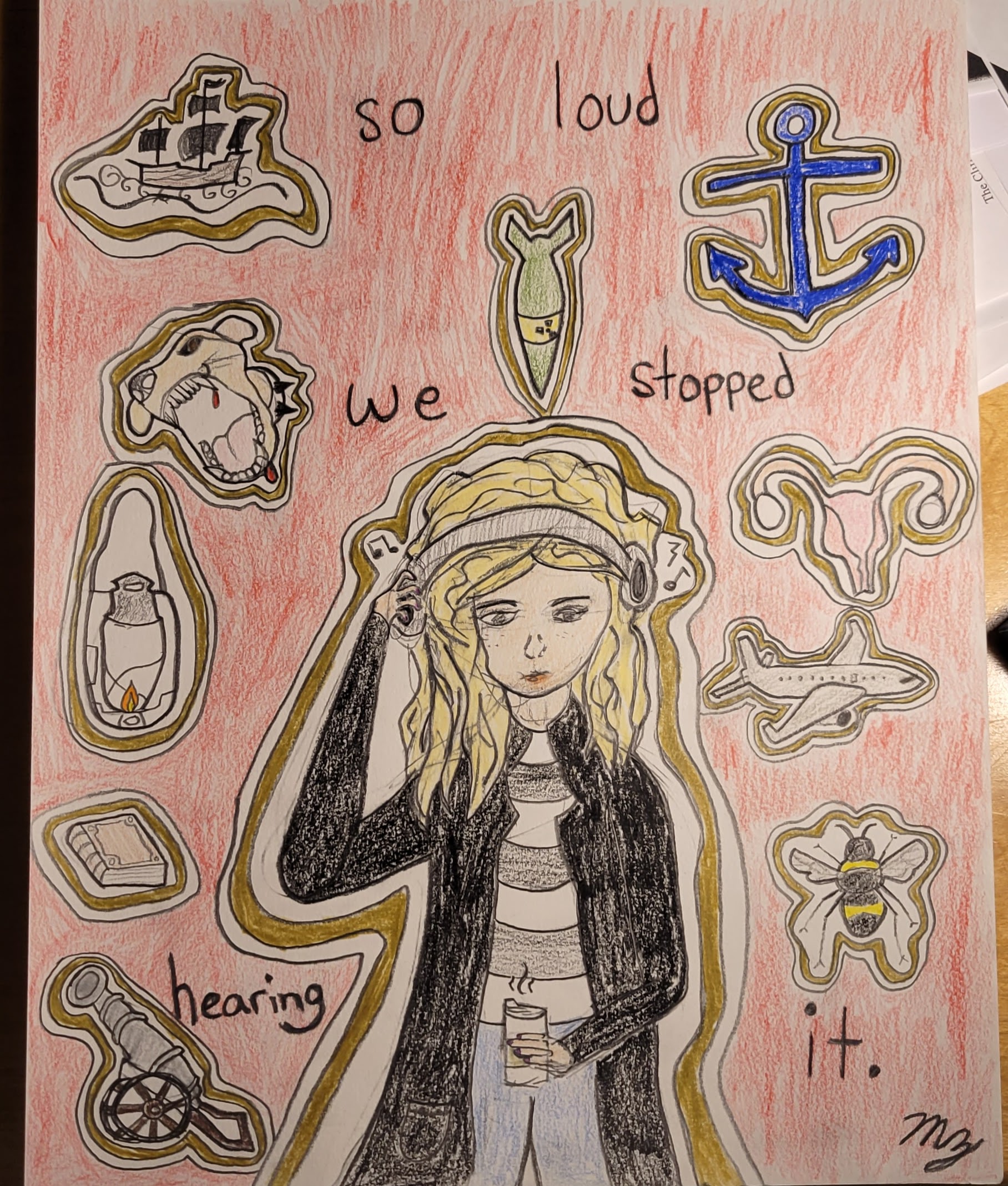
For my Unessay, I read “The World Keeps Ending, and the World Goes On” by Franny Choi. As a response to this, I decided to depict my understanding in a drawing. I drew a picture of a girl, headphones on, coffee in hand, listening to loud music, and not hearing the apocalypse going on around her. The background is red, with the apocalyptic elements behind her, reverberating, and the last few words of the poem are written boldly. The reverberating lines around each element in the drawing made me think of 70’s groovy line art patterns, and I used them to signify how these tragedies happen over and over, cemented throughout history, in one way or another. This history, these mini apocalypses, follow this girl around, follow everyone around, but we are so used to it that we don’t hear it anymore. and the bomb especially, it’s pointed right at her head. We are no longer aware of our doom. I chose to draw a picture for this poem because I like the message. I’ve gotten interested in politics recently so that made me want to bring my interpretation of it to life.
A connection I see between “The World Keeps Ending, and the World Goes On” and Death and the King’s Horseman by Wole Soyinka is the theme of ignorance. In Death and the King’s Horseman, the character Simon Pilkings ignores the people warning him that stopping the ritual suicide will have terrible consequences. He is ignorant of danger, just as the people in the poem, and also in our real world, are ignorant about danger. The Dew Breaker by Edwidge Danticat is also a sort of apocalypse in itself. It’s about political unrest, showing people in distress, dying, losing loved ones, and standing by each other in order to cope. It shows just how much is going on, just like how the poem has so much going on. But unlike the poem, which is lonely, The Dew Breaker shows community.
My picture adds to conversations about this poem because you could debate why I chose to have a white woman as the main character of this art piece. It may also prompt a conversation about the apocalyptic elements in our everyday lives, or even apocalyptic writing itself. Apocalyptic writing often comes in response to changing socio-political landscapes, just like how The Dew Breaker is about the dictator François Duvalier. I suppose dystopian writing is supposed to make us feel better that our world is not as terrifying as fictional ones…but it is becoming increasingly more like George Orwell’s 1984 outside nowadays.
I have a very bold, graphic art style as I tend to use soft graphite pencils and draw heavyhanded. I researched it and learned it could perhaps be likened to the Chiaroscuro art style. This technique definitely affects the appearance of my art and really emboldens the impactful message I am trying to convey in this drawing.
Citations
Choi, Franny. “The World Keeps Ending, and the World Goes On.” Poetry, 2019.
Danticat, E. (2004). The Dew Breaker. Vintage Contemporaries.
End of the world as we know it: Apocalyptic, post-apocalyptic, and dystopian worlds. The New York Public Library. https://www.nypl.org/blog/2019/12/19/apocalyptic-post-apocalyptic-dystopian-worlds
The National Gallery, L. (n.d.). Chiaroscuro. Chiaroscuro | Glossary | National Gallery, London. https://www.nationalgallery.org.uk/paintings/glossary/chiaroscuro#:~:text=This%20is%20an%20Italian%20term,modelling%20of%20the%20subjects%20depicted.
Soyinka, Wole. (2002). Death and the King’s Horseman. W. W. Norton.

 Sprockets and Springes