


The catalyst for the creation of the piece I Speak began when I read The Wife’s Lament1, a tormented poem from the tenth century by an unnamed poet written from the voice of a woman who speaks of betrayal, abandonment and trying to start over again while carrying the burden of great suffering. This poem for me was a clear example of work written from the voice of a wound, and strongly compelled me to go beyond reading the text and find another medium of understanding with this pain. Lines such as: “make us survive along the widest wound of us — / could they be any more loathsome? — / and I became a longing inside.”2 touched me deeply, raising questions about this female-presenting voice in the poem—was this poem actually written by a woman as suggested? How do I respond to her pain in this text? What was it about this wound that reached me, and why did I feel that reading this piece was not enough? What would my response in order to understand this poem look like?
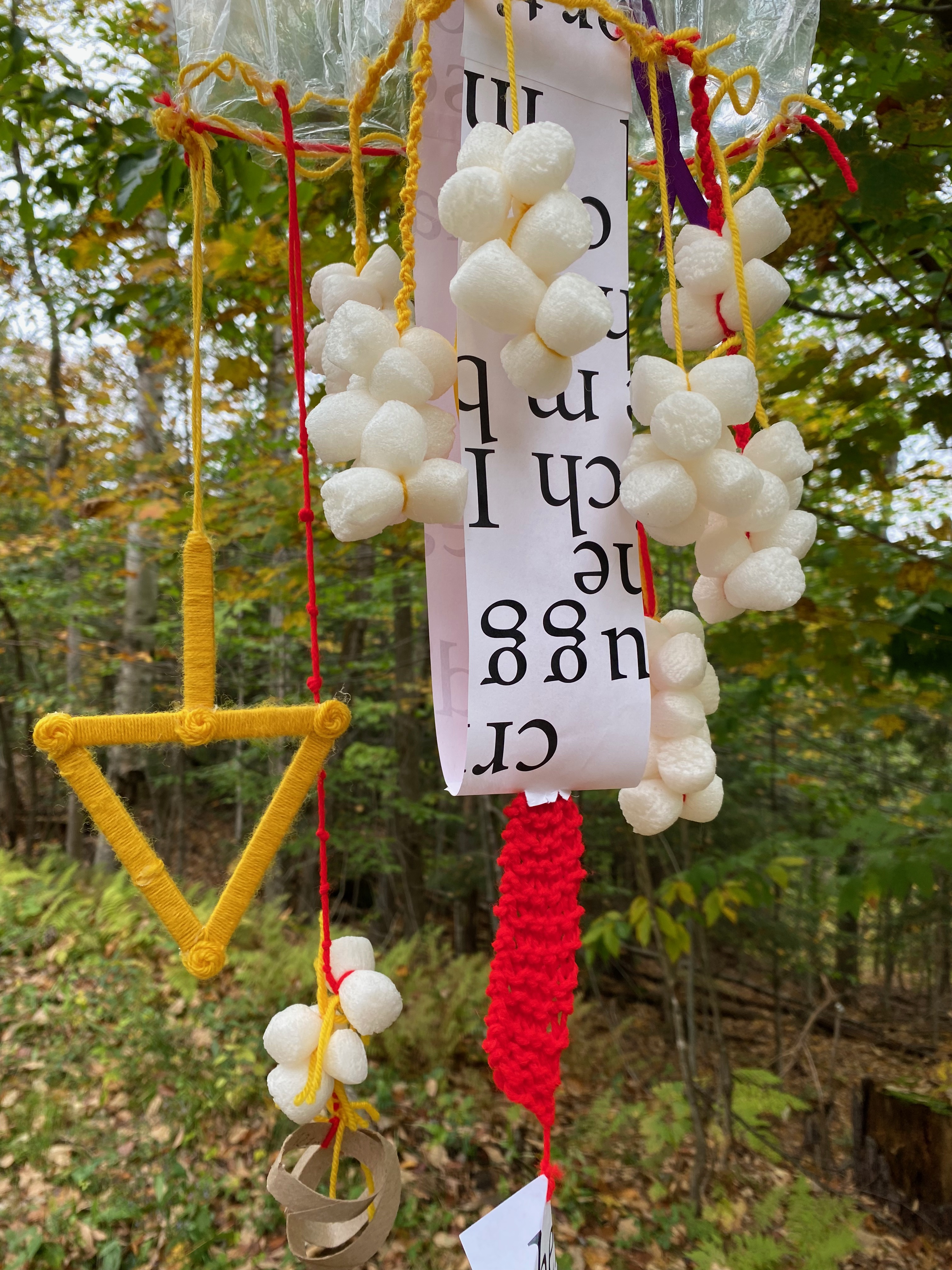
I found myself moved to make a piece of art that not only commented on The Wife’s Lament, but also one that ruminated on the broader subject of a “women’s voice” within literature—whose voice gets written down, who writes it, what it says, and how do we sit with that complex and often suppressed wound of the feminine voice in history. I was drawn in the process to use only repurposed materials as I felt it resembled the idea of bringing to light the objects and and “voices” of these materials that get constantly stepped on, and overlooked in daily life: “make myself / a map of miseries & trek right across.”3 Additionally, in my creative response, I wanted to center weaving, red thread and text within the work borrowing from the artist, healer and activist Cecilia Vicuña’s work. Niki Tulk on Vicuña’s work in Performing the Wound writes: “Vicuña creates from a realm that is not so much unrepresentable, as pre-language, on the cusp of language—the ‘form / before the form’”4 and later in the Chapter on the subject of weaving and red:
“The binding together with red wool is also a binding together with blood, shared wounds—this carries multiple symbolic layers: blood as death, blood as water, blood as life, blood as the menstrual power that created the universe. There is anger, mourning and celebration. There is also a profound joining together of the interface of death and life, absence and presence, memory and erasure.”5

I also sourced inspiration from previous works6 I have made using text that revolves around memory, being a young woman and finding my voice, connecting The Wife’s Lament with a more personal thread of my artwork, and my lived experience.7


- says:, Margo, et al. “The Wife’s Lament.” Old English Poetry Project The Wifes Lament Comments, oldenglishpoetry.camden.rutgers.edu/the-wifes-lament/. Accessed 16 Oct. 2023. ↩︎
- ibid ↩︎
- ibid ↩︎
- Tulk, Niki. “Chapter 5.” Performing the Wound: Practicing a Feminist Theatre of Becoming, Routledge, Abingdon, Oxon, 2022, pp. 124–124. ↩︎
- Tulk, Niki. “Chapter 5.” Performing the Wound: Practicing a Feminist Theatre of Becoming, Routledge, Abingdon, Oxon, 2022, pp. 134-134. ↩︎
- Molly Tulk, Organic Space, 2022 ↩︎
- Molly Tulk, Learning to Read, 2022 ↩︎
- Tulk, Niki. “Chapter 5.” Performing the Wound: Practicing a Feminist Theatre of Becoming, Routledge, Abingdon, Oxon, 2022, pp. 123-123. ↩︎
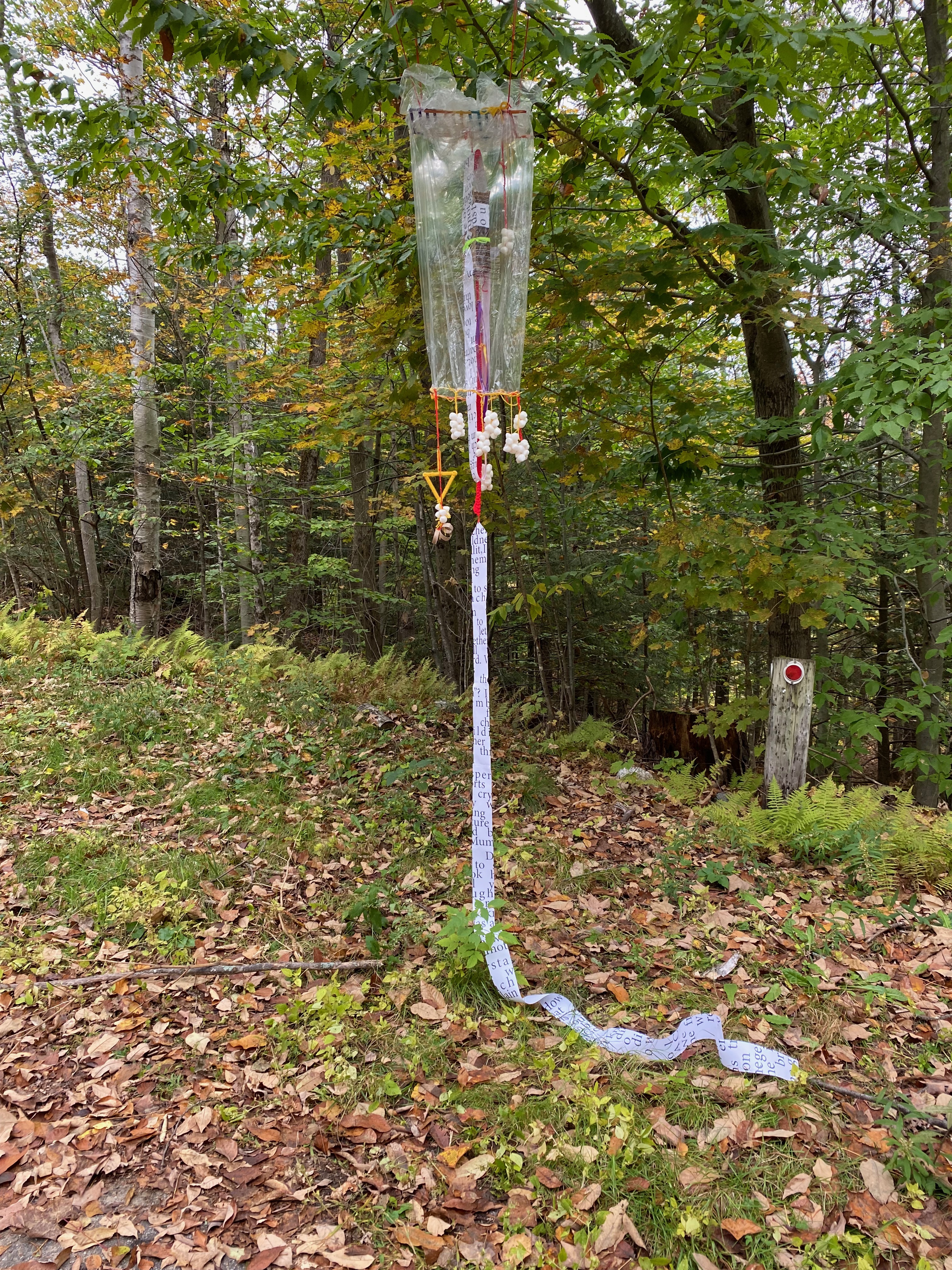
In this piece, I combined wool, plastic sheets, packing peanuts, strips of text, popsicle sticks—some wound with wool—ribbon, and cardboard. I intentionally made the effort to use no methods of binding and connecting objects that involved “new” materials and so I sewed, wove, tied, hung and stacked pieces together as a way of adhering them to each other. Additionally, combining unusual materials helped create an interesting conversation within the work, forcing me to engage further with the materials, the process, and the finished product while simultaneously continuing the relationship infinitely.8 It was very clear from the beginning that it needed to be hanging—allowing movement, and added height—so, I used sticks and more thread to hang it from a tree which added an entirely new element of movement with its new outside environment. The text threads could then tangle in the plants, the plastic swept the piece side to side with the spontaneous currents of air—suddenly giving the piece life, and giving it a voice.

 Sprockets and Springes