Morgan Burdick
Nic Helms
Currents in Global Literature
13 October 2023
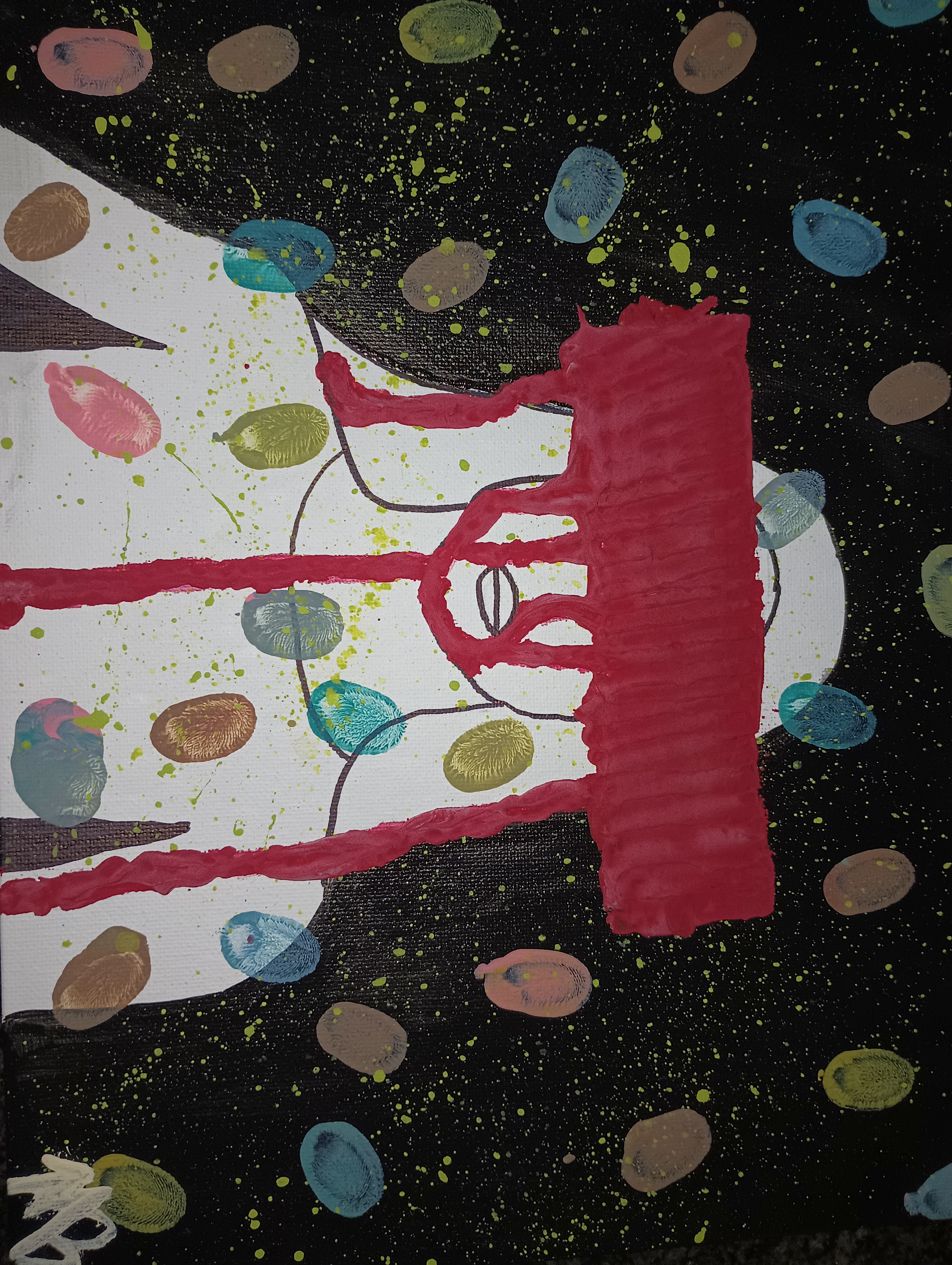
For this assignment, I decided to paint what generational trauma feels like, or what I assume it feels like. I was inspired to paint what generational trauma feels like after reading The Dew Breaker by Edwidge Danticat. I am not a painter and yet I am relatively proud of this painting. I felt inspired to create a painting similar to Helen Delmaire. Her paintings are beautifully tragic. I took inspiration from her eyeless paintings. Her paintings capture the images of a young woman looking toward the audience but a streak of paint is covering her eyes.
In my painting, I made the woman’s face look toward the audience. This was intentional. Having the focus of the painting looking toward the audience felt more direct to me, and I’m not the only one who feels that way. “{A group of} researchers discovered that when looking at a painting with a direct gaze, the viewer’s brains would activate similarly to when a person is being observed by another living person.” (The Power of the Gaze.) Eyes are considered the windows to the soul. So I decided to take that away in my painting. Ka is pretty much blind to the trauma her parents have gone through and how their traumas have affected her and her life until they tell her. And what better way to convey blindness than literally covering one’s eyes? The paint streak going across the woman’s eyes also dripped down the canvas. This was intentional also. I wanted it to look like blood in a way. However, the paint wasn’t thick enough for my liking. I wanted it to be thicker and have more texture. I combined the red paint with some baking soda to make the paint thicker until I got my desired thickness. I then put the thicker paint on top of the original red paint streak. Back to the paint color and dripping, I decided on the red dripping streak because it reminded me of blood. The blood to me represents the hundreds, maybe even thousands, of innocent people Ka’s father killed and tortured. And blood is also another way of saying family. So not only did the blood represent Ka’s father being a Dew Breaker but it also represented that Ka can’t escape her father’s side of the family: the murderer and torturer side. I only wish I could have added more of a generational trauma idea into the painting, more than finger painting.
I chose random colors and painted the tip of my pointer finger before pressing my fingertip all over the canvas. I left behind fingerprints all over the canvas because I thought leaving behind actual fingerprints kind of connected to leaving behind a family/legacy and trauma if your family has some, which Ka’s family does. Then I got really interested in who invented finger painting and why it’s so much fun. Turns out modern-day finger painting has only been around since the 1930s when Ruth Faison Shaw “{o}ne day sent a pupil with a scratched finger to the bathroom for some iodine. When he did not return, she investigated and found him, she said, ‘blissfully absorbed in decorating the bathroom door with a finger dipped in iodine.’” (Finger Painting.) Finger painting is also believed to be therapeutic to not only children but adults. So I can only imagine finger painting can help relieve some of the stress about trauma. Now for the real kicker…so what? What does this painting reflect on the literature it is based on? And why does your response to this literature matter? I’ll be honest, I’m still figuring that out. I originally wanted to write a traditional paper but time got the better of me so I decided to do an unessay. I would like to believe that I somewhat grasped the idea of generational trauma in Ka’s family. Throughout the entire novel, I could see Ka’s father dealing and having regrets from his path. Like him or not, he is traumatized by what he’s done and what has happened to him that one night. So I wanted to shed light on how many people are traumatized in this book by the Dew Breaker’s actions and how his/their actions affected those they love intentionally or not.
Works Cited
Danticat, Edwidge. The Dew Breaker. Alfred A. Knoff, 2004.
Delmaire, Helene. “Eyeless.” Helene Delmaire, http://www.helenedelmaire.com/albums/blind/. Accessed 13 Oct. 2023.
“Finger Painting.” Encyclopædia Britannica, Encyclopædia Britannica, inc., kids.britannica.com/students/article/finger-painting/274313. Accessed 12 Oct. 2023.
“The Power of the Gaze: How Artists Evoke Emotion Through the Eyes.” Portraits Inc., portraitsinc.com/blog/the+power+of+the+gaze:+how+artists+evoke+emotion+through+the+eyes/. Accessed 13 Oct. 2023.

 Sprockets and Springes