The Hero’s Journey: we’ve all heard of it. For a long time, stories have been basing their plots around this outline, whether intentionally or not. This pattern was discovered by Joseph Campbell, a mythologist in the 1930s. Throughout the stories he read, he noticed that there were certain themes and events that reoccurred.

In 1949, Campbell published The Hero with a Thousand Faces: a book presenting the concept. In this, he explained every step of the cycle and provided examples of various legends that supported his theory. Here is a quick SparkNotes of each step (this short video also explains it well):
- The Status Quo: This is where the protagonist begins.
- Call to Adventure: Here’s where something happens that triggers the protagonist’s quest.
- Supernatural Aid: This doesn’t necessarily have to be supernatural, but it often is. Here is where the protagonist gets their mentor or other help.
- Crossing the Threshold: This is where the protagonist leaves the status quo and begins their new adventure.
- Road of Trials: Various things occur that prevent the protagonist from completing the mission.
- Approach: The protagonist faces a big challenge.
- Ordeal: This is the darkest moment for the protagonist. They may get close to death, or even die.
- Reward: The protagonist claims some treasure from their quest.
- Magic Flight: The hero leaves the special world.
- Return: The hero goes home.
- Resurrection: This can be literal or figurative; either way, the protagonist is reborn as a new person.
- Resolution: The story concludes, and the protagonist begins a new status quo.
This cycle is also called “The Monomyth.” Mono literally means one, so Monomyth is translated as The One Myth. The name implies its meaning; all myths follow the same general plotline, with changing details such as characters, setting, etc.
Think about your favorite book, film, or other form of storytelling: does it follow the Monomyth outline? Oftentimes, it does. But what happens when this cycle is broken partway through? What effect does that have on the story? Obviously, Campbell’s framework is not a requirement for every story ever written. However, throughout our readings this semester as well as outside media, I’ve found that interrupting the Hero’s Journey in one way or another often results in a tragic ending.
For example, The Green Knight (2021, dir. David Lowery). This movie is based off the Arthurian tale of Sir Gawain, and up until a certain point, follows the Hero’s Journey.

1. The Status Quo. The movie begins by establishing the “normalcy” for Gawain. His uncle is King Arthur, he’s a member of the knights of the round table, his lover is a beautiful woman; he seems to have it all. Surely nothing will go wrong!
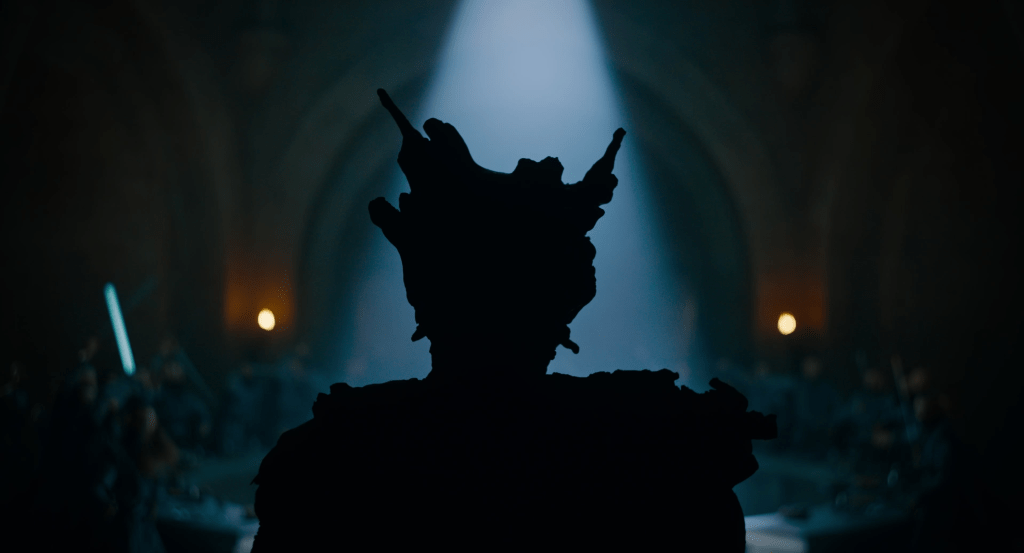
2. The Call to Adventure. On the night of Christmas, Gawain is seated at King Arthur’s right hand at the round table for a feast. Gawain doesn’t know this, but his mother is elsewhere, summoning the Green Knight. As they eat, the Green Knight enters and says that one of the knights may strike him and win his green axe, but in exactly one year he will be able to strike an equal blow on them. Obviously, Gawain thinks this sounds like a great idea, so he takes the challenge and beheads the Green Knight, believing that if he is decapitated he will not be able to strike an equal blow to him. The Green Knight stands, picks up his head, and reiterates the deal to Gawain.
3. Supernatural Aid. A year later, Gawain takes the green axe and a green girdle given to him by his mother to prepare to leave. His mother claims that as long as he wears the girdle, no harm will come to him. The aid here is not necessarily supernatural, but still there.
4. Crossing the Threshold. Gawain sets off on his quest, doomed to die.
5. Road of Trials. On his quest, Gawain suffers many trials. He comes across a battlefield littered with corpses, and a young boy scavenging. Gawain asks him for directions to the Green Chapel and the boy leads him to a stream that will lead him there. Gawain gives him a coin and is later ambushed by the boy and others. They steal his axe, girdle, and horse then leave him tied up to die. However, he’s able to reach his sword and cut himself free. In another instance, he’s asked by a young woman to help her get something from the bottom of a small pond– though it’s never said what. He dives to the bottom to find her skull, which he then reunites with the rest of her corpse. The axe is magically returned to him after that, but he does not retrieve the girdle his mother made for him. Instead, a young woman in a castle gives him a new one.
6. Approach. As he approaches the Green Chapel, Gawain’s fox companion urges him to turn back. He doesn’t, instead chasing the fox away and going to the chapel alone.

7. Ordeal. Gawain reaches the Green Knight. The Green Knight goes to strike a blow, but Gawain flinches. He apologizes and says he’s ready, but when the Green Knight strikes again, he scrambles away. Here is where things get weird, because the next things that happen aren’t real. We see Gawain return home and live through the rest of his life happily, becoming King and having a son with Essel, his lover. He leaves Essel, though, for a noblewoman, and raises his son as a prince. Later, his castle is under siege and his family has left him. He takes off the girdle, which he has kept on all these years, and his head falls off his shoulders. Then, we’re snapped back to the present, where Gawain tells the Green Knight he is ready, and is beheaded.
Obviously, the Hero’s Journey cycle does not truly go all the way through here. But in a way, it almost does, and that makes the story all the more tragic. We see that even if Gawain had fled and survived, he would have been bested one way or another. Despite how greatly the audience wants Gawain to survive and live the rest of his life happily, he doesn’t.
In Greek tragedies, the hero always has a hamartia, or a tragic flaw. Coined by Aristotle, this is a term used to describe the thing that ultimately leads to the hero’s defeat. In the case of Sir Gawain, his hamartia was his inability to truly listen and his need to prove himself. The Green Knight was very clear in his instructions: any knight who dealt him a blow would be dealt that same blow equally. Gawain did not listen to this, instead needing to show his strength, and that was what led to his death.
What’s another example of this happening? Let’s pick a more modern choice. Most people know the story of the Star Wars prequels (episodes 1-3) and Anakin Skywalker. This is a tragic story where the hero’s tragic flaw causes the Hero’s Journey to be interrupted.
Anakin Skywalker’s journey is much longer than that of Sir Gawain. It takes place over the course of three movies. Well, technically more like six, but for clarity’s sake we’ll stick to episodes 1-3. The movies also deal with a lot of sci-fi politics that don’t quite apply to Anakin’s journey, so we’ll be avoiding that, too.

1. The Status Quo. Anakin’s story begins on Tatooine where he is a young child, in Star Wars: Episode I – The Phantom Menace.
2. Call to Adventure. Jedi Master Qui-Gon Jinn and his apprentice Obi-Wan Kenobi arrive on Tatooine with Queen Padme Amidala, looking to get their ship fixed. They meet Anakin Skywalker, a 9-year-old slave on the planet. Qui-Gon strongly believes that Anakin could be the Chosen One, meant to bring balance to the Force. Obi-Wan doesn’t quite agree.
3. Supernatural Aid. Qui-Gon is able to buy Anakin out of slavery and take him in to begin training to become a Jedi Knight. Qui-Gon suggests this to the Jedi Council, but they say no because Anakin is too old. (Typically, Padawans, Jedi trainees, begin training from birth.) Undeterred, Qui-Gon takes him in anyways.

4. Road of Trials. A lot happens here, but the main plot points are as follows: Qui-Gon dies, Obi-Wan promises to take Anakin in as his own Padawan, and they begin training. End of The Phantom Menace. In the next film, Star Wars: Episode II – Attack of the Clones, Anakin is now 19. He has fallen in love with the Queen Padme Amidala, but the Jedi forbid attachments of any kind. Regardless of this, they get married in secret at the end of the movie, the only people knowing being droids C3PO and R2-D2.

5. Approach. In Star Wars: Episode III – Revenge of the Sith, we begin to see Anakin be manipulated more and more by the evil Darth Sidious, who has been known to them as Chancellor Palpatine of the Galactic Senate. The “approach” here is more figurative; they are not literally approaching anything physical, but emotionally Anakin is reaching a peak. Anakin is pulled to the dark side because he’s convinced doing so can prevent Padme from dying.
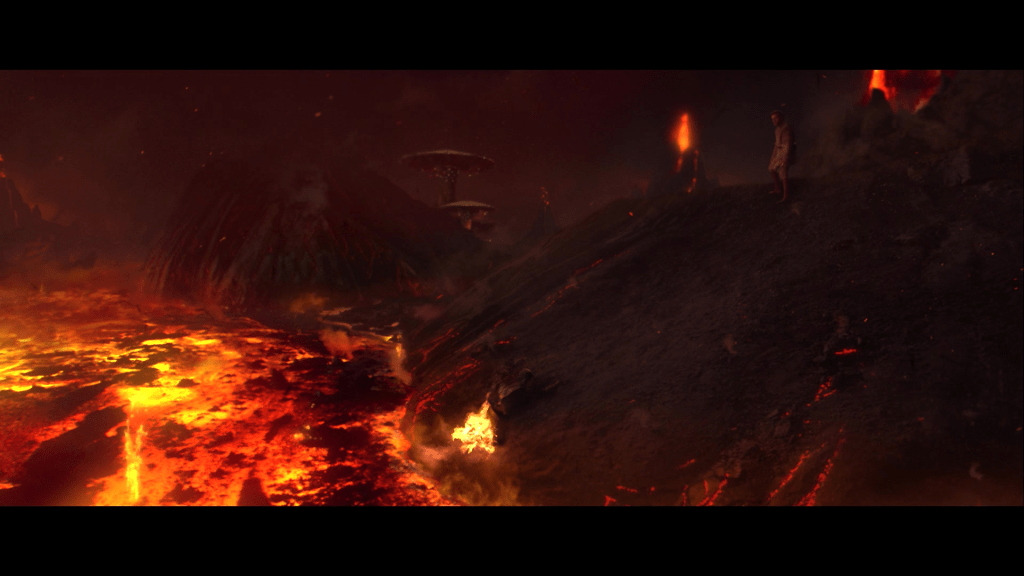
6. Ordeal. Anakin pledges his allegiance to the dark side, and later fights Obi-Wan Kenobi, his former Master, on a lava planet called Mustafar. Obi-Wan defeats Anakin in battle, cutting off his legs and leaving him burning in the lava. However, Anakin is “rescued” by Palpatine, who puts him in the classic Darth Vader suit. Padme dies while giving birth to twins Luke Skywalker and Princess Leia Organa. The story does not end here, but here is where it deviates from the Hero’s Journey. Anakin is given no reward, he does not return to the status quo, and he does not end the story happily.
Anakin’s hamartia was his inability to accept death. Having lost his mother, he did not want to lose Padme. But death is part of the natural cycle of life, something he could not accept. His tragic flaw caused him to seek out the dark side and turn into a villain.
The Hero’s Journey is a cycle. It has no “beginning” or “end,” per se. It’s a circle that can keep going forever as heroes come and go, as new events occur and new stories are told. But when the cycle is broken and the “happy ending” is prevented, a story that would normally fall under the Monomyth becomes a tragedy.
Works Cited
“[ Cap-That.com ] Star Wars Attack of the Clones > Screencap Archive.” Www.cap-That.com, http://www.cap-that.com/starwars/2/. Accessed 10 Dec. 2022.
“[ Cap-That.com ] Star Wars Revenge of the Sith > Screencap Archive.” Www.cap-That.com, http://www.cap-that.com/starwars/3/. Accessed 10 Dec. 2022.
“[ Cap-That.com ] Star Wars the Phantom Menace > Screencap Archive.” Www.cap-That.com, http://www.cap-that.com/starwars/1/. Accessed 10 Dec. 2022.
“Heroes and Villains.” Myths and Monsters, directed by Daniel Kontur, starring Nicholas Day, season 1, episode 1, 3DD Productions, 2017. Netflix, netflix.com.
Hobscheid, Maya. “Subject Guides: The Monomyth (the Hero’s Journey): Home.” Libguides.gvsu.edu, libguides.gvsu.edu/monomyth.
—. “Subject Guides: The Monomyth (the Hero’s Journey): The Hero’s Journey.” Libguides.gvsu.edu, 10 June 2021, libguides.gvsu.edu/c.php?g=948085&p=6857311.
“Image Gallery of the Green Knight (2021) | Fancaps.” Fancaps.net, fancaps.net/movies/MovieImages.php?name=The_Green_Knight_2021&movieid=2909. Accessed 10 Dec. 2022.
Lowery, David, et al. “The Green Knight.” IMDb, 30 July 2021, http://www.imdb.com/title/tt9243804/.
TED-Ed. “What Makes a Hero? – Matthew Winkler.” Www.youtube.com, 4 Dec. 2012, http://www.youtube.com/watch?v=Hhk4N9A0oCA&ab_channel=TED-Ed.
The Editors of Encyclopedia Britannica. “Hamartia | Drama.” Encyclopædia Britannica, 1 Mar. 2016, http://www.britannica.com/art/hamartia.
The Green Knight. Directed by David Lowery, 2021.

 Sprockets and Springes