This ad is for people who are most likely to suffer from body dysmorphia. Women are more likely to experience it, or they are at least more likely to talk about it. Teenagers are also some of the most common victims of this disorder. That said, this disorder can affect people of all genders and ages. It doesn’t discriminate. That’s why I put Frankenstein’s creature in this ad. He always felt discriminated against and it all started with the way he looked. From there, he went a little bit crazy. Obviously this is an extreme case, but body dysmorphia can lead to mental health struggles in humans, so I thought it could be a useful image to use in this poster.
I would love to see this ad placed around schools. Middle and High Schoolers are the people who are most affected by this disorder, so the bathrooms there would be a good place for it. Unfortunately this ad won’t make body dysmorphic disorder go away, but hopefully it’ll provide some awareness and comfort to people so that they know they aren’t alone. Maybe this will even prompt them to seek some advice or help from therapists or even just their friends. It’s so important to know that a lot of people are going through the same thing.
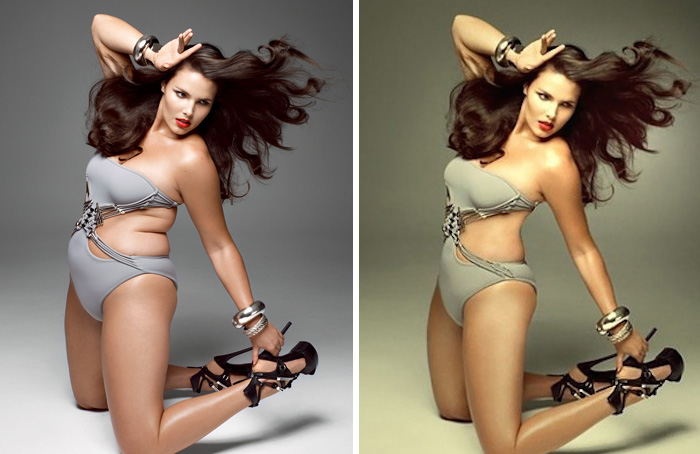
College students can also suffer from body dysmorphic disorder. I have many friends– and myself– that agree that it’s such a tough subject to talk about. It mostly stems from models and photoshop and airbrushing that creates false realities in magazines. It can cause anxiety socially and emotionally because we aim to fit those standards. The standards, however, are both unhealthy and unrealistic. It’s unfortunate that in this day and age we are still fighting against this obstacle day-to-day, but it is great to see more inclusivity among models based on gender, weight, orientation, race, height, etc. We are moving in the right direction and ads like this will help that. Though we are moving in the right direction, we aren’t doing it fast enough. Anxiety, depression, body dysmorphia, etc. are all linked to this highly preventable idea that photoshop needs to be used. Some actresses, like Zendaya, are taking a stand against this type of thing by refusing to publish the pictures that are photoshopped to an extent that doesn’t look real. Hopefully with her platform and the ones of other celebrities standing up against it, they are able to reach other influencers and it prompts them to do the same. I think that would be really important in changing the game.
Mostly everyone that I know has either read or at least heard of Mary SHelley’s “Frankenstein”. Frankenstein’s creature clearly had some issues with the way he looked. He would seclude himself because he looked different and wasn’t confident at all. He definitely had a case of body dysmorphia and depression about that subject. “I, the miserable and the abandoned, am an abortion, to be spurned at, and kicked, and trampled on.” (Shelley). He has no belief in himself which is a clear side effect of the disorder as well. It’s important to teach these things to people. Maybe more ads will help them to learn about and deal with the common disorder. I put Frankenstein in there to prove that it doesn’t matter what you look like at all! I know that humans aren’t built like the creature, but it is more meant as a powerful effect.
Works Cited:
“Body Dysmorphic Disorder: Symptoms, Causes, Diagnosis, Treatments.” Cleveland Clinic, https://my.clevelandclinic.org/health/diseases/9888-body-dysmorphic-disorder#:~:text=Body%20dysmorphic%20disorder%20affects%20about,may%20not%20receive%20a%20diagnosis.
Moreno-Domínguez, Silvia, et al. “Images of Thin and plus-Size Models Produce Opposite Effects on Women’s Body Image, Body Dissatisfaction, and Anxiety – Sex Roles.” SpringerLink, Springer US, 11 Aug. 2018, https://link.springer.com/article/10.1007/s11199-018-0951-3#:~:text=Exposure%20to%20thin%20models%20deteriorated,it%20did%20not%20affect%20anxiety. The Creature, http://knarf.english.upenn.edu/Chars/creature.html.
“Body Dysmorphic Disorder.” Johns Hopkins Medicine, https://www.hopkinsmedicine.org/health/conditions-and-diseases/body-dysmorphic-disorder#:~:text=Body%20dysmorphic%20disorder%20(BDD)%20is,are%20flaws%20in%20our%20appearance.
“Zendaya Gets Photoshopped; Singer Slams Magazine for Promoting Unrealistic Beauty Ideals.” E! Online, 21 Oct. 2015, https://www.eonline.com/news/708613/zendaya-gets-photoshopped-singer-slams-magazine-for-promoting-unrealistic-beauty-ideals.
YOU ARE BEAUTIFUL

after-photoshop-celebrities%2F&psig=AOvVaw3iBgJnrOAgwPnoZL0OP0cb&ust=1648656699314000&source=images&cd=vfe&ved=0CAsQjRxqFwoTCIi_8dTb6_YCFQAAAAAdAAAAABAD


THEY ARE BEAUTIFUL
Everyone one is different, but beautiful in their own ways… even Frankenstein’s Creature!
1 in 50 people in the United States suffer from body dysmorphia. You are not alone.

 Sprockets and Springes